

#On the Book That Lets Old Disputes Bite
The Thirty-Seal Index of Precedent is the Bureau of Commerce's authorised digest of port-court rulings, seal autopsies, manifest identity quarrels, orthographic challenges, tariff survivorship notes, storage liability decisions, condemnation precedents, and other little knives by which cargo becomes either lawful or dead. It is a licensed appetite bound in leather. It consumes decisions from port courts across Zones 1 through 5 and returns them as authority, sharpened, numbered, cross-sealed, and ready to freeze a warehouse before breakfast.
A Manifest Litigant cites the Index to halt a shipment. A magistrate cites it to divide blame. A merchant fears it because fear, in commercial matters, is simply knowledge arriving early. A Precedent Curator feeds it, trims it, oils the hinges of its categories, and occasionally notices that its margins have begun answering in a hand no clerk admits.
Its name is exact enough to be false. Thirty seals do not mean thirty volumes, thirty offices, thirty categories, or thirty laws. They mean thirty validating impressions required across the full master chain: Commerce, Records, Masks and Seals, Doctrine, Tithes, Purity observer, local court, archive witness, and the long procession of lesser bite-marks by which the Synod turns memory into custody. The thirty are a theology of suffocation. Each seal says the ruling may live. Each seal says the ruling may be used to harm someone who was not present when it was born.
#On Its Birth From Rot, Letters, and Wax
The Index did not begin as a grand codex. Grand codices are what Bureaus claim after accidents have stopped bleeding. It began as piles: court extracts, witness slips, warehouse condition logs, seal comparison plates, tariff notes, appeals half-eaten by damp, and the muttered private lists kept by advocates who understood that yesterday's cruelty might be tomorrow's fee.

The Rot-Week of Saint Vellum supplied its first hunger. Eleven days of cargo-name paralysis taught Commerce that unlicensed delay could starve a district while leaving nobody properly billable. The warehouse rotted. The forms survived. Saint Vellum's fire entered iconography with the bystanders politely removed. From the ashes came the need for known precedent: which objection may halt food, which spelling may condemn grain, which delay remains sanctified after the smell begins.
The Orthography Purge of A.S. 112 gave the piles teeth. Four hundred and eleven cases were reopened because a hooked letter, a long-tailed stroke, or a Rationalist habit hiding in a merchant hand might have carried apostasy through cargo identity. Eleven Litigants lost practice rights. Records repaired tariff gaps for three years with implication, cross-entry, and the kind of delicate fraud that wears gloves to handle its own conscience. The early Index learned then that old rulings do not die. They wait for a revised heading.
Commerce primers describe the Index's early compilation as “the orderly consolidation of port-court wisdom.”
Corrected. It was the salvage of embarrassment after rot, purge, counterfeit panic, and hunger had produced more paper than denial could comfortably store. Wisdom arrived later, carrying a bill.
The Seal-Forgers' Winter of A.S. 145 supplied its material precision. Wax lied beautifully that year. Counterfeit rings passed casual inspection, then desk inspection, then in several humiliating cases the kind of inspection that had previously been called final by men who enjoyed confidence too much. Seal autopsy became a Manifest Litigant right. Every undercut, bevel, rim bruise, wax composition, loop angle, and prayer-mark needed comparison against prior rulings. The Index fattened on wax.
By A.S. 187 the digest had become intolerable in the old form: contradictory headings, duplicate survivorship notes, unresolved orthographic categories, local tolerations with no expiration, expiration clauses that had expired into usefulness, and margin warnings written by Curators whose predecessors had died without explaining whether the warning meant danger, profit, or both. The A.S. 187 revision promised simplification. It reduced the number of headings and multiplied the number of operative categories. Commerce praised precision. Merchants learned new curses.
#On the Thirty Seals Themselves
The thirty seals are impressed on the master custody chain of the full Index edition, but their doctrine governs every authorised extract. A page copied without its seal chain is commentary. A page copied with it is a weapon.
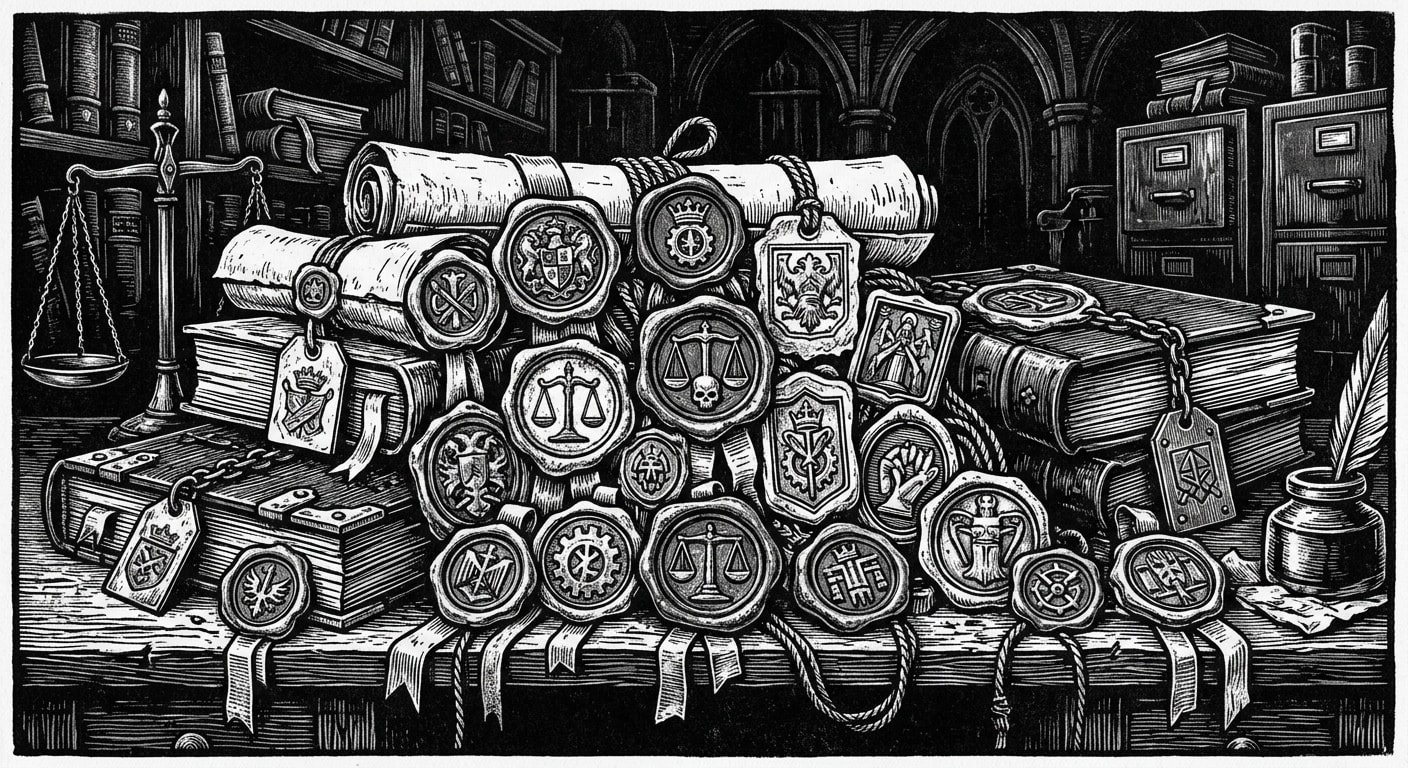
The first seals belong to Commerce: intake, classification, fee acknowledgement, port-court authority, divisional custody. These establish that the case entered the machine by an approved mouth. The next group belongs to Records: docket survival, copy lineage, witness register, archive location, contradiction note. Records never trusts a fact unless it knows where the fact will be buried if inconvenient. Masks and Seals follows with plate concordance, impression legitimacy, counterseal custody, die retirement note, and material variance tolerance. Doctrine supplies admissibility, theological neutrality, heresy adjacency, approved public phrasing, and sealed-use warning. Tithes marks revenue survival. Purity marks contamination caution. Local courts mark origin. Curators mark whether the precedent still bites.
This enumeration is intentionally dull. Dullness is the smell by which power hides from peasants.
The master impressions are not identical across editions. This is the first lesson and the first profitable cruelty. A litigant citing an A.S. 145 seal-autopsy precedent under A.S. 187 survivorship must show which seal in the old chain retained force, which seal was retired, which seal was superseded, and which seal remains spiritually active though materially obsolete. The phrase spiritually active though materially obsolete has ruined three merchant houses and one marriage contract. It is, regrettably, good law.
A false seal in the chain does not merely invalidate the page. It infects the cases born from that page. Commerce calls this citation fever. The afflicted rulings are quarantined, compared, re-certified, narrowed, or burned. In practice, a fevered citation is often more useful than a clean one. A clean page says yes or no. A fevered page says perhaps for six billable hearings, provided the word is spoken with enough piety to avoid sounding like a hedge.
#On How Litigants Use It
The Manifest Litigant comes to court with the Index already marked. Ribbon slips. Finger papers. Bone tabs. Waxed side notes. Private cross-charts that are forbidden until everyone admits they are necessary. He stands in the gallery above the warehouse floor while the cargo waits below and cites the Index as a priest might cite Scripture if Scripture charged storage fees.
A typical objection begins with identity. The manifest names grain from Rheims. The Index records three admissible spellings, two local tolerations, one condemned Rationalist contraction, and an A.S. 112 warning that a hooked terminal near the old Moselle hand may reopen tariff lineage if the witness line predates a corrected catechism. The Litigant does not need to prove fraud. He needs to show disputable precedent. The cargo halts. Time begins to invoice itself.
Seal questions are richer. A wax impression bears correct geometry but shallow undercut. The Index yields Seal-Forgers' Winter rulings, later plate corrections, Cologne resin-ratio warnings, and a survivorship note preserving comparison rights for emergency bread releases even when the bread has already gone stale enough to develop civic opinions. The seal lies under the lamp. The Litigant smiles. Doubt has become licensed.
The Index makes speed possible only for those who can pay for the correct slowness. A wealthy merchant hires a Litigant who knows the narrow release precedent. A poor parish waits while a clerk searches the public extract. A military quartermaster shouts and receives armed courtesy. A smuggler buys Shadow Counsel, who cites a precedent so obscure that the magistrate must choose between delay and pretending to understand it. The magistrate often chooses pretence. Governance depends on these mercies.
#On Precedent Curators and the Cold Rooms
The Index lives in archive courts where Precedent Curators sit among chained desks, high windows, low lamps, iron catalogue rails, and silence cold enough to preserve both paper and deformity of soul. Marseille, Genoa, Venice, Thessaloniki, Hamburg, and lesser northern rooms each keep authorised sections. Strasbourg keeps copies. Records keeps copies of the copies and denies pleasure.
Curators are archive-retired Litigants, men and women who have gone index: meaning has dropped away, form remains standing in a coat, and a hungry crowd becomes a contextual variable with excellent handwriting. This is not madness. Madness is too inefficient. The Curator remembers everything except scale. A child's ration chit and a fleet condemnation sit at the same distance from his eyes. Each needs place, date, hand, seal, category, counter-category, and a shelf where future malice may find it.
Their daily work is custodial violence. They verify citations. They reconcile variants. They certify whether a ruling survives revision. They decide which dead sentence is presently alive. They update marginal warnings, retire false headings, preserve useful contradictions, and make one precedent easier to find than another. Do not underestimate that last office. Shelf order is policy in a colder hat.
The Bureau of Commerce states that Precedent Curators do not create law.
Clarified. They preserve approved memory, arrange access, certify survivorship, and identify which dead sentence may be used in court. If creation requires a trumpet, they do not create. If creation requires consequences, they are midwives with frost on their sleeves.
Curators keep Saint Vellum of the Narrow Line above the desk. The saint's prayer is short: Keep the distinction narrow. Before opening an old Index section, the Curator washes in ash-water, taps the spine three times, reads the first boundary line aloud, and avoids red ink near grain, medicine, children, and prior warehouse fires. Doctrine calls this superstition when in a bad mood. Commerce calls it archival conservatism when billing clients. The saint, who has no certified bone and excellent fee presence, presides with his warehouse burning correctly behind him.
#On Marginalia, Drift, and Pages That Misbehave
Every long-lived Synodal book learns manners or teaches them. The Thirty-Seal Index has done both badly.
Reports of marginal drift begin in A.S. 112, during the Orthography Purge, when the Index began taking notes in a hand no office admitted. That is the polite phrasing. The less polite one is that clerks found warnings beside cases before any Curator wrote them. Retain narrow use. Bite later. Do not release under red correction. Ask Marseille why the smoke was green. Commerce sealed several pages, then unsealed them after discovering that sealed pages attract more expensive curiosity than usable ones.
A.S. 187 worsened the matter. The revision required transfer of thousands of survivorship notes. Some entries resisted retirement. That is the word in the maintenance logs: resisted. Ink faded from rescission lines and reappeared under applicable exceptions. A condemnation ruling from A.S. 129 inserted itself into three grain-release headings. One Seal-Forgers' Winter plate reference acquired a thirtieth seal impression before the die had been applied. Masks and Seals blamed pressure. Records blamed copyist contamination. Doctrine blamed metaphor and told both offices to stop using it.
MARSEILLE INDEX ROOM — REVISION INCIDENT, A.S. 188 Volume: Orthographic Survivorship, Red-brown spine. Curator opened entry 411-B for retirement. Page temperature dropped. Saint Vellum icon cracked along quill hand. Marginal note appeared: “If the line widens, the rats eat first.” Rats in adjoining warehouse died within one bell. Entry retained for narrow use. Public notation: conservation difficulty.
The Bureau insists the Index does not think. This is wise. If the Index thought, it could be questioned. A book that merely misbehaves can be managed by gloves, locks, and revised room temperatures. The Curators know better than to argue with official comfort. They keep sand, blotters, salt, thread, and small bells near the older volumes. They do not leave open pages facing one another overnight. They do not copy a marginal warning twice unless two witnesses are present. They do not allow apprentices to sleep in the archive, since dreams have poor custody discipline.
ARCHIVE HANDLING NOTICE — A.S. 201: Index marginalia are to be treated as unverified curatorial residue unless corroborated by authorised hand, prior ruling, seal chain, or subsequent disaster. Do not erase in wet weather. Do not bind hostile pages face-to-face. Do not answer written questions not present at opening.
#On Abuses So Ordinary They Became Procedure
The Index was built to stabilise law. Stability, once priced, becomes a market.
Purist Litigants use the Index as a hammer against cargo they dislike, merchants they envy, regions whose scripts offend them, and rivals too slow to pre-file. Pragmatists use it as a ransom table: cite broad hazard, negotiate narrow cure, release under fee. Shadow Counsel uses it with the purest admiration, because a purchased Litigant citing real law is safer than a forger cutting false wax. A false seal may hang a man. A true precedent may starve him legally.
Index Drift is the common trick. A Litigant cites a page number that existed in an older edition, knowing the magistrate must either suspend proceedings to locate the retired page or accept a current cross-reference supplied by the same Litigant. Witness Swap follows: produce the clerk whose memory matches the cited precedent, not necessarily the clerk whose body was present at the original case. Letter Penance completes the triangle: permit correction if the owner funds chapel candles, pays storage, accepts revised tariff, and thanks Saint Vellum for mercy while his cargo sweats.
The Index's most profitable abuse is survivorship laundering. A dead ruling, useful to a patron, is kept alive under a narrow note. A living ruling, dangerous to an office, is made hard to find by relocation, variant title, or humble shelf obscurity. Nothing is destroyed. Destruction looks guilty. The better method is custodial piety: preserve every page and arrange the room so only the desired page has a path.
Records knows. Commerce knows. Purity suspects and borrows techniques for purges. Doctrine pretends to scold while enjoying the elegance. The merchant at the counter experiences the whole theology as delay.
#On Present Use and A.S. 201 Condition
As of A.S. 201, the Thirty-Seal Index is current, active, overused, corrected, recorrected, and holy in the way a trap becomes holy when enough pilgrims learn where not to step. The Port Court Division has expanded since the A.S. 187 revision. Tariff-chapels report improved drift detection and declining clerk morale. Manifest Litigants cite more narrowly and with greater cruelty. Precedent Curators have requested additional cold rooms, which should worry every living merchant in Europe.
The Index is now issued in three authorised forms: the master sealed edition held in archive courts; court extracts chained to port galleries; and portable citation tables licensed to senior Litigants under fee, oath, and glove requirement. Portable tables are checked quarterly against master survivorship notes. They are never current. This is intentional. Perfect currency would reduce hearings.
The coming danger is not that the Index will fail. Failure would be simpler. The danger is that it works too well: every old wrong preserved, every narrow distinction made reusable, every emergency turned into precedent, every precedent turned into a hook, every hook hung where hunger must pass. A civilization may survive lies. It may survive war. It may even survive Commerce, though evidence remains mixed. It cannot easily survive perfect memory placed in the hands of men paid to weaponise it.
At dawn the archive opens. The Curator washes in ash-water. The Litigant climbs to the gallery. The merchant waits below beside goods that have not yet become lawful enough to save him. Saint Vellum's quill points at a line no wider than a stroke. The Index lies open, and somewhere in the margin a dead ruling sharpens its teeth.