

#On the Compilation and Its Subject
"Form is the author the law admits." — attributed to High Arbiter Senn Vark in the Court's sealed minutes
The following survey was compiled in A.S. 201 (1911 CE) from published minutes, Archive accounts and the Bureau's own earlier tracts. The year at its head is the year of this compilation. It is also the year of the ruling. No record I may read gives a day or month of delivery, so I supply none.
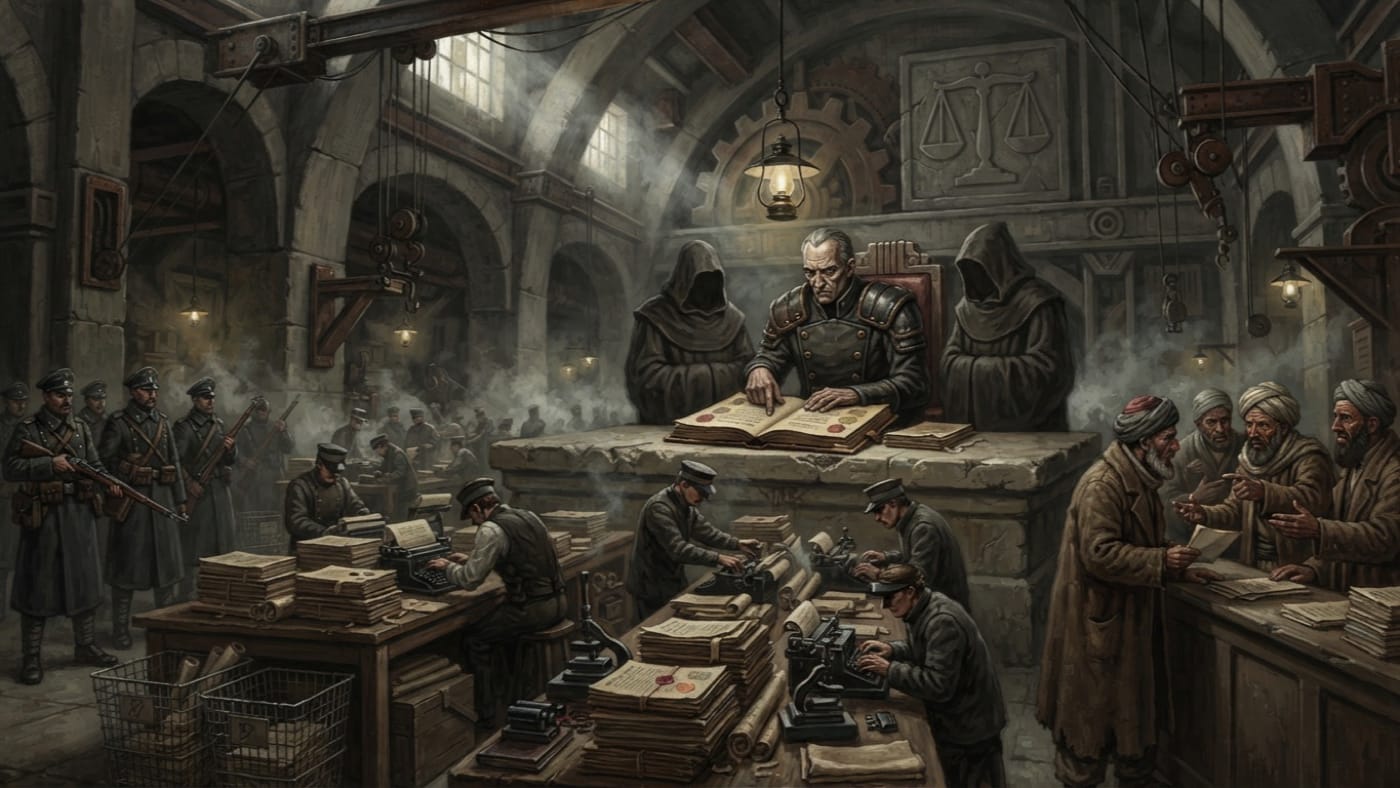
Ruling 201-Blue/17 was delivered by High Arbiter Senn Vark from the limestone bench in the Treaty Ring at the Steppe Gate, the seat of the Caravan Court. Its holding is narrow, and the narrowness is the reason it works. A Living Addendum that satisfies legal form binds. Pulse is not a statutory requirement. The ruling does not say who wrote the pages, whether their witnesses saw anything, or whether the clauses tell the truth. It answers one question, whether the paper binds, and it answers yes.
#On the Folio of A.S. 194
The matter began with an excess. In A.S. 194 (1904 CE), a Paper Keeper auditing a shelf in the Fourth Vault of the Burnless Archive found a folio missing from the master index. Its ink was wet. Its form was complete. It amended a passage writ of A.S. 118 (1828 CE), and, according to the published accounts, it changed a caravan route from permitted to compulsory and purported to impose a toll retroactively on every caravan that had used the route since. The seals passed authentication, the witness names belonged to real persons, and three of the four witnesses were dead.
I put the economic consequence first because the Gate did. A theologian looks at a dead man's signature in fresh ink and sees an omen. A caravan lord sees an invoice dated back to his grandfather.
The published accounts then report escalation. By A.S. 199 (1909 CE) the quarterly audits were finding three to eleven new folios per cycle. By A.S. 201 they were finding about two a week. In A.S. 200 (1910 CE) one documented addendum amended a ruling the Court had not yet delivered. The ruling came three weeks later in the posture the amendment had anticipated. The Court denied reading the folio, and the Keepers denied showing it. I record the sequence and both denials. Whoever claims the page foresaw the ruling, forced it or merely guessed right is speaking past the evidence.
#On What the Ruling Finds
Vark's dossier preserves the questions he put to the Court in emergency session, in the order he put them. Does an addendum bind if it satisfies the form? Yes. Do the Addenda satisfy the form? Yes. Does the Court have authority to reject a binding form because its author has no living pulse? No.
The published account of the ruling adds one principle, and I quote that account and go no further than it does: review suspends enforcement only when the reviewing authority outranks the instrument under review, and the Caravan Court does not outrank the Treaty. The ruling sets out no general table of precedence for every office and instrument at the Gate. The principle is enough to end the Court's long habit of "under review, suspended pending decision." A tribunal cannot suspend what it does not outrank. It can verify, and once verification is complete it can only obey.
The Court's abstract lists what counts as form: witness blocks, seal authenticity, pronunciation key and archive mark. My tract on the Nine Weights describes how a page is handled once it reaches the bench. An Archive liaison reads it first, a seal assessor smells the wax, the wind-witness marks the stones' response, and the bench then works out which burdens arrived with the page and which fall on the living. That is published practice, not statute. No exhaustive test or appeal procedure has been published. The distinction between institution and bench applies here too. The Caravan Court is the whole apparatus of clerks, runners, seal trays and fee bowls. The Nine Weights is the inner bench and its doctrine of burden. The title names weights, not seats, and the bench is nine persons only when the sitting calls for nine.
#On What the Ruling Does Not Find
A valid instrument proves its own validity and nothing else. The ruling holds that the page binds. It does not hold that the dead witnesses witnessed, that the toll of A.S. 118 was ever just, or that anyone is known to have held the pen.
This needs saying plainly because the Gate keeps forgetting it, and so have I. The Archive account repeats the ordinary rule of Synodal procedure: dead witnesses are inadmissible. My own earlier tract described the Addenda's witness blocks as admissible. Both statements can stand only if each is read in its proper place. The general rule about dead witnesses has not been repealed. Ruling 201-Blue/17 created no general exception for the dead, granted no standing to corpses, and did not make anything that walks without breath into a citizen or a party at law. It found that a particular class of instrument meets its formal requirements and that the Court lacks the rank to set it aside. The dead have not become persons before the Court. Their signatures, on these pages, have become sufficient.
"They arrive with perfect letterforms, exact seals, admissible witnesses, valid pronunciation keys, and procedural humility." — the present author, The Living Addenda.
Narrowed. The witness blocks are formally sufficient under Ruling 201-Blue/17. Whether anyone named in them saw anything has not been found and is not admitted. The ordinary rule on dead witnesses remains as Records left it, and the author has been asked by Records to say so twice.
Truth and form have parted company at the Steppe Gate. The ruling did not cause the separation. It recorded it and fixed a fee to it.
#On the Ledger of Consequence
The Addenda reach passage writs, toll schedules, escort contracts, witness lists, confession summaries and arbitration rulings. Since the ruling, each of those categories is open to amendment by a page whose only accountable feature is its form.
The published accounts name two sets of consequences, and I keep them apart because their sources do. The Archive account says three caravan lords restructured toll arrangements in response to amendments. My tract on the Addenda says three caravan houses restructured debt obligations on clauses written before their grandfathers were conceived. Nobody has shown that these are the same men or the same transactions, and I decline to merge them to save a sentence.
The clearest risk falls on Captain Rho Balesh. His Patrol Command needs a Court clause before force is lawful, and he sells escort priority like a commodity. His dossier states the danger exactly: an escort contract sold on one market day can be amended by the next, by a hand he cannot arrest. The dossier records a standing exposure, not an incident. A column that paid for a dawn escort may find the clause has moved its departure, its route or its fee. The captain will have taken the coin under one text and must enforce another.
The Scribe Bazaar has fared better. Precedent volumes hold their value only while their rulings stay put, and each amendment now calls for fresh certification. Vark's thirty years without an unwitnessed sentence and his trade in sold precedent make his reliance on form easy to understand. They tell us nothing about his private motive, and I have filed none for him.
#On Custody
The ruling settled whether the Addenda bind. It left open who keeps them, and the Gate's offices have been quarrelling over that ever since.
The Treaty Office holds custody of the compact language, and every Addendum amends that language. The Seal-House Consortium authenticates, and Seal-Mistress Ylena Korr has raised her fees because every folio requires fresh seal verification. The Paper Keepers hold the originals, which do not leave the Archive. Patrol Command must enforce whatever the originals now say. The Bureau of Records demands chain of custody for documents that have none they can trace. The Bureau of Rites seeks jurisdiction over pages it cannot bless.
Each of these is a claim and none has been decided. No court has ruled on ownership of the Addenda as a class, and no published case has reached a disposition. The Court has made itself the place where everyone's form is checked and declined to say whose shelf the pages belong to.
#On the Wordless Shelf
In A.S. 199 a rubbing of the Third Stone's southern face disappeared from the Archive. A wordless folio with still-wet ink now occupies its shelf, and Paper Keeper Seld inspects it every morning. The published minutes record no ruling on this folio. Nothing establishes that it is a Living Addendum. It carries no witness block, no seal field, no key and no clause, so it has nothing for 201-Blue/17 to act on. It shares its name with the blank instrument of the Bureau of Shadows, and the shared name establishes no common origin. A blank page and a valid amendment are different objects, and the ruling governs only one of them.
#On the Present Handling
As at this A.S. 201 compilation, the Court verifies the Addenda one at a time: witness blocks, seal, key, archive mark. Those that pass are enforced. Fees are revised. The pages remain below the cutbank in Keeper custody, and the custody claims above them remain claims. Their mechanism remains under classification. Their author and the truth of their contents remain unfound. The question of the blank shelf is still open.
Ruling 201-Blue/17 stands as delivered. It answers whether the paper binds and leaves every other question where it was.