

#On the Question
"Which rib keeps you warm?" — Shibboleth of Brest; locals answer with a number
Five words, asked on a bridge. The survey of Bastion-Brest files them under insider shibboleths, with a single parenthesis of instruction: locals answer with a number. That parenthesis is the whole documentary deposit. The Codex has the question, the form of the reply and the classification. It does not have the reply.
I state the limits plainly because the Bureau prefers its clerks to find limits by tripping over them. The rest of the record is absence, and the absences are specific. No register sets a correct number against a name. The count has no recorded starting gatehouse. Nothing confirms that it counts the thirty-two trusses at all, though at Brest the word "rib" means the brass trusses first and everything else afterward. The record names no examiner and writes down no penalty for a wrong answer. What survives is a habit of speech among residents, recognised as a test by the survey that took it down, and that is less than a password.
#On Warmth Within the Ribs
"Ribs don't bend for pity." — Proverb of the Ribs
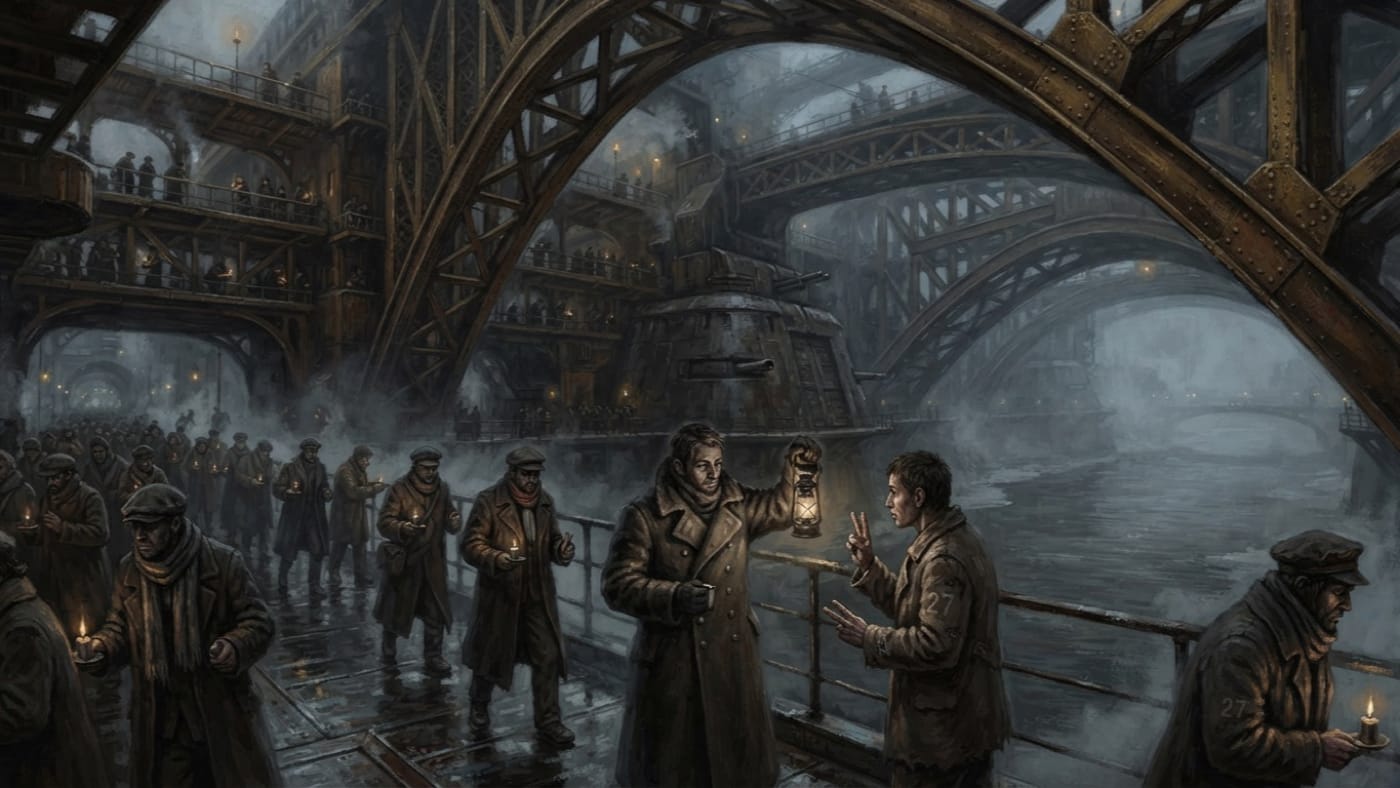
To understand why anyone at Brest would frame belonging as a matter of warmth, one must stand on the decking in the hour after the dawn bell. The Bug runs cold and brown beneath eight hundred metres of riveted brass and iron. Mist climbs the trusses. The brass is cold enough to take skin, the decking is slick, and wool never dries. The morning smells of tallow and wet iron, then smoked fish, then cordite when the casemates test their shutters.
Fourteen thousand people live inside this structure in ordinary times, and more than twenty thousand when the convoys back up. The Ribwalk is their street and their market. Below it, in the stone of the fourteen pylons, lie the Pylon Warrens: vertical, damp, ill-lit, and allotted by declared sin. Those who confess pride sleep high, toward the Ribwalk. Those who confess sloth sleep low, toward the water. Nobody at Brest needs a theologian to tell them which end of that arrangement is colder.
In such a place, warmth is the polite word for a bunk, for a fire one is permitted near, for a neighbour who will let you stand in their lee while the stamp comes down. A question about which rib keeps you warm is a question about where you are kept. Whether the number names a truss, a bunk, a gun crew, a household or a debt, I cannot tell you, and anyone who claims to know has written it themselves. The sources leave the number blank. They leave the cold in no doubt at all.
#On Speech Fit for Crossing
"No sin, no step." — Proverb of the Ribs
Brest teaches its people to talk at the speed of the stamp. A crossing requires a confession receipt, an absolution token, and a seal from the Crossing Bureau certifying that today's sin agrees with yesterday's. Rations, bunks and employment are tangled into the same paper. A resident confesses the way a gunner loads: briefly, correctly, and without looking round for applause.
The bridge has built manners on top of this. Present your papers before they are asked for. Speak your sin concisely. Keep your candle steady. These are the respect signals of the Ribs, and a stranger fails them before saying a word. Hospitality runs the same way. A host offers a warm candle cup and a "safe sin" for the guest to declare, some small offence that can be admitted to a confession scribe without inviting a second question. In return the guest never asks the host's true crossing history. Everyone drinks. Nobody digs.
The survey records a second shibboleth beside the first: "Name your sin in five breaths." Its note is shorter and crueller: outsiders can't. The two sit together in the record, and neither is called the answer to the other, so I keep them apart here. They test the same capacity all the same. Each wants a reply that is brief, ready, and costs the speaker nothing they cannot afford to lose.
That is the native tongue of the Confessional Lanes: speech pared until nothing dangerous remains in it, delivered before the scribe's pen has finished lifting. The shibboleth takes that speech out of the booth and onto the deck, between neighbours, with no scribe present and nothing to sign.
#On Recognition and the Ledger
"The river forgets; the ledger doesn't." — Proverb of the Ribs
Brest recognises a person twice. The first recognition belongs to the Ledger: identity file, crossing writ, receipt, token, seal. It is exact, and it is for sale. Forged tokens trade beneath the deck. Sin-scrip is written to order for any profession. Identity fraud heads the bridge's list of crimes, and the Bridge Tribunal hears "manifest irregularity" daily, which is its term for a person whose papers have begun to disagree with them.
The second recognition belongs to the deck, and to no one in particular. It asks whether you move like someone who lives here. Do you hand over papers unprompted? Can you confess in one breath? Can you hold a candle cup without asking how your host first came across? Can you answer a question about warmth with a number and no hesitation?
I make no claim that the second recognition is more reliable than the first. The sources record no impostor caught by it, no forger exposed, no Tribunal inquiry turned aside, and I will not manufacture one to flatter the custom. The Ledger checks whether your documents are in order. The deck checks whether you have been living among the people who handle them. These are separate certificates. Brest demands both and prints only one.
There remains the enemy across the river. The bridge sits on the Sagittal Line, and every frontier distrusts the stranger with perfect papers. Brest has more reason than most, since its whole apparatus sorts souls at gunpoint and the sorting is known to be counterfeitable. It would be tidy to declare the shibboleth a weapon of the war, and tidiness is the Bureau's oldest vice. The survey filed it among the slang, between the swear words and the euphemisms, and I leave it there. Nothing in the record shows that it has ever shielded anyone.
#On Present Usage
"Mist carries what mouths can't." — Proverb of the Ribs
The question heads the section on life inside the ribs in the Codex's account of Bastion-Brest for this year of A.S. 201, and it is gathered again among the proverbs of the Ribs. That is the present attestation. The record does not say who first asked it, in which decade, or of whom. I decline to date it from the western-bank works, from the raising of the brass span or from any convoy season. A saying is born when it is first said, and no clerk was present.
Since A.S. 199 the bridge has had cause to be more careful still with its mouths. The Confession Echo returns sins spoken in the booths to the deck in the confessor's own cadence. The sources give the shibboleth no part in that affair, and I give it none. I observe only that people who now hear their confessions coming back across the decking have good reason to prefer questions answered with a single number.
The Bureau of Doctrine may wish to know the correct number. So do I. The question is asked along eight hundred metres of brass between the gatehouses, and it is answered there, and the answer has never once been written anywhere I could read it.