

#On the Survey and Its Limits
This entry is a documentary survey of the Saint-Metal Yard of Essen-of-Hymnsteel, compiled in A.S. 201, which is 1911 CE. That is the year of this compilation and nothing more. It is not the year the yard was founded, and it is not the date of any inspection or of any edition of the yard's papers. Nobody has given those dates to this office. I have learned not to ask an archive for ledgers it never kept.
The Essen record lists the Saint-Metal Yard as one of the city's districts and gives it three kinds of work: reliquary plating, bone-inlays and "holy rivets." The record also says what the place smells of, which is ash and sweet rot. The Bureau can certify that much. It cannot certify the yard's boundaries, a plan of its sheds or the output of its benches, and I have none of these to give the reader. Whoever wants a floorplan may draw one in private and confess it at the next Ninth Peal.
The name raises an obvious question. Saint-Metal implies a saint, and no saint is on record. No patron is named, no relic is identified, and no feast day is attached. The yard has the adjective and no noun. In Essen that is not unusual. Half the city's piety is a word stamped on an object, and the stamp is held to be holier than the object.
#On Plating, Bone and the Holy Rivet
Essen's economic record includes reliquary fasteners among the city's main industries, and its exports include stamped fasteners. The rail spur to Bastion-Constantinople is recorded as carrying reliquary rivets, along with Hymnsteel and bell-cannon throats. Those rivets travel east and hold relics together in places where men are dying. That is the whole of the yard's purpose as far as the record shows, and it is purpose enough.
The record does not explain how the yard plates a reliquary, sets bone into metal or makes a rivet holy. I will not describe the process. The city's general doctrine treats precision as holiness and entropy as sin. Whether the yard sings its rivets awake the way the choirs sing bearings at the First Bell Warming, or blesses them some other way, is something its benches have not reported to me.
The yard has a festival. At the Procession of Rivets, saint-metal fasteners are displayed in public, and the Essen record says theft attempts rise during it. Neither the date nor the route of the procession is recorded. The city carries its holiest hardware out into a crowd once a year, and the pickpockets turn out to meet it.
The local risks are listed plainly as theft and the substitution of counterfeit bone fragments for genuine ones. I record both as risks. I have not been shown any particular theft, any wronged chapel or any chain of custody, so I will not invent a victim to make the paragraph mourn. The record does show that raw relic bone is restricted cargo. It may not pass through the Seven Locks at all, so whatever bone reaches the yard comes under conditions this survey has not seen.
The sweet rot is unexplained, and I have chosen not to pursue it.
#On the Heat Beneath
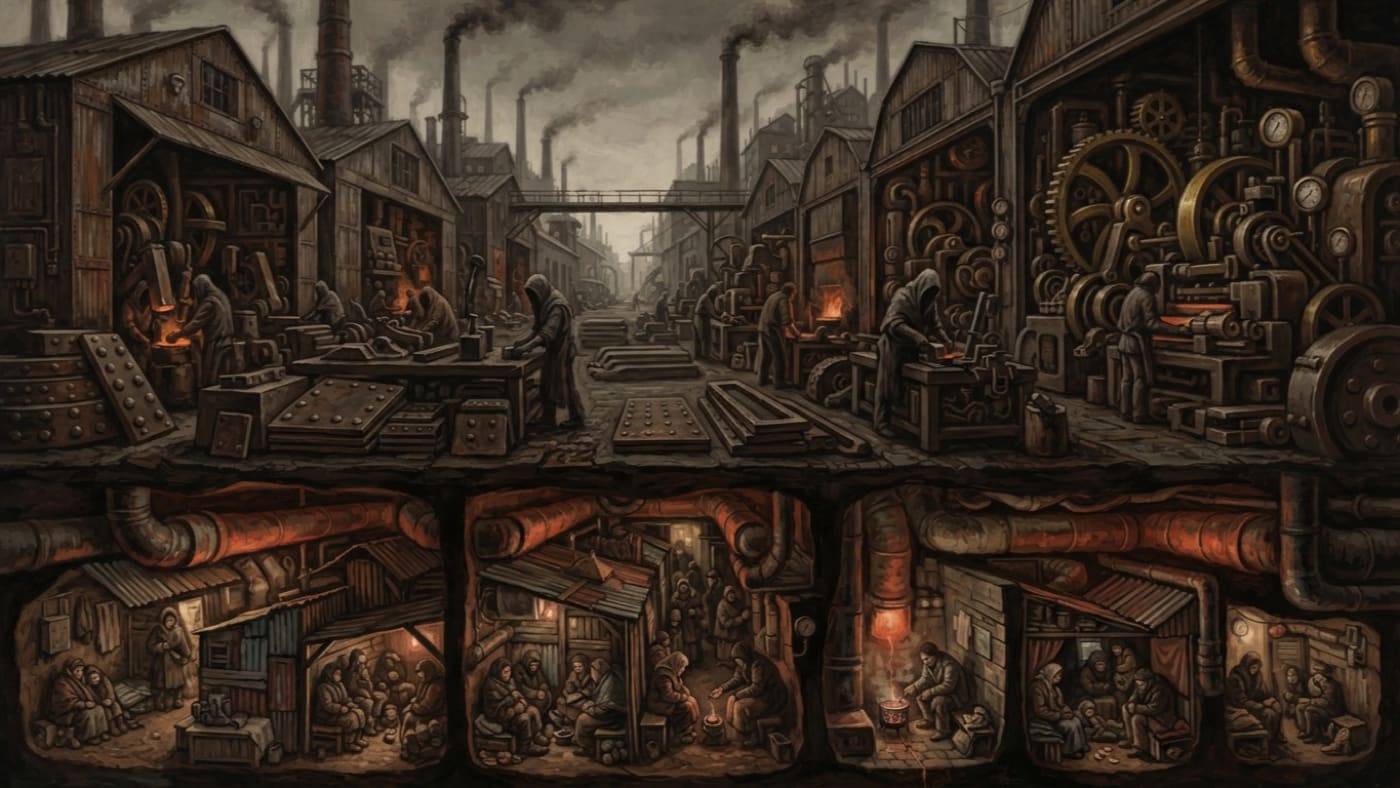
Under the yard runs the warmth. The published Codex entry on the Ash Warrens describes that district as the refugee and condemned-labour sprawl beneath Essen's southern warm ducts, where waste heat from the Foundry Core is carried toward the terraces. It says the best berths in the Warrens lie near the main warm veins under the Saint-Metal Yard. The worst lie under cracked ducts that leak soot and give no heat.
The arrangement is vertical. Reliquaries are plated on the upper level and families sleep in the duct-warmth below. That ordering is all the record gives me. I have no route from one level to the other, no stair or hatch, and no deed showing that the yard owns the ducts beneath it or collects anything for the heat they give off. A reader who imagines the yard's foremen renting warmth to the families underneath has imagined something this office cannot sign.
Heat credits are lawful in themselves. The Essen record defines them as duct-space rights. The Bureau of Records regulates them through Ledger Row, where, as the Warrens entry puts it, clerks with clean collars decide which family has lawful proximity to a pipe. A paid chit for a berth near a warm vein is just as legal as a ration renewal, and just as easy to lose.
The illicit trade sits around that lawful paper. The Warrens entry records disputed marks, heat-credit transfers, dead men's work permits and forged exemptions, and the Essen record places a black market in the duct-tunnels under the Shard Markets, selling counterfeit seals, hush-cloth and "false quiet" rooms. So the distinction runs as follows. The yard does lawful devotional work above. The ground below holds lawful heat credits, disputed heat credits and outright contraband, and Records sorts them one chit at a time.
This Codex's Ash Warrens entry carries A.S. 110 in its dateline and A.S. 201 on its footer seal.
Both numbers stand, and neither one dates the Saint-Metal Yard. The first indexes the Tri-Bureau Compact, to which the Warrens trace their origin. The second is the year of that entry's seal. The Warrens' own milestones, which put the heat-credit boards at A.S. 121 and the chapel rows at A.S. 130, belong to the Warrens. The yard above them has no recorded founding year, and this survey gives it none.
#On the Mark and Its Counterfeits
The Tri-Bureau Compact keeps three red lines. One of them is forging a Saint-Metal certification mark, which the Essen record says is treated as sacrilege and sabotage together. The other two concern bell schedules and stanzas. Only this one concerns a mark that can be cut into a punch.
The published dossier on Kestrel Waxhand states what the mark does. In that dossier's words, the mark certifies the plating and holy rivets made in the Saint-Metal Yard, and a forged one would send uncertified metal into the Sagittal Line, where relics and men depend on its holding together. I cite that as the dossier's account. Who applies the mark, at what bench, and after what test is recorded nowhere I have been allowed to read.
Saint-Metal Certification appears in the city's list of papers alongside Lock Passes, Quiet Permits, Safety Waivers and Rail Priority Seals. Essen's paper market is as large as the city's fears, and this mark is one item in it.
Kestrel Waxhand is recorded as a counterfeit-seal maker who keeps a stall of devotional ironwork in the Shard Markets. She is associated with the Shard Market Syndicate, but no rank or terms are given. I name her here as a documented example of the counterfeit trade that surrounds the yard, and for no other reason. No record shows that she forged the Saint-Metal mark, worked in the yard, supplied it, or partnered with Old Juro. Her birth and the year she began trading are unrecorded. The Syndicate's equipment of stolen stamps, river skiffs and duct routes is described in the record for the Syndicate as a whole. None of it is assigned to any operation against the yard.
Records tolerates the Shard Markets, and the Essen record also lists the Syndicate as an enemy of Records. Being tolerated does not mean having a pact. When a rivet fails, the city will look downhill for a culprit. The Codex has already corrected itself on this point: Resonance Bloom activity predates the documented operations of the Mirror Choir by approximately forty years. That correction does not move the blame for the Blooms onto counterfeit parts, and this survey ties no failure on the Line to any particular fastener.
#On the Present Pressure
The city's pressure in the survey year is a matter of record. Strasbourg has demanded tripled output for hymn-drive siege engines. Furnace-Marshal Kord of the Bureau of Engines and Furnaces threatens conscription. Sister Rauth of the Bureau of Orison and Song refuses to raise the tempo without liturgical stability. Arch-Notary Veyl's Records profits from the quarrel, as it profits from every quarrel that needs stamps.
All of this is pressure on the city as a whole. I have found no quota for the Saint-Metal Yard, no output figure and no order addressed to its benches. If the demand reaches the yard, it will presumably come down through the same Compact channels that govern everything else in Essen. I record the demand, the absence of any yard figure and the warm berths underneath, where the families are likely to learn of any change before the clerks do.
The Creator made bone, ash and iron. Essen has made a certification mark that joins all three and a red line to protect it, and has given the whole arrangement the name of a saint it has never identified. Doctrine holds no objection to that on file.