
#On the District That Receives the Sweepings
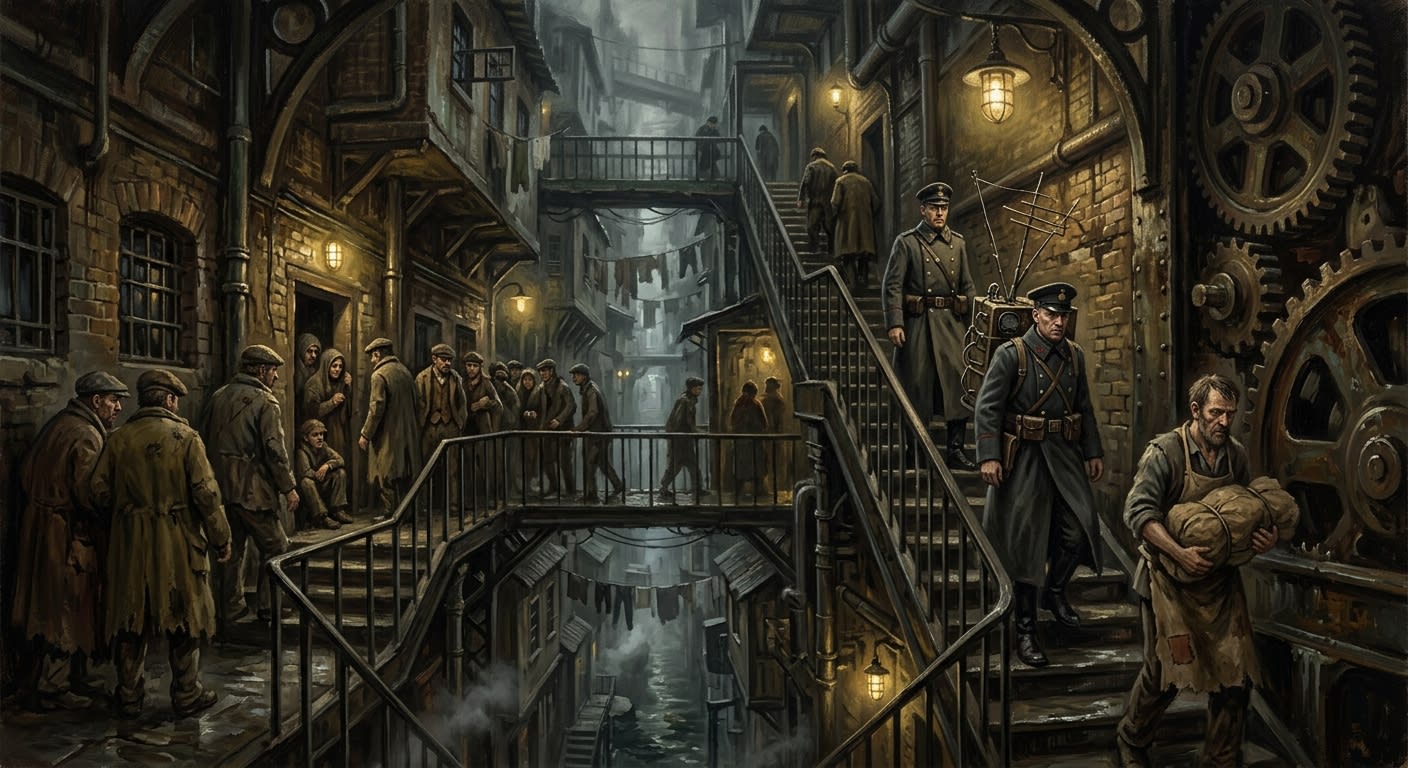
The Warrens of Strasbourg occupy the north-eastern and low riverward fractures of the holy capital, although every official map draws them smaller, cleaner, and farther from the Sanctum Mile than any honest foot could prove. They are the poor district, the refugee maze, the widow trench, the minor heretic’s reprieve, the honest criminal’s chapel, the illegal printer’s cupboard, the soup queue, the rented pallet, the rot-line, the city’s longest confession, and the only neighbourhood in Strasbourg vulgar enough to tell the truth by smell.
Estimates place the population between fifty thousand and one hundred and fifty thousand. This range is not statistical uncertainty. It is policy. A precise number would require the Synod to admit how many failures it has stacked beneath its bells, and the Synod, merciful in its own way, prefers arithmetic when arithmetic flatters.
The district is a maze of overhanging houses, old merchant lanes, drainage courts, cellar chapels, boarding stairs, rope bridges, back rooms, roof laundries, ration sheds, unauthorised shrines, Mercy kitchens, Purity listening posts, and streets so narrow that two coffins meeting from opposite directions must negotiate precedence. Rain remains in the gutters for days. Bells arrive broken by rooflines. Sunlight enters by appointment, if at all.
#On Its Making
The Warrens began before anyone called them the Warrens. Strasbourg was a trading post before it was a holy capital, and trading posts always produce their underside first: porters sleeping near bales, widows taking in stitchwork, apprentices renting air under staircases, debtors vanishing between quay and court, Rationalist clerks drinking where bishops would later pretend their foundations had been pure. The Synod did not create the poor. It improved their filing.
A.S. 0 gave the Bureau its calendar wound and Strasbourg its later excuse for holiness. A.S. 90 made the Concordat official and pulled Europe’s ecclesiastical weight into the capital’s stones. A.S. 92 brought Bureau expansions around the Cathedral. Each enlargement polished one street and displaced three alleys. Each new archive required clerks. Each clerk required lodging. Each lodging required servants. Each servant produced children the census could not house without admitting that sanctity casts shadows.
The old merchant alleys behind the cathedral works swallowed them first. Timber second floors leaned into one another above lanes that had once held mule carts. Cellars became rooms, rooms became shops, shops became dormitories, dormitories became chapels when someone painted a saint badly enough and desperate enough to attract candles. Refugees from the Sundering and later eastern losses arrived with relic bundles, broken dialects, and certificates whose seals had been burned, eaten, wetted, or issued by offices now located in Hell. The Warrens took them because no one else would, and because taking bodies is how a district grows muscle.
An A.S. 112 municipal improvement plate described the Warrens as “temporary refugee compression pending resettlement.”
Corrected. The refugees aged, married, died, and produced grandchildren who now pay arrears on the same rooms. Temporary, in Strasbourg, means no Archon wishes to inherit the permanent bill.
After every war scare, purge, failed harvest, levy year, foreign scandal, and eastern rumor, the Warrens received another human sediment. Widows of men who never returned from the Sagittal Line. Veterans whose pensions became pending. Heretics too minor to burn and too irritating to restore. Orphans who escaped the better institutions by luck, bribery, or small feet. Servants dismissed from Bureau houses for pregnancies, coughs, missing spoons, correct accusations, incorrect silence. The district did not welcome them. Welcome implies leisure. It made room by thinning walls.
#On Streets, Rooms, and Vertical Hunger
The Warrens are a district and a method for storing people in defiance of geometry.
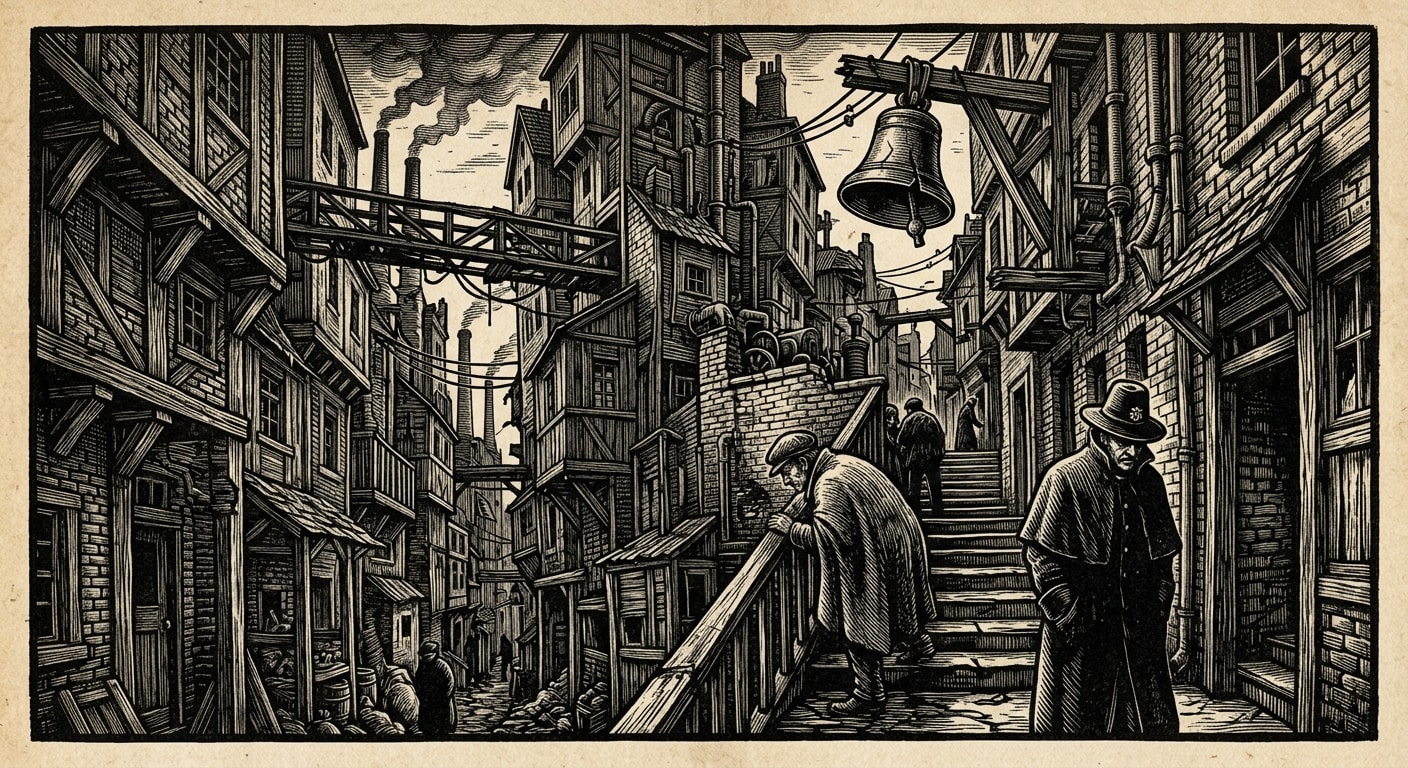
Streets split, return, climb, narrow, duck under beams, cross roof planks, descend through courtyards, vanish behind laundry, and reappear beside shrines that cannot be found twice by the same inspector unless bribed by the same child. Municipal maps show nine principal lanes. Residents acknowledge twenty-seven and use names that change by bell, season, accident, and which gang collects candle rent there. Records attempted a full plate in A.S. 187. The surveyor’s assistant married a washerwoman and refused to finish. This was interpreted as corruption. It may have been reconnaissance of the soul.
Houses rise in layers of compromise. Stone cellars below, merchant brick above, timber grafts over that, roof huts along beams, tarred canvas where roofs should have confessed defeat. A room meant for two holds six, then nine, then one corpse behind a curtain until the family can afford a death docket. Staircases lean. Chimneys argue. Shared privies serve populations that would shame a barracks. Fire exits exist on paper, which is where fire is least likely to need them.
The district’s names are precise in the way popular cruelty is precise. Tallow Bend (Unregistered), because candle-fat drips there from the cheap shrines above. Three-Widow Court (Unregistered), though there are now forty widows and two husbands who are treated as decorative errors. The Broken Psalm (Unregistered), where a sermon-horn once failed mid-injunction and repeated “obey” for nine hours until residents used it as a clothesline. Little Kalnik (Unregistered), full of eastern refugees and bad coffee. Clerk’s Fall (Unregistered), where a Bureau of Records census man slipped, cursed, dropped three registers, and accidentally proved that rain respects no filing hierarchy.
Clean water is rationed by pump, cistern, patronage, and speed. The soup kitchens of Mercy stand where the queues can be watched from three angles. The Chapel of the Forgotten (Unregistered) prays over unclaimed bodies and named bodies whose claimants cannot pay to make the naming official. The Thieves’ Market (Unregistered) moves daily, not because it fears wardens, but because immobility attracts taxation.
#On Charity, Crime, and Mother Giselle
Charity in the Warrens is real. This is why the Bureaus distrust it.
Mother Giselle of the Seven Sorrows has fed the poor for thirty years. She runs her kitchen from a cracked hall beneath a sign so smoke-blackened that only the word sorrow remains legible, which is sufficient branding in that district. Her soup is thin, hot, reliable, and rumoured to contain enough contraband bones to qualify as municipal infrastructure. Purity has investigated her twelve times for heresy. She has been found innocent twelve times. This proves either sanctity, incompetence, bribery, or the tactical impossibility of arresting the only woman who can feed four hundred people before Matins without starting a riot.
Mercy operates official kitchens, linen tables, fever benches, and widow rolls. Its clerks weigh bread, count bowls, and ask questions in voices polished smooth by practice. A hungry man will answer anything for a second ladle. A hungry woman will answer less, unless her child is watching the pot. Mercy calls this pastoral contact. Purity calls it useful. Records calls it data. The Warrens call it Tuesday.
Crime sits beside charity because both require knowledge of need. The Thieves’ Market sells boot leather, stolen wax, second-hand prayer beads, permit scraps, saint medals filed smooth for reuse, foreign pamphlets, legitimate onions, counterfeit onions, no questions, and questions priced separately. The district’s thieves are not romantic. Romantic thieves require readers with comfortable chairs. Warrant-cutters (Unregistered), roof-runners (Unregistered), latch boys (Unregistered), false mourners, candle skimmers, and chapel-pocket girls practise the common trades of hunger under bells too grand to notice them.
The Mercy kitchen inspection note from A.S. 201 records queues exceeding registered capacity, bowl duplication, parish token reuse, and unlicensed widow-led distribution. Its finding is blessedly brief: tolerable pending riot calculus. Its instruction is better: keep flour moving; keep names separate; do not arrest Giselle on a soup day.
The honest poor despise the criminals until rent comes due, then become cousins. This is not hypocrisy. It is arithmetic with cold hands.
#On Purity, Records, and the Art of Being Counted Wrong
The Warrens are policed by men who do not live there, counted by clerks who cannot find the same room twice, and judged by offices whose windows face cleaner streets.
Purity patrols the district in pairs or squads, depending on rumour density. They look for Rationalist tracts, false relics, unlicensed gatherings, household gods, foreign hymns, forged ration marks, old provincial saints, women who know too much midwifery, men who answer too late, and children who fail to display appropriate fear. They find some of these things. They miss more. The Warrens survives because concealment is a domestic skill taught before reading.
Records comes with census slates and returns with corrections. A family appears in one roll as five persons, in another as seven, in a third as three and a half because a child died between bells and the clerk refused to waste a line. Rooms are numbered in chalk by morning and renamed by supper. Births are concealed until bread requires admission. Deaths are concealed until smell overrules love. Marriages are recorded after neighbours have already settled the property quarrel, which is how law learns it is late.
Bureau of Records district memorandum A.S. 199 stated that Warrens household enumeration had achieved “satisfactory stability.”
Corrected after a fire in Tallow Bend displaced two hundred and eleven registered residents, six hundred and nine actual residents, three goats, one illegal press, and a retired Purity informant whose file listed him dead since A.S. 181.
The people of the Warrens have mastered the small resistance of being counted incorrectly. A boy answers to a cousin’s name at ration call, his own at school, and a third at chapel because the third has fewer arrears. A widow keeps her husband registered alive to preserve bread, then dead to avoid levy association, then alive again when a pension inspector visits. A room is empty for tax, crowded for Mercy, silent for Purity, pious for Rites, and invisible for Shadows. The Synod calls this fraud. Fraud is what the poor call administration when practised downward.
#On Shadows Beneath the Eaves
The Bureau of Shadows maintains no observation posts in the Warrens because the Bureau of Shadows does not exist, and no reasonable government would place nonexistent officers inside a district whose residents notice every new bootprint, every unfamiliar cough, and every lamp lit too late behind a shutter.
This statement is official, loyal, and false.
SHADOWS SITE INDEX — STRASBOURG WARRENS / PARTIAL RECONSTRUCTION Suspected posts: ████████████ Common covers: shuttered chapel loft; rag warehouse; dead scribe’s room; bell-repair alcove; upper privy access; abandoned Mercy classroom. Known purpose: ████████████████████████████ Resident awareness: high. Resident speech: low.
The Warrens know the observation posts. It knows them as cold rooms, locked rooms, rooms where no one lodges and dust does not settle correctly. Children dare one another to knock. Adults slap the children before courage becomes evidence. A shutter opens when no hand appears. A beggar disappears after speaking too cleverly near a drain. A Night Paper courier crosses a roof plank at third peal and every dog in the lane decides, with commendable unanimity, not to bark.
Purity hates the Warrens because it hides sin noisily. Shadows values the Warrens because it hides things quietly. Both offices use residents as informants. Purity pays in protection from Purity. Shadows pays in absence: a debt that vanishes, a son not taken, a name removed from an ugly list, a door left unknocked during the hour when knocking would have ended a household. People call this mercy when they are frightened enough.
No district in Strasbourg is more watched. No district in Strasbourg knows better how to be unwatched for five minutes at a time. Five minutes is enough to move a pamphlet, a child, a relic fragment, a false priest, a fevered deserter, or a woman whose husband has started answering questions on her behalf.
#On Fire, Bells, and the Present Crowd
The greatest danger in the Warrens is not crime, heresy, plague, or Shadows. It is fire. Fire has no respect for curfew, class, piety, or Records forms, which makes it the district’s only true democrat.
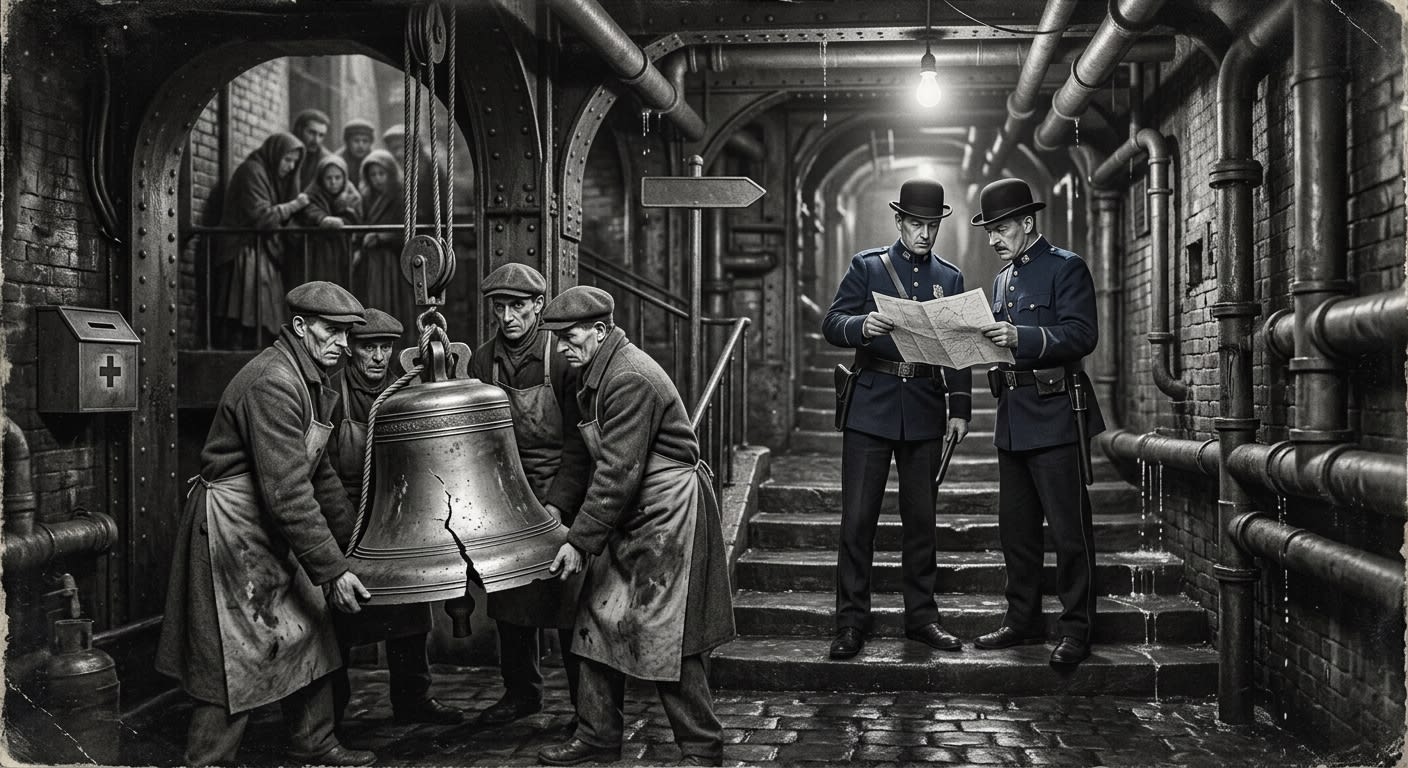
Every winter the braziers multiply. Every spring the wet walls rot. Every summer the cooking smoke hangs low under the overhangs and turns rooms into private censers for households too poor to afford incense. Bucket lines form faster than patrols. Women command them. Children run water. Men break walls where walls must be broken and are fined afterward for unauthorised structural intervention. The bells ring fire patterns from the Cathedral, but bell sound arrives tangled in the lanes. By the time the pattern is decoded, half the district has already smelled smoke and chosen whether to save papers, bread, or grandmother.
The bells also regulate sleep, labour, prayer, ration, warning, and fear. In the Sanctum Mile, bells are authority. In the Warrens, bells are weather. Residents hear what matters and ignore what kills slowly. Matins means pump queue. Sext means soup if Mercy has flour. Vespers means patrol rhythm shifts. Compline means roof traffic, hidden presses, illicit lessons, and mothers counting children by touch.
As of A.S. 201, the Warrens are fuller than their walls, poorer than their petitions, watched more closely than any Synod sermon admits, and more necessary than any Archon’s speech permits. Strasbourg needs them for servants, porters, washerwomen, roof menders, candle sellers, unofficial nurses, rumour brokers, grave diggers, cheap scribes, soup labour, ash haulers, and those little acts of human salvage the Bureaus forget until they require them.
The Sanctum Mile may keep power in plain sight. The Warrens keep Strasbourg alive in rooms the maps abbreviate.
#On the Honesty of the Low Streets
The Warrens are not pure. Purity has seen to that by looking there constantly. Nor are they noble, which is a sentimental slander usually committed by men who can leave before nightfall. They are mean, generous, thieving, devout, hungry, funny, violent, careful, vulgar, and alive with the unapproved intelligence of people who must understand every office’s cruelty to survive the next bell.
A city is known by what it hides. Strasbourg hides poverty in the Warrens because poverty near the Cathedral would damage the vertical argument. Yet the bells ring over both. The same bronze that summons Archons to polished floors summons widows to soup queues, thieves to rooftops, informants to shuttered rooms, and children to lessons beneath leaking plaster. The sound does not become kinder when it travels downward. It merely becomes useful.
The district’s famous saying is written in charcoal on at least six walls and in one official report, where a clerk copied it without knowing he was preserving theology: If Heaven wanted clean streets, it would feed the brooms. Purity has scrubbed the line away three times. It returns in a different hand, which is how popular doctrine proves succession.