

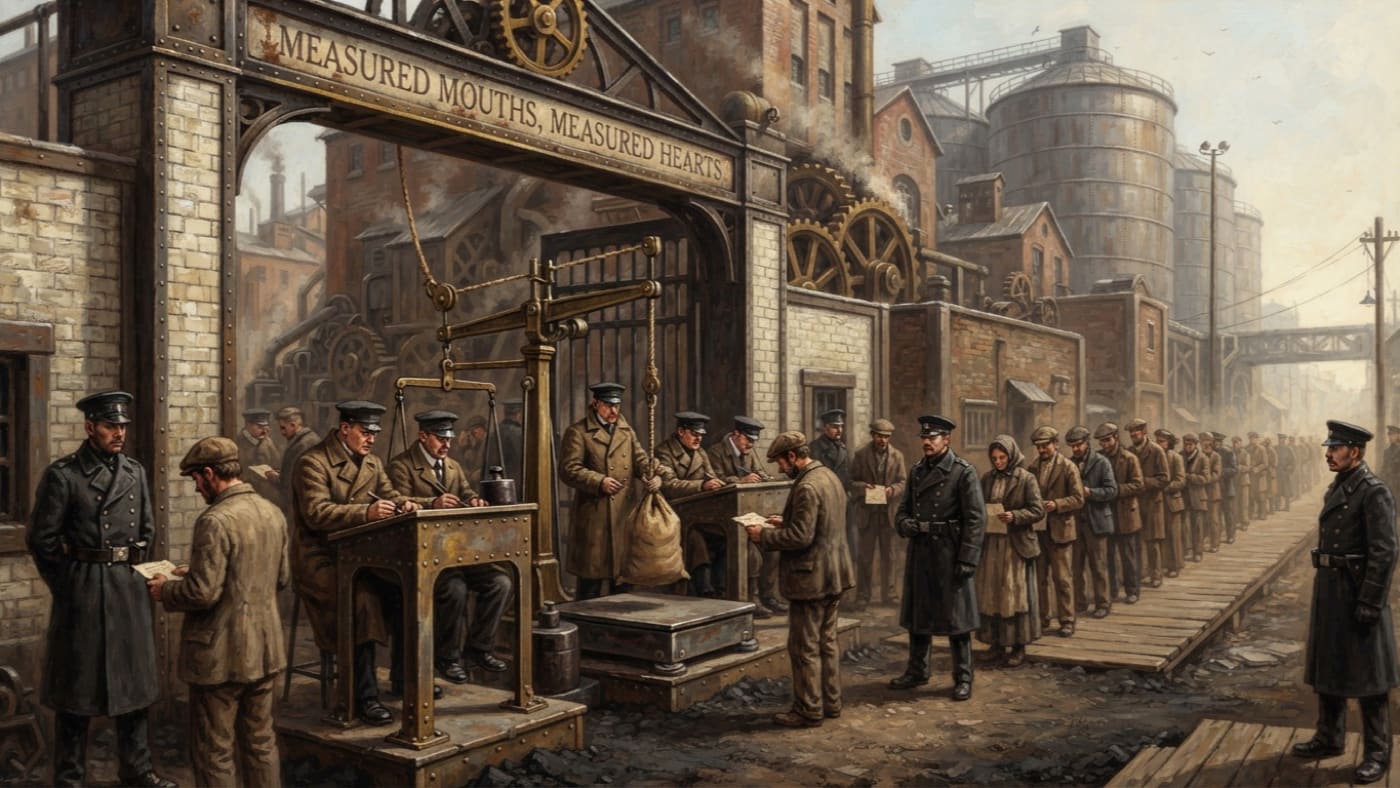
#On the Iron and Its Ward
"Measured mouths, measured hearts." (Inscription above the Scale Gate, paint renewed quarterly by civic mandate)
Most towns have a door. Wexel has a scale, and it has built its door around it.
Three things in Wexel share one name, and the Bureau of Records would want them kept apart. The Scale Gate is the checkpoint, one of the town's two road chokepoints. The other is the Chit Bridge over the irrigation canal, and nobody who wants to keep their household papers in order confuses the two. Scale Gate Ward is the district around the checkpoint: pale brick, weigh-stations, inspection tables, and a smell of iron and of the people standing closest to it. The Weighline is the worksite itself. Every sack of grain entering or leaving Wexel must cross its iron. The Scale Gate Authority runs the scales, and it also runs the clerks, the seals and the guards. It ranks them in that order.
Traffic comes in by the Queue Road from the west, and by the rail spur from the Palatine Switchyard of Lorn, which is a day away by rail and two by wagon. The basin is flat and offers no cover. A claimant can be seen coming toward the line for a long time before arriving, so the face has plenty of time to arrange itself.
The weighline opens at dawn. Chits are issued and the hymn bell sounds. The wind never stops in Wexel, and it rattles the steel skins of the silo crown in the rhythm the locals call "the counting." On each of my three visits I stood in that cold before the first weight. The bell was always on time, and the dust was always already in the air.
The records I was allowed to consult say nothing about when the Gate was built or how the Authority was constituted. The town was founded in A.S. 98 on the Bureau's belief that famine is an accounting failure. The Dust Fire of A.S. 112 killed three hundred and forty people and gave Wexel its Prefecture, its Mirth Office, and eighty-nine years of temporary joy discipline. Nobody has written down when the iron was first hung or on whose warrant. In a town that writes down laughter, I count that omission as a document in its own right.
#On What Crosses the Scale
"Hunger teaches holiness." (Ration Prefecture broadsheet, distributed at every Scale Gate checkpoint)
Nothing goes on the iron before the Scale Benediction. It is a hymn sung over the balances, and its words concern truth in measure. I have heard it sung well and sung badly, and the iron took no notice either way.
Then the work begins. Sacks come up on hemp rope that strains and creaks under the load. A balance clanks and settles. A clerk presses a stylus into a wax tablet, and that scratch is the most important sound in the ward, because it turns grain into an entry and an entry into an account. Household papers are checked. Stamped ration chits sealed with tallow-wax are issued. The hourly bells divide the morning into portions as carefully as the clerks divide the flour.
Etiquette at the Gate is precise. A citizen presents a chit with both hands and keeps their eyes lowered. The clerks examine the documents. The doctrine monitors examine the faces. The work is split between these two kinds of reading, and neither group pretends the other is optional.
The chit is the Gate's product. It is stamped paper sealed in wax, and it can be redeemed for grain, flour, soap and the thin broth that Wexel serves as hospitality. Redemption happens elsewhere, at the Chit Market, where chits are exchanged under a covered arcade that smells of onions and burlap. The Gate weighs and issues, and the Market redeems and trades. Coin still circulates and matters less with every season. Confession slips carry value, and so do logged labour-hours. I asked three clerks for the conversion rates between these currencies and got three versions of the same silence.
#On Honest Weights
The Authority's public promise is honest weights. It paints the promise on placards, preaches it in the Benediction, and repeats it to every inspector the Bureaus send.
The dedicated lore records that the weights are tuned for favoured families.
The arithmetic of a tuned weight is simple, which is why it lasts. When a household brings grain in and the iron reads it light, the household is credited with less than it delivered. When a ration goes out and the iron reads it heavy, the household receives less than it is credited. A favoured household gets the opposite reading on both counts. Neither error is large enough to argue about at the line. The wax tablet keeps no record of the argument anyway, only the quantity, and the quantity becomes the household's history. A short entry this week becomes a reduced eligibility next season. A run of short entries makes a household look like a poor provider, and the Prefecture knows what to do with poor providers.
The Authority has other tools besides the balance. It confiscates. It accepts payment: extra flour slipped onto the scale's honest side, clean paper (a rarer commodity in Wexel than grain), or another citizen's name offered "for review." A name payment can clear a citation. It cannot buy immunity, because the name goes into the same apparatus that will later hunt for a name to replace it. Speaker Huld Bex keeps a drawer beneath the Parliament's dais for exactly this purpose, and he is the one who decides when it is opened.
The Authority calibrates its own scales every week. The Bureau of Alchemical Standards has asked nine times for independent verification. Each request has been filed as "received." I have read the receipts. They are well made, with clear seals and ink that has not run. As specimens of bureaucratic penmanship I can find nothing wrong with them, and as answers to the request they are useless.
Earlier dispatches recorded the Scale Gate Authority's measurements as "honest weights, impartially applied to every household presenting at the iron."
Correction: the Authority's weights are tuned, and its calibration is certified by the Authority alone. "Impartially" has been struck. "Honest" stands only as the Authority's description of its own work.
#On the Face Across the Iron
A sack has a weight, and so does a face.
A citizen who presents grain while looking too pleased with it can have their allotment reduced for "suspect abundance." The principle is plain: anyone who looks as though they have enough has too much. Wexel's emotional-compliance regime punishes two faults equally, excessive pleasure and insufficient gratitude. Between them lies a strip of permitted expression narrower than the gap between two weights on a rigged balance.
That strip of expression is not under the Gate's control. Expression belongs to the Mirth Office under Sister-Lector Neme Varr, whose brass smile-gauge sets the town's standard. Her office reports a tolerance of three millimetres. I measured two. I note both figures and do not reconcile them, because the Bureau did not ask me to, and because in Wexel the discrepancy is itself the instrument. A citizen who cannot know the true tolerance will aim for the middle of a range that does not exist.
So a mark made at dawn starts to travel. A disputed quantity or a mirth notation leaves the ward on paper and arrives at offices that never saw the face it describes. The Parliament votes the quotas. Prefect Marwen Kile sets each household's allotment, decides when it is paid, and decides whether the payment is logged as provision or as clemency. Provision is a right. Clemency is a debt, and debts in Wexel turn into labour penalties, then into further debt, and then into an audit. At the far end of that sequence, in another part of town, are the Ash-Fine Marshals with their foreclosure writs. They are not Gate guards, and the Gate does not need them to be. It only has to write the first line of the entry.
Why do the citizens endure all this? Because a clean household ledger means lawful calories, and lawful calories come as usable chits, and there is no other lawful way to get them. The Cellar Circles in the undercellars and along Canalback deal in hidden grain, forged chits and forbidden jokes. Their existence puts pressure on the checkpoint. It gives the guards a reason to look harder, and it gives every honest household one more reason to look acceptable.
#On What the Seal Certifies
A seal from the Scale Gate Authority certifies what the Authority says it found: a weight, a household, a chit, an empty bin. Its authority stops at the edge of the wax.
Town reports in Wexel describe grain shifting inside sealed bins that the Authority had locked, inspected and certified empty. People who listen closely say the shifting sounds like applause. The chaff-winds have been reported carrying voices and laughter that nobody spoke. The Bureau of Rites classifies the winds as a Category One Localized Atmospheric-Acoustic Disturbance. That classification applies to the winds. It has never been applied to the Weighline, and the Weighline has received no classification of any kind beyond its own seals.
I note three discrepancies and offer no explanation for them. First, the bins are certified empty, and the reports say otherwise. Second, the scales are certified accurate, and the verifying Bureau has not been allowed to touch them. Third, the surplus figures for Wexel are classified. My clearance reached the Gate's tablets and stopped at the door behind them, and the Bureau of Purity has assured me that the door is not there.
None of this has stopped the Weighline. It opened this morning. It will open tomorrow at the hymn bell, with the rope straining and the stylus scratching and the dust already up, and the clerks will enter what the iron tells them, and the iron will tell them what it has been tuned to say.