

#On the Permit Desk
"The smallest piece of brass in the Irongate, and the heaviest."
This is a survey of Seal-Broker practice at Bastion-Irongate as it stands in A.S. 201. It also records the two fiscal accounts that currently compete over that practice. It is not a history of the occupation, because no such history has been filed. The title appears in the record against permit work at the Breath Office. The record does not say who first held it, who grants it, or whether anyone ever formally granted it at all.
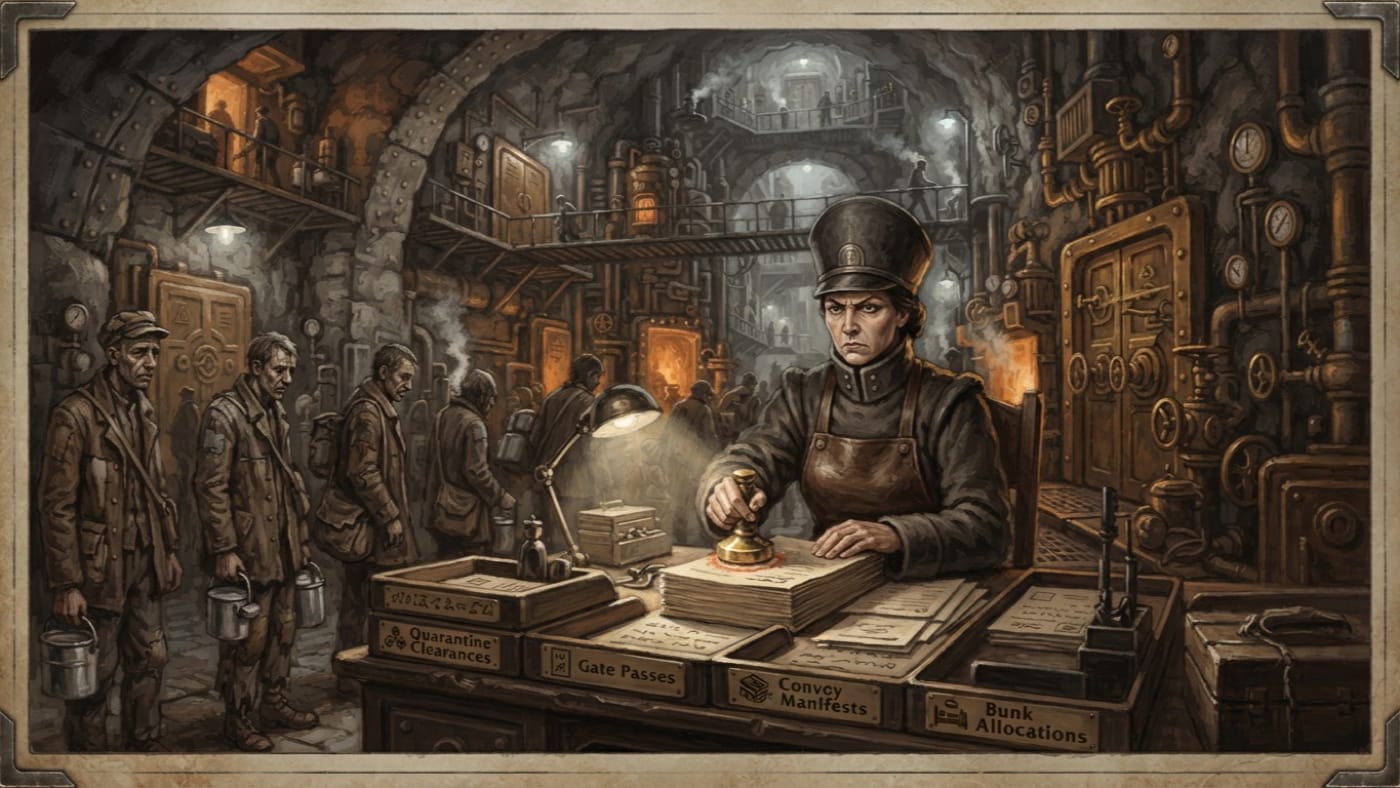
Four kinds of paper make up the work: quarantine clearances, gate passes, convoy manifests and bunk allocations. A clearance decides whether a coughing worker stays among the singers or is sent toward the Breatheries. A gate pass decides who gets through a checkpoint. A manifest decides what goes down the Transit Spine with a convoy, and who goes with it. A bunk allocation decides where a body sleeps. In a mountain above the Danube in winter, that decides whether it wakes.
The attested practitioner is Lysa Murne, who runs the Breath Office's permit desk. All four kinds of paper cross her desk and leave it under her seal. The garrison credits her with this entry's epigraph, said over pine tea in the officers' canteen. I have no quarrel with it. She is the only broker the record names. This survey does not hang every sin of the occupation around her neck. A reader who wants to may obtain a seal of his own.
#On Lawful Permission
"Sing, or the stone sings for you."
Start with the work that has to be done, since the Bureau insists on it and the mountain agrees. Sound holds Irongate up. In the Great Hush of A.S. 94, nine silent hours brought down the Third Lung and killed three thousand. Since then the Gasket Choir has sung in unbroken watches to keep the pressure seals seated. A fortress in that condition cannot let people wander where they like. Sooner or later each of these will kill someone other than the person at fault: an untrained throat in a breath line, a lung-rot case bunked beside a chant crew, a convoy with no manifest arriving during a pressure swing.
The paperwork exists to answer those dangers. The voice-license tier system was ratified in A.S. 97. It ties residence, heat, rations and bunk to vocal standing: first tier allows residence and basic labour, fifth tier allows supervisory chanting and access to the pressure ledger. The candle test measures whether a lung still works. A clerk holds a flame at arm's length and times how long the applicant can keep it bent. The lung-rot outbreaks of A.S. 199 widened the Office's quarantine powers, and a failed score can now bring compulsory isolation.
Authority is divided, and the broker holds the smallest share of it, though not the least important. The Choir Magistracy, under Cantor Ys Varr, conducts the licensing auditions and sets the prescribed stanzas. The Hush Court hears silence offences and appeals. Tunnel Command holds the gates, the pressure doors and the demolition charges for sealing off compartments. The Breath Office keeps the seals, the candle-test results, the heat allocations and the record of quarantine movement. A Seal-Broker examines no voice and opens no door by hand. The broker writes down what others have decided, and in Irongate a decision takes effect only once it is written.
Done honestly, the work saves lives. Quarantine stops rot from spreading through the garrison. A sound manifest keeps a convoy from being taken for an attack. A genuine bunk seal puts a licensed singer somewhere warm enough to sing again at the next watch. That should be said plainly before the abuses are counted.
#On Administrative Advantage
"Pressure is political."
Every one of the four papers can be turned into a means of pressure, and the desk that issues them holds that means. The record names Murne's hold plainly: she stamps permits, she clears quarantine, and she trades on the fear of a lung-rot entry in a person's file. The entry does not have to be true to do harm. Once written, it follows the worker to the next audit, the next bunk queue and the next convoy roster. A worker so marked can lose bunk hours or heat before any physician has examined him.
The corruption recorded at Irongate falls into four kinds: license upgrades, quiet passes, exemptions from prescribed stanzas, and allocations of ration heat. By the same account, bribes at the gates are paid in gasket grease, valve-springs or exemptions from choir duty. The record pins these on the fortress, not on any one clerk. I keep the same distinction and state it once here so I need not repeat it. The occupation offers the chance to abuse the desk. Whether a particular broker took that chance is a matter for evidence. On Murne, the record lists her powers and the fear she trades on, and gives no particular instance.
The abuse works through discretion. A heat allotment can be cut for a failed tier, an unpaid air-rights note, a suspicion of infection, or conduct the Office files as silence-adjacent. Each reason has its form. Each form has a line for appeal, and appeals are heard in a cold room. Debt from license fees ends in compelled chanting shifts or labour in the valve pits, which the garrison calls lung service. The broker does not set these penalties. The broker decides how fast the paper moves. For a man waiting in an unheated corridor, speed is the only mercy on offer.
#On Papers Below the Baffles
"A permit desk creates routes around itself as stone creates seepage."
The Underchords supply what the desk refuses. The Underchord Cartel works the upper and middle corridors under cover of maintenance crews. It sells counterfeit voice-licenses, false maintenance chits, warm bunk seals, oxygen bulbs and quiet passes. Every item on that list either copies or gets around something the permit desk issues. A forger needs a real seal to copy and a runner needs a real checkpoint to avoid, so the Breath Office in effect sets the specifications for the black market.
A quiet pass is a different thing from a gate pass. A gate pass is issued, sealed and filed. A quiet pass is a route, a timing and a silence, sent in tap-code and often carried in pieces by separate runners. It leads past the gate checkpoints, the permit desks, the auditions and the quarantine ropes. It gives no right to be anywhere. A client caught using one has no document to show.
Payment below is made in Gasket-Rings. These are small brass washers from the Valve Quarter, stamped with a pressure rating and a date whose meaning no one has established. They are not the broker's brass seal, though both are small and both are brass. A washer in a rigger's apron proves only that he is a rigger, since the rings have honest work in every flange in the fortress. No issuing authority has been found for the currency, and the record sets no exchange rate between the rings and the dues collected above.
The record puts no broker on the Cartel's rolls. It lists the Breath Office as the Cartel's enemy. The Office condemns each forgery while living off the fear that makes forgery pay. The Cartel has no need to recruit at the desk, because the desk sends it customers every day.
The clients carry the risk. Forging a voice-license seal is one of the fortress's recorded red lines. Below the baffles, a wrong note in the wrong corridor can unseat a gasket seal, and the Choir Magistrates will not send a crew to re-pressurize a section that officially does not exist. The Cartel sells to the desperate at desperate prices, and it takes brass from the dying as steadily as from the frightened. It rescues nobody. It sells escape at a price the fortress created, through passages the fortress denies.
#On the Competing Accounts
"Denial is the most profitable office in Irongate."
This survey follows the narrower account given in the Gasket-Rings entry. The Bureau of Tithes collects its lawful dues throughout Irongate: tolls, license fees and labour-hours. It cannot tax ring transactions in the Underchord corridors because the corridors are officially denied. Taxing them would mean admitting the corridors exist, and admitting who uses them: the discharged, the unlicensed and the quarantined. For a Seal-Broker's clients, the line that matters is between dues that are recorded and trade that is kept unrecognized. A license fee owed above stays owed. A ring spent below is recorded nowhere.
The Codex entries on the Underchords and on Bastion-Irongate state that the Bureau of Tithes has no jurisdiction inside the mountain.
That claim remains in those entries as their account. This survey does not adopt it. The Gasket-Rings entry records lawful Tithes collection throughout Irongate and limits the gap to the denied trade. No charter, treaty or boundary has been produced that would reconcile the two accounts, and I decline to draft one for the sake of tidiness.
The same two entries say that every Seal-Broker since A.S. 102 has exploited this gap. The sentence is an indictment and serves well enough as one. It makes a backdated charge of exploitation from A.S. 102 onward. It does not show that the occupation began that year, that any exemption was issued that year, or that any particular broker since has done what it alleges. The Bureau often indicts whole professions this way. Whether any one member is guilty is still a matter for evidence.
#On Present Practice
"No warmth without current seal."
In A.S. 201 the desk works under emergency conditions. The quarantine powers widened after A.S. 199 remain in force. Ward Seven of the Breatheries is full. Ward Eight is being cut from the rock behind the Third Lung by crews whose own breath scores, in the Shaft Priory doctor's opinion, are not monitored closely enough. Every failed candle test sends a clearance across the permit desk. Every clearance the desk refuses sends another buyer down into the Underchords.
The fortress now depends on both trades. The Bureau of Purity raids the corridors and files the rings it seizes. Then it asks, privately, that essential quiet traffic resume before the next convoy pulse. The Choir Magistracy relies on the same traffic to move its failures out of sight. The permit desk keeps stamping.
The survey finds the practice lawful in form, necessary in function, and open in every season to the abuses recorded above. It finds Lysa Murne at her desk with her seal. It records no price for her signature, because nobody has written one down.