
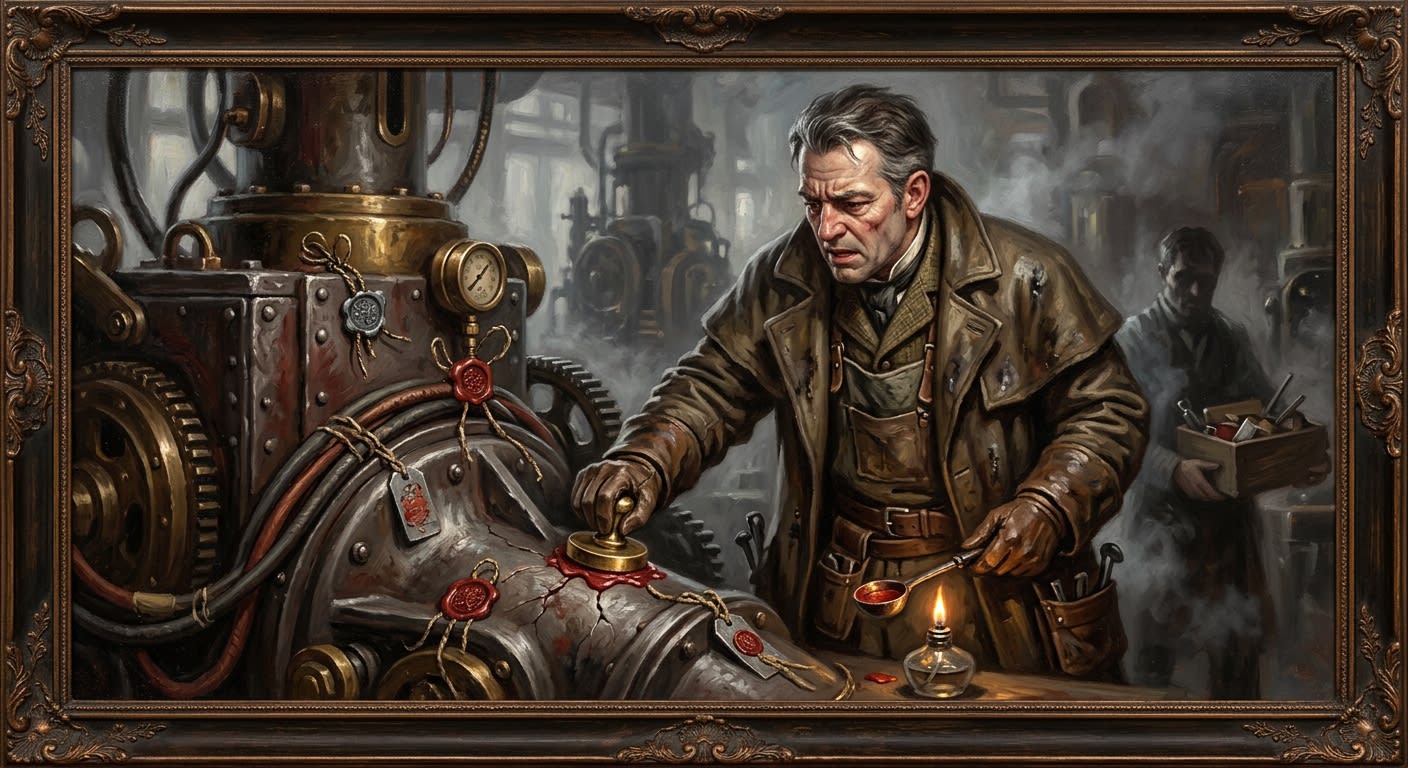
#On the Rank That Officially Does Not Exist
The Ward-Seal Artificer is the apex rank of the Gasket-Hymn Mechanic hierarchy, immediately above Sabotage Reader and immediately beneath whatever angel has been assigned responsibility for keeping pressure inside things that hate us. The Bureau of Engineering denies the title in public tables. The Bureau of Doctrine cites it in sealed memoranda. The Bureau of Records files pay chits under “senior boundary personnel, irregular.”
This is how truth enters the Synod: sideways, stamped in the wrong ink.
A normal mechanic seats a gasket. A Hymn-Gasket Master supervises a crew. A Sabotage Reader determines why a seal failed, preferably without implicating anyone who signs budgets. The Artificer stands where the seal is also a ward: at Bastion-Irongate, where the mountain's lungs are tuned by the Gasket Choir; at the Chrismole Furnaces of Brast, where fuel remembers hymns and furnaces sulk; at pre-Sagittal stone junctions where the masonry predates the Sagittal Line and may predate the politeness of remaining stone.
#On the Verses Outside the Manual
The scandal of the Artificers is simple. They know verses that appear in no approved repair sequence.
The standard nine movements — diagnose, cleanse, align, seat, recite, torque, seal, verify, document — suffice for ordinary pressure lines. Ordinary pressure lines are rare luxuries, like honest minutes and edible sausage. The forward bastions are full of borders that behave badly: resonance manifolds, hymn-gasket throats, sealed hinge vaults, old culverts underneath newer chapels, valves running through stone that hums under cold weather, and pressure doors whose bolts retain the temperature of hands long dead.
At these junctions, the approved sequence brings the seal to compliance. Then the room answers.
The Artificer adds what the trade calls the hidden turn. Sometimes it is a breath held before the Third Line. Sometimes a syllable is inverted. Sometimes the torque key is laid flat against the flange and the mechanic taps the handle against bone. Sometimes the Artificer murmurs into the gasket groove with the mouth covered, as if secrecy might protect the listener from the sound.
IRONGATE MAINTENANCE TRANSCRIPT 7-G/199: Artificer █████ Voss ordered all unlicensed personnel beyond the second baffle, removed the rite card from its wax sleeve, and spoke a phrase recorded by three gauges as downward pressure. The seal seated. The Choir Nave lost one quarter-tone for six minutes. Two singers reported “a hand on the inside of the note.” Medical classification: fatigue.
The Bureau of Doctrine has asked three times where these verses came from. The first answer cited field necessity. The second cited corrupted oral transmission from early Litany-Engineers. The third answer was a sealed tool chest delivered to Strasbourg containing one cracked torque key, a prayer slip in pre-Concordat orthography, and a gasket ring that had hardened around a human tooth.
Doctrine filed all three under “Forthcoming Clarification Required.” Translation: the thing works, and no one wishes to discover why at a volume audible to Purity.
#On Apprenticeship by Refusal
No one applies to become a Ward-Seal Artificer. Applications are for posts with chairs.
The usual candidate is discovered after a failure that should have killed him. A Wax Hand hears the wrong hum before the gauge moves. A Torque Technician refuses a sanctioned gasket because the ring “smells awake.” A Field Pragmatist cuts the second verse, saves a crew, and then adds a line no instructor taught him while asleep in the infirmary with cracked lips. The district Hymn-Gasket Master writes a disciplinary notice. The notice vanishes. A grey-coated auditor arrives with clean gloves and asks whether the candidate dreams in pressure diagrams.
Training takes place in condemned chambers, abandoned pump chapels, and disused pressure schools where the walls are thick enough to embarrass screams. The candidate learns to distinguish mechanical failure from ward refusal, demonic pressure from old-stone memory, counterfeit wax from wax that has been truthful too long. He learns the Artificer's three prohibitions: do not sing the hidden turn in open air; do not teach it to a worker who still enjoys being admired; do not seal a junction that has begun to address you by name.
The last prohibition is obeyed most often by the dead.
#On Irongate and Brast
Irongate is the Artificer's holy trap. The fortress survives through vibration, gasket discipline, and the Choir's endless expenditure of human throat. Sixty-nine per cent of its structural integrity rests on acoustic maintenance, which is a statistic so obscene that even the Bureau of Tithes hesitates before taxing it. A critical seal in the Transit Spine may carry pressure, chant, diesel resonance, confession ash, and the impatience of a hollow mountain. The ordinary mechanic sees a flange. The Artificer sees a border treaty signed by air under duress.
The Counterkey Circle claims the Magistracy uses inefficient harmonics to preserve its own power. Artificers do not repeat this claim. They adjust certain hidden turns when the Choir's official pages begin to bite the seals. Several Artificers have vanished after Hush Court inquiries. Their replacements arrived with the same tools and fewer opinions.
Brast is worse because Brast is polite about its horrors. The Sulking Engines delay, contradict, speak, remember, and comply with the smallest quantity of obedience required to accuse the command. At Kiln Three, the Furnace Chapterhouse guards rites it does not understand and the Calibration Choir sings machines into manners they resent. The Artificer works beneath both, where chrismole lines cross pre-standard conduit, where grey substrate drums sweat in cold rooms, where a gasket can hold pressure and still fail as a ward.
Engineering circulars formerly described Ward-Seal Artificers as “advanced repair technicians assigned to nonstandard infrastructure.”
Corrected under sealed amendment. The Artificer is assigned where standard repair would succeed mechanically and fail catastrophically. The distinction is expensive, humiliating, and necessary.
#On Their Tools and Their Sins
The Artificer's kit resembles a mechanic's kit after confession: torque key, seal irons, alignment pins, pressure chalk, wax sleeve, rite card, listening rod, thread gauge, salt dish. Then come the private instruments. A bone-handled key for cold seals. A black wax stylus that records vibration by cracking. A brass plate etched with no office mark. A little mirror kept face-down. Three folded slips whose contents the Artificer burns after use and somehow possesses again by dawn.
Their sins follow their function. They alter sequences without authorisation, conceal successful deviations, falsify rite sheets to protect useful heresy, and occasionally classify a ward failure as material fatigue because material fatigue can be repaired without convening four Bureaus and an execution choir. The Line-Purists call them apostates with tools. The Field Pragmatists call them proof that the sequence is a living craft. Doctrine calls them troubling. Engineering calls them unavailable for comment.
Purity calls them when the door will not hold.
#On the Present Dispute
Standing Order 14-Q, revised A.S. 199, requires written authorisation for all sequence modifications. No Artificer obeys this order in the instant where obedience would kill the witnesses. Every Artificer obeys it on paper afterward. This arrangement satisfies the Ledger, insults the truth, and keeps the corridors warm.
The number of active Artificers is unknown. Engineering's public count is zero. Internal pay ledgers suggest forty-one. Doctrine's sealed vocational annex lists twelve names, six titles, and three blank lines with pension deductions attached. Irongate claims four and denies two of them. Brast claims none and feeds three.
This Codex previously accepted the Bureau of Engineering position that Ward-Seal Artificer was a slang term for Sabotage Reader.
It has always been the case that Sabotage Readers interpret failures after the dead are counted. Ward-Seal Artificers prevent failures before the count becomes interesting. The former write causes. The latter bargain with edges.
As of A.S. 201, the Artificers remain institutionally impossible and operationally indispensable, which is the Synod's favourite category of human being. They seat the forbidden ring, speak the missing line, sign a false sheet, and leave before gratitude can become testimony.