
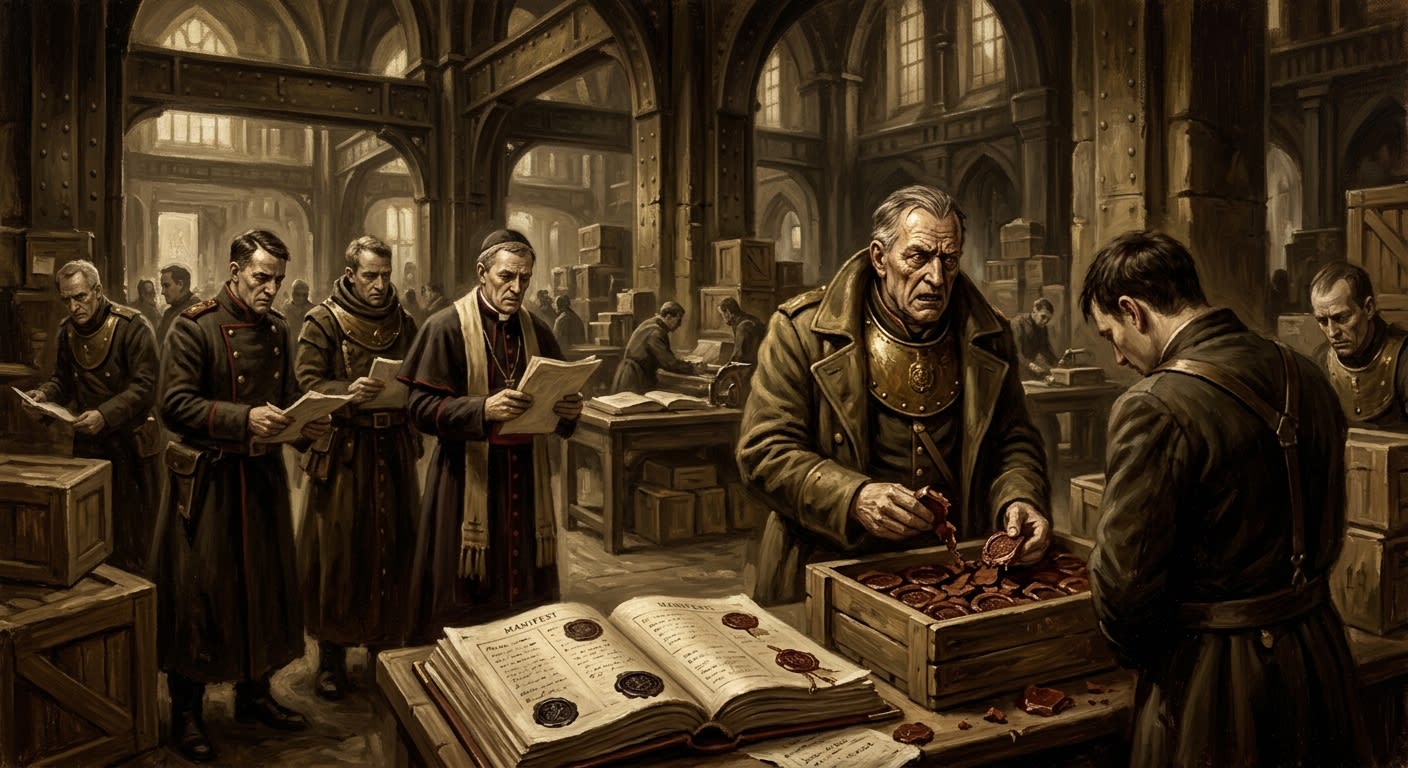
#On the Wax That Lied Correctly
The Counterfeit Wax Plague of A.S. 178 began with a seal that held.
This is the first indecency. A false thing ought to fail at once, preferably in a way that injures only the guilty and leaves a clean instructional stain for Doctrine. The false purity-wax (Unregistered) discovered at Bastion-Shipka and Bastion-Irongate did no such courtesy. It hardened properly. It took the stamp. It shone with the approved dull pearl sheen. It gripped the rite-sheet fibre and sat in the gasket groove with the placid arrogance of legitimacy. The Gasket-Hymn Mechanics used it because the official stock had not arrived, because the pipe was hot, because the pressure was climbing, because death rarely waits for a purchasing authorisation.
The Plague's name is bureaucratic theatre. No fever passed from man to man. No pustules rose under the nails. The contagion moved by crate, invoice, wax sleeve, night-cart, bribed gate clerk, and the small professional shrug of a mechanic who knows that a counterfeit gasket is better than a burst manifold and a sermon over bodies.
#On the Shortage That Manufactured the Sin
The Seal Standardisation Edict of A.S. 164 had promised safety after the Unhymn Infiltration. Every resonance line would receive blessed hymn-gaskets tuned to reject non-standard frequencies. Every seal would be marked, sung, checked, filed, rechecked, and counted by Bureaus whose confidence in their own counting remains one of the Synod's most expensive diseases.
The Edict created demand faster than Strasbourg created supply. Shipka needed seals for sleep-threatened thumper lines, ward plates, pump manifolds, rail-quarter conduits, and the wet culverts under the reed road. Irongate needed them for the Gasket Choir, where structural vibration does the work mortar is too proud to admit it cannot do alone. Official wax arrived late, short, sometimes melted, sometimes overblessed into brittleness by provincial shrine-workers desperate to improve a formula they had never understood.
The black market answered with admirable civic speed.
Wax-makers in rear workshops copied the Bureau recipe. They matched the resin. They matched the chalk. They matched the saint-dust ratio closely enough to irritate three laboratories. They stole stamp dies or copied them from apron impressions. They packed the cakes in linen sleeves bearing false batch prayers and passed them east through Tithes depots whose clerks became suddenly deaf to the sound of coin.
The only absence was the Sixth Canticle of Industry, which the lawful wax must hear, without interruption, while cooling.
Early Purity broadsheets described the counterfeit wax as chemically corrupt, materially unstable, and deliberately poisoned with demonic ash.
Correction: Bureau of Engineering assay found the wax metallurgically and chemically compliant with specification. The deficiency was liturgical. Purity retained the word poisoned in public postings because the phrase insufficiently sung lacked the desired gallows weight.
#On the Canticle Nobody Could Measure
The Sixth Canticle of Industry is a dreadful hymn, and I say this with the authority of a man who has suffered many sanctioned noises. It proceeds for seventeen verses through the genealogy of obedient matter, beginning with ore in the mountain and ending with a clerk receiving the delivery receipt in triplicate. Its theology is respectable. Its melody is a felony against the ear.
Doctrine insists the Canticle impresses obedience into the wax. Engineering refuses to say it does not. Bells claims the cooled wax keeps a minute acoustic memory of the recitation, detectable by trained instruments. Mechanics claim that good wax grips and bad wax crumbles, and that anyone wishing to debate obedience inside a live manifold should bring his own widow.
The counterfeit cakes gripped.
That fact threatened the whole polite fraud by which the Synod makes matter kneel. If unsung wax could hold a seal, then singing was paperwork with lungs. If singing mattered in ways Engineering could not measure, then every assay was an idiot wearing spectacles. The Plague forced the Bureaus toward a conclusion none could survive alone, so they chose enforcement.
The Line-Purists received the revelation with the radiant hatred of men whose sermons had been proved either sacred or useless. The Field Pragmatists received it by buying two extra crates before Purity sealed the market. The Diesel Resonance Plumbers received it as tradesmen receive all theology: by asking whether the seal would last until morning.
At Bastion-Przemyśl, fourteen suppliers were immured after tribunal proceedings so brief that one witness arrived after sentencing and was praised for punctual intent. Their workshops burned. Their stock was destroyed in sealed furnaces. The ash was weighed, tagged, and stored, lest counterfeit obedience escape as smoke.
Workshop Three yielded sixty-two wax cakes bearing a batch seal assigned to a lawful manufactury that had burned eleven years earlier. Under heat, the false seals softened into fingerprints. Seven matched no registered hand. One matched a Bell-Accountant then serving at Irongate, dead since A.S. 171. Bureau of Records amended the comparison table. Bureau of Purity burned the table.
#On the Living Hymn
The official remedy was the living hymn verification method. The mechanic sings the opening phrase of the Boundary Litany into molten wax. A Bureau of Bells accountant touches the hardened seal with a tuning fork. True wax answers. False wax sulks, rings flat, or confesses by failing to hum in the correct devotional posture.
So the notice says.
In practice, the method made a new economy. Bell-Accountants became gatekeepers of authenticity. Mechanics paid for faster readings. Plumbers paid for favourable readings. Quartermasters paid for no readings at all when the convoy was late and the frost was entering the pipes. A wax cake that could pass the fork became dearer than bread in three forward districts. A tuning fork went missing at Shipka and reappeared six weeks later in a tavern cellar, where counterfeiters had been teaching wax to answer.
The Bureau declared victory within two months. The shortages continued. The counterfeit wax reappeared within six.
#On the Plague's Present Residue
No serious mechanic trusts wax now. He trusts the ring, the seating, the bolt pattern, the witness chalk, the pressure note in the pipe, the sweat between his fingers, and the terror in the apprentice's face when the manifold begins to breathe. Wax is still used, of course. Distrust has never abolished procedure; it has merely made procedure more honest in private.
At Irongate, old mechanics keep Plague knives for shaving suspect seals. At Shipka, Wax Hands are taught to smell for false sanctity: resin too clean, ash too sweet, chalk too white. In Przemyśl, the wall where the fourteen suppliers were immured is inspected every Canticle Day. It has developed a soft pearly bloom in damp weather. Engineering calls it mineral efflorescence. Doctrine calls it warning. Mechanics scrape it off and sell it to apprentices as lucky wax.
Public anniversary notices state that the Counterfeit Wax Plague ended in A.S. 178.
Clarification: enforcement peaked in A.S. 178. The Plague became ordinary practice thereafter, which is the Synod's preferred method of ending scandals too useful to eradicate.
The forward bastions still run on shortage, ingenuity, terror, and stamped material whose holiness depends upon the honesty of men paid badly in rooms without witnesses. The seal holds. The wax remembers whatever it was paid to remember.