
#On the Law That Put a Choir Inside a Washer
The Seal Standardisation Edict of A.S. 164 was issued after the Unhymn Infiltration at Bastion-Shipka, when Syrion's servants discovered that a poorly maintained diesel resonance conduit could be made to carry sleep with the same obedient punctuality by which it carried sermons, alarm pulses, ward-thumper rhythm, and the pleasant little tremor that tells a frightened garrison the state still owns morning.
A district slept through dawn. The pipes had sung the order. This injured several doctrines at once, which is the only reliable method of making Strasbourg move quickly.
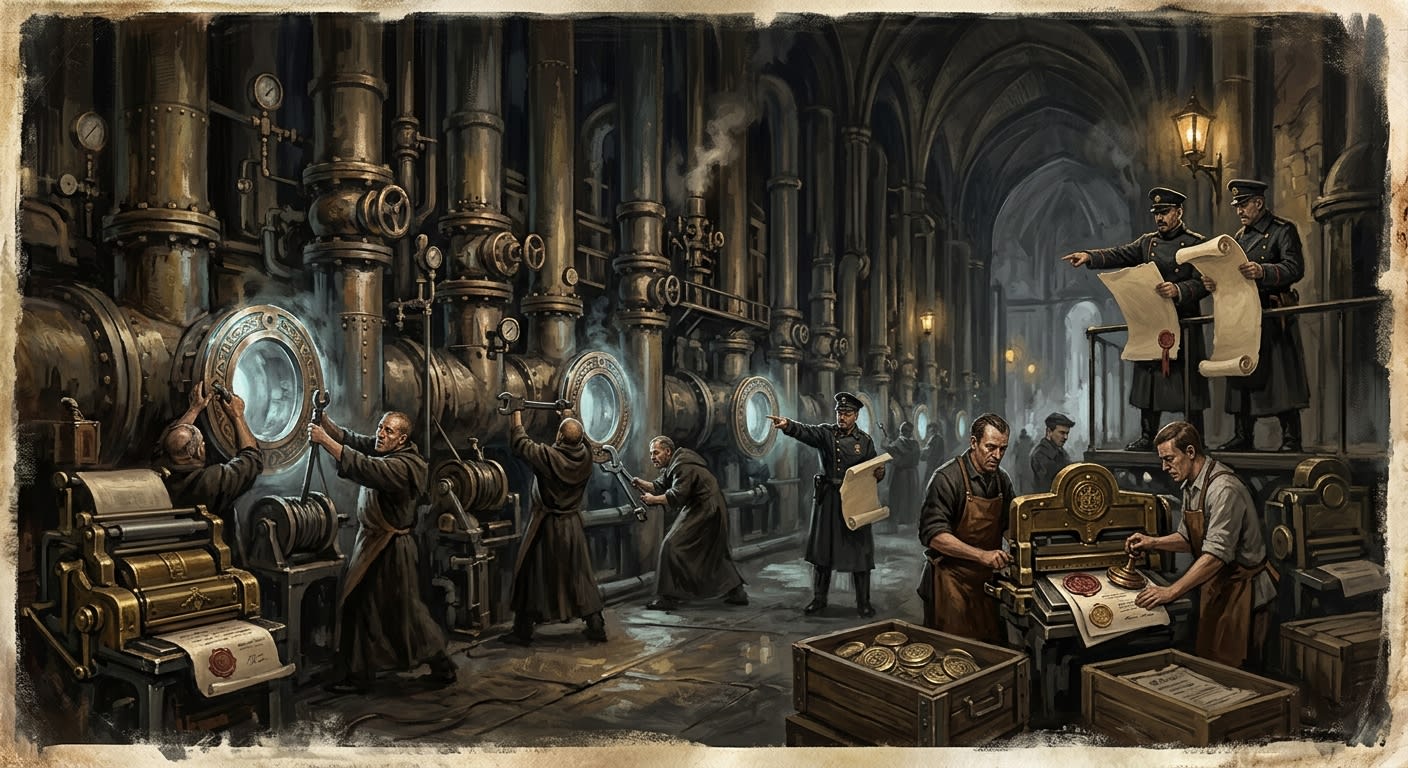
The Edict's command was severe and simple enough to survive committee: every diesel resonance conduit, thumper manifold, ward-harmonic join, sermon-feed coupling, pressure throat, and sanctioned vibration line across the Sagittal Line would be fitted with blessed hymn-gaskets tuned to reject non-standard hostile frequencies. Each seal would bear purity wax cooled under the Sixth Canticle of Industry, a triple office stamp, and a custody entry legible to Records, billable to Tithes, tolerable to Engineering, and sanctimonious enough for Doctrine.
#On the Gasket as Border Theology
A gasket, to the vulgar mechanic, is a ring that stops leakage. To the Synod, whose genius consists in making even rubber kneel, it is a border contract: pressure inside, atmosphere outside, sermon in the conduit, enemy cadence left begging at the seam. The hymn-gasket codified by the Edict was designed to hold that border with matter and song together. Rubber, waxed fibre, brass edge, saint-dust, salt-chalk, and a cooling hymn so long that several honest workmen have grown old during the third verse.
The lawful seal had three virtues. First, it seated under pressure without splitting when the thumper pulse rose during Matins load. Second, it carried a licensed harmonic memory, a tiny obedient echo impressed into the wax by the Sixth Canticle. Third, it rejected the known sleep-cadences recorded after Shipka, including the low returning interval by which the southern barrack district had been persuaded to remain in bed while alarms behaved like lullabies with badges.
The Diesel Resonance Plumbers received the Edict with the sour reverence tradesmen reserve for orders written by men whose boots are clean. The Gasket-Hymn Mechanics acquired ceremony, licence, audit exposure, and enough new forms to tile a chapel roof. The Bureau of Bells gained inspection rights over wax memory. Tithes gained surcharge authority. Purity gained a fresh class of criminals. Truly, a feast for the offices.
Public summaries state that the Edict “restored confidence in the Line's resonance infrastructure.”
Correction. It restored confidence in Strasbourg's ability to name a wound, invoice the bandage, and prosecute the man who tied it on without permission.
#On the Shortage That Arrived on Schedule
The Edict worked against the Shipka pattern. Let that be written, because truth, when properly harnessed, pulls propaganda more steadily than invention.
The specific Syrionic sleep-cadence of A.S. 163 did not recur in the treated Shipka lines. Ward plates rejected the known intrusion. Sermon-feed couplings stopped carrying the soft delay that had curled through barracks, kitchens, and alarm housings. Harmonic Listeners reported fewer false lullabies. The Line breathed easier for half a season.
Then the invoices matured.
Official hymn-gaskets cost four times the prior seal allotment. They required certified wax, licensed singing, office stamp dies, protected transport, audit witnesses, dry storage, and the kind of procurement discipline commonly found in sermons and nowhere else. Forward bastions received partial crates, wrong diameters, melted wax, overblessed brittle stock, or notices explaining that the material was en route, which is Bureau language for “imagine the gasket spiritually.” Irongate needed seals for chambers where silence can kill. Przemyśl needed them for lower engine pits and western ward conduits. Shipka needed them because Syrion had already read the pipes.
The black market answered before the second enforcement copy reached Munich.
Counterfeit hymn-gaskets appeared under lawful-looking sleeves, false batch prayers, borrowed saint-dust claims, copied stamp marks, and wax that could pass three assays while missing the one hymn the Bureau insisted mattered. Some failed. Some held. The ones that held were the dangerous ones, because failure confirms authority and success asks questions.
PURGED SUPPLIER NOTE — SHIPKA ROUTE, A.S. 165 Batch 44-C rejected by Bells: no Canticle memory. Installed during pressure rise: held seven days. Removed for evidence: district line began singing in children's voices. Reinstalled under emergency: voices ceased. Supplier immured. Gasket retained under sealed Engineering custody.
#On the Offices That Fed Upon the Edict
Tithes collected fines from counterfeiters and emergency users with equal appetite, proving again that sin becomes more legible when priced. Purity collected confessions from suppliers, mechanics, Plumbers, convoy clerks, two wax singers, and one porter whose crime consisted of carrying a crate with insufficient theological suspicion. Engineering filed exception after exception, each labelled temporary, each renewed until temporary achieved the dignity of architecture. Doctrine preached obedience over the new invoices. Bells touched seals with forks and listened for the wax to answer in the correct devotional posture.
The Edict's genius lay in its exception clause. Emergency substitutions were forbidden except where failure would endanger Synodal property, personnel, route continuity, or reputational integrity. This covered nearly every moment in a functioning bastion. The exception ate the rule with a napkin tucked at the throat.
The later Counterfeit Wax Plague of A.S. 178 was not a betrayal of the Edict. It was the Edict flowering in the soil prepared for it. A law that commands sacred material faster than sacred industry can produce it does not abolish illicit supply. It appoints it.
Training catechisms describe counterfeit gasket use as “deviation from the Edict's intent.”
Clarified. Counterfeit gasket use followed the Edict's arithmetic. Demand was mandated. Supply was insufficient. Punishment was profitable. The deviation lay in admitting the sums aloud.
#On the Edict's Present Condition
As of A.S. 201, the Seal Standardisation Edict remains in force across all seven bastions. Its forms have been amended, annotated, reissued, contradicted, harmonised, and blessed again with the patience of a bureaucracy teaching a corpse to sign. The modern hymn-gasket carries more stamps than surface. Plumbers still keep illegal stock in dry niches behind tool shelves. Mechanics still know which counterfeiters sing well. Bell-Accountants still insist wax can remember. The pipes still carry what the pipes carry.
The Edict saved lives. The Edict created crimes. The Edict gave Purity a cudgel, Tithes a purse, Engineering a shield, Doctrine a sermon, and the underworks a new exchange currency in gasket-rings. This is the Synod at its most efficient: wound, writ, market, gallows.