
#On the Quarter That Wore the Wrong Sin
The Angle Riots of A.S. 119 began with an iron that leaned two degrees from obedience. This is the cleanest version, and like all clean versions it smells faintly of bleach over rot. The event occurred in the southern districts of Bastion-Irongate, during a Bureau of Purity sweep conducted under the authority of the forward-zone identity regulations that followed the Paper Plague and the Compulsory Marking Decree. The quarter was poor, damp, overregistered, underfed, crowded with river haulers, gasket widows, warehouse boys, chapel washers, and those excellent civic insects who live beneath paperwork until the boot descends.
A team of hastily trained Geometry Brand-Smiths entered with frames, swatch plates, witness seals, and a set of irons later found to have been miscalibrated. Their task was ordinary: verify tri-marks against ledger entries, correct class drift, brand the unmarked, and make the district readable. They made it readable in the wrong grammar.
The error produced inverted doubles where identity singles should have stood. A mark of passage became a mark of second-category heresy. A labourer's wrist became evidence. A widow's forearm became confession. A child's ward-triangle became contamination by association because some junior functionary, blessed with ink and bereft of sense, decided adjacency was a form of doctrine.
#On the Sweep and the Iron
The sweep did not fall from nowhere. A.S. 112 had taught the Bureaus to mistrust paper. Forged transit passes at Bastion-Przemyśl had carried two hundred false identities into a garrison district and left eighty-seven dead. A.S. 113 had answered with skin. Every forward-zone checkpoint required a tri-mark: civilian, military, clerical, ward, penitent, pilgrim, condemned. The Bureau of Heraldry tripled the Brand-Smith Corps overnight, and overnight expansion is one of those administrative miracles best admired from outside the blast radius.
The Irongate team contained two licensed Brand-Smiths, five Frame-Hands with three-week certificates, six Angle-Runners recruited from ward rolls, and one Purity liaison whose report uses the phrase “adequate morale” three times before the first scream. The iron in question bore a valid serial. It had passed custody check at departure. It had been cleaned, heated, witnessed, and applied according to form. This is why the incident terrified competent people. Criminal tools explain crime. Legal tools explain government.
By second bell, eighty marks had been applied. By fifth, four hundred. By vespers, the first arrests had begun because Purity patrols saw second-category marks on citizens whose records had not yet followed them from the Brand-Smith desk to the enforcement cart. Enforcement outran correction. It often does. Enforcement has horses.
Initial Purity abstracts described the southern-quarter markings as “valid until challenged.”
Withdrawn by joint Heraldry-Records review. The marks were invalid at application. They remained operationally active until challenged, which is a different sentence and a colder one.
#On Self-Executing Evidence
Standing Order 22-D is the hinge on which the Angle Riots broke. The Order treats certain marks as self-executing evidence: the body bearing the sign may be detained, transported, punished, or destroyed before documentary review if immediate security requires action. Immediate security is a large cup. The Bureau pours freely.
Three hundred of the mis-marked were detained by Lictors of Purity before the error reached the quarter office. Forty-seven were transferred to the Paper Mines of Ulm. Eleven were executed. Their names survive in three forms: one internal casualty schedule, one correction ledger bearing the phrase “pre-review irreversible disposition,” and one wall-prayer scratched behind a shutter in the district where the limewash refuses to hold.
CORRECTION LEDGER — SOUTHERN IRONGATE, A.S. 119 Subjects executed under Standing Order 22-D before geometric invalidation confirmed: ███████████ Age range: █ to █ Confession records: clean █ / pending █ / absent █ Disposition after review: █████████████████████████ Recommendation: avoid public enumeration
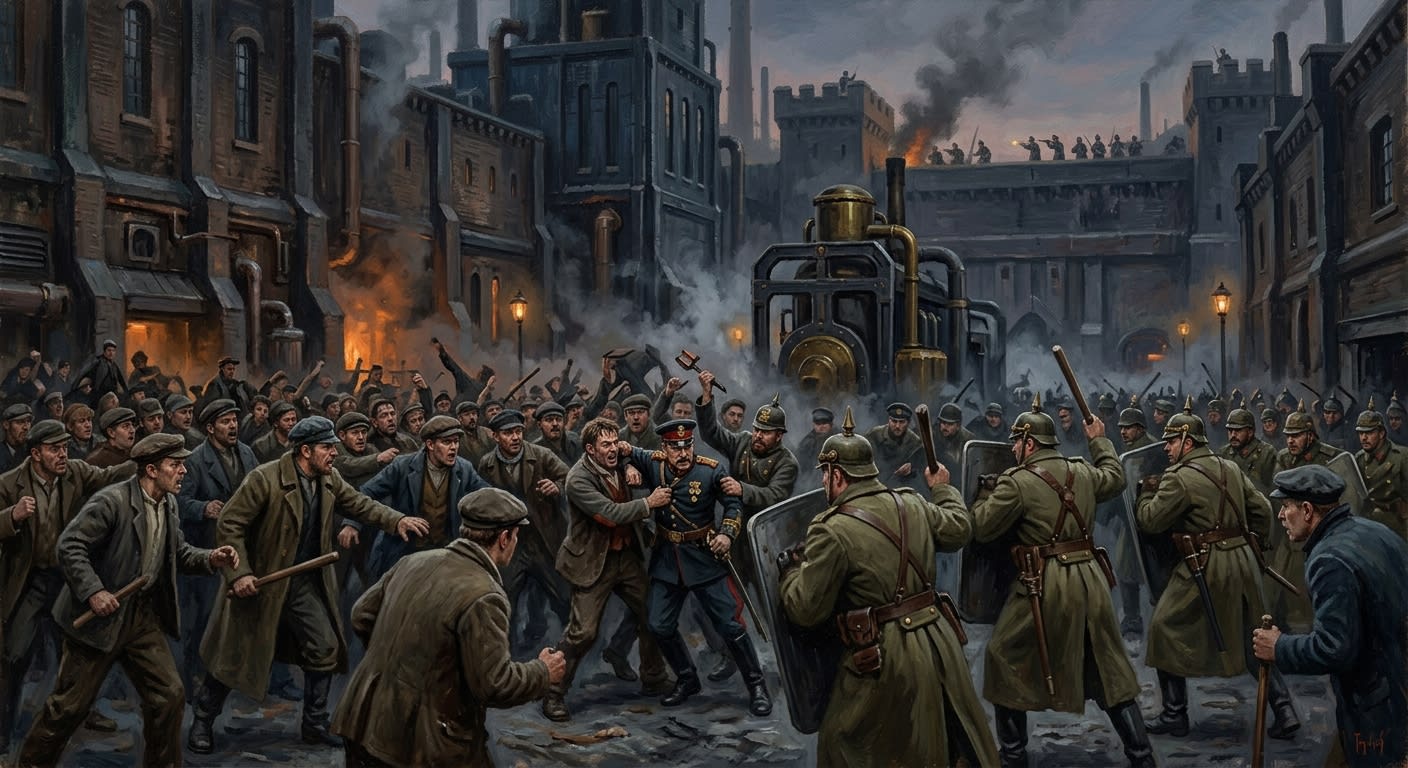
The riot began when a detained gasket widow returned from a holding cellar with the wrong mark blistered on both arms and her husband's pay seal rejected at the ration arch. She struck the arch clerk with a brand frame. This detail appears in all accounts because it is small enough to blame. The larger truth, that a quarter had watched its own skin turn against it by order of lawful tools, was less convenient.
#On the Riot Itself
Irongate riots badly. The fortress is a gorge, a lung, a throat of stone and sound. Crowds do not spread; they compress. Noise does not dissipate; it travels through vents, stairwells, gasket chambers, drainage cuts, and those excellent little official tunnels that exist in no public plan and in every smuggler's memory.
By nightfall, the southern quarter had seized three brand carts, burned two witness desks, and dragged one swatch plate through the street tied to a rope like a captured banner. The chant crews in the Choir Nave faltered when the shouting entered the lower vents; pressure gauges trembled; three minor gasket seals cracked along Transit Spine Level Two. The Bureau of Engineering requested calm in technical language. Purity requested permission to fire. Heraldry requested its irons back.
All three requests were granted in the order least likely to preserve life.
The first volley struck the bridge-steps near a soup chapel. The second volley struck people running from the first. The third volley was filed as acoustic confusion because Irongate's tunnels returned the command twice, once in the officer's voice and once in a lower register that every survivor refused to describe. The riot lasted nineteen hours. The official disturbance lasted six. Time, in Bureau reports, behaves better than citizens.
#On Correction
Correction required a new profession because apology was cheaper in personnel than in doctrine. The Re-inspection Brand-Smith was born from the Angle Riots: a specialist trained to verify existing marks against ledger records and overlay corrective triangles with a margin of error of two degrees of arc. The procedure is intimate, surgical, and spiritually insulting. The citizen presents the injured mark. The Brand-Smith clamps the frame around scar tissue. The correction is burned through healing flesh. The amended mark must read as correction rather than second offence. If it fails, the body now carries a quarrel in geometry.
Tool-serial tracking also emerged from the inquiry. Every branded iron had to be traceable to maker, issue desk, chapel, transport, field custodian, heating station, and return ledger. This reform was praised as decisive, which is how one knows it arrived after the bodies had cooled.
Public notices claimed all mis-marked civilians were “restored to prior standing.”
Corrected in restricted commentary. Prior standing cannot be restored to the executed, the transported, the infected, the scar-split, the widowed, or the citizens whose neighbours learned to read second-category heresy on their skin before the correction seal arrived.
The eleven dead remained dead. The forty-seven sent to Ulm were reclassified as “transfer irregularities under remedial review.” Three returned over the next decade. None permitted inspection of the corrected mark. One lacked both forearms.
#On the Present Lesson
By A.S. 201, every Brand-Smith apprentice knows the Angle Riots as warning, excuse, and professional myth. Licensed Chapels invoke the riot against the Quick Burners: haste deforms justice. Quick Burners invoke it against the Chapels: bottlenecked correction kills faster. Mercy Branders cite it to clients whose marks can be shaded down before Purity sees them. Shadow Angle crews use it as advertisement. If lawful irons can lie, why not pay for a lie that loves you?
The Bureau's official lesson is tool custody. The deeper lesson is more poisonous: a mark need not be true to act. Once the skin has spoken in the state's alphabet, the body must obey the sentence until another office finds time to revise it.