
#On the Drain That Learned Custody
The Ash Canal is the southern runoff channel of the Cloister of Miscounted Beads, a narrow black watercourse cut below the Dorm Row drains, chapel waste sluices, yard gutters, fever sinks, and municipal embarrassment of Strasbourg’s western pilgrim intake. Public maps call it a sanitation cut. Cloister clerks call it the south boundary. The Outer Watch calls it the wet side. Detainees call it what it is: the place where the Cloister throws away what still has a name.
It began as drainage after the A.S. 94 western-gate surge, when Records and Pilgrimage discovered that enough waiting bodies will produce mud, vomit, candle scrap, spoiled grain, fever cloth, old bandage, failed petitions, and a theology of smell. The original ditch carried wash-water from the Lost Procession Yard into a municipal culvert. By A.S. 112 it had acquired brick lining. By A.S. 134 it had acquired hatches. By A.S. 187 Records praised its efficiency in draining rain and blood from the Yard without specifying which fluid prompted improvement. By A.S. 201 it had acquired smugglers, fever, Watch cuts, Quiet Thread rites, and a reputation for returning small objects cleaner than they entered.
The Canal’s water is black-grey in ordinary weather, tar-brown after rain, milk-pale during lime wash, and ink-shot during Anomoly Weeks, when covered wells, salted basins, and frightened clerks send their unwanted liquids south. Ash gives it name. Records gives it denial. Pilgrims give it beads when they still believe offerings work upon infrastructure.
#On Stone, Sluice, and Boundary
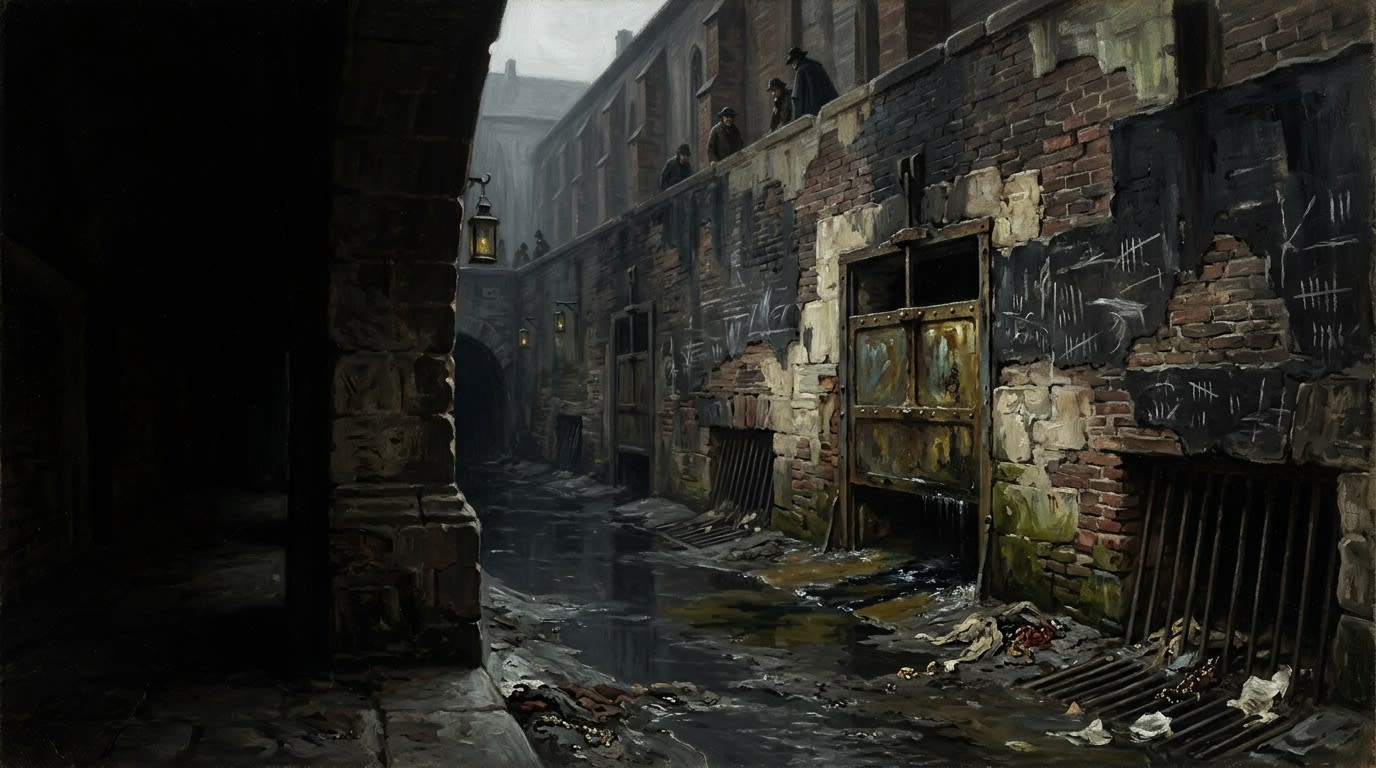
The Canal runs along the south wall from the Yard gutters, past the Dorm Row drain mouths, beneath the chapel side run, through the Watch hatch, and into a covered municipal channel whose downstream outfall no office has traced in public since A.S. 158. Its upper reach is open to the sky for sixty-seven paces, walled with old brick, patched stone, iron staple, and a later tar lining that blisters in summer. The open reach is where expelled sleepers gather, brokers signal, fever rags snag, and rats negotiate the city’s truest commerce.
The hatches matter more than the water. The Yard hatch takes mud, blood, loose straw, torn wrist ribbons, and those little paper squares on which pilgrims write names they are afraid to submit. The Dorm hatch takes wash slop, lice water, grain scrap, and the occasional bead passed through a floor drain by a hand too hungry to be pious. The Chapel hatch is smaller, iron-collared, and keyed from within. It receives grey basin water when Keth has not asked for it, when Purity has not arrived loudly enough, or when everyone present wishes to sleep before dawn. This last motive accounts for more theology than catechists admit.
The south wall above the Canal carries three kinds of marks. Official chalk shows Watch patrol turns, hatch-seal dates, tar repair needs, and fever cordon stripes. Broker chalk sits lower: two dots for berth sale, a slash for sponsor interest, a hooked line for names warm enough to sell. Quiet Thread marks are lowest and often washed half away: single knots drawn in ash paste, cord loops pressed into soot, fingernail circles around drain bricks where someone has listened too long.
During ordinary weeks the Canal is boundary. During sealed weeks it becomes doctrine. The Ash Canal hatch is nailed and blessed. Chains double at the south gate. No name passes through the wall aperture. No watchman answers if called from the water. This rule was added after a runner opened a view-slit to a voice wearing his own armband and learned, too late, that pity has hinges.
Municipal sanitation reports describe the Canal as “non-accessible from Cloister interior except by maintenance hatch.”
Corrected for restricted circulation. The Canal is accessed by maintenance hatch, floor drain, broker crawl, child passage, Watch ladder, and any desperation thin enough to fit through bad masonry. The phrase non-accessible means only that the official key is kept somewhere respectable.
#On What the Canal Carries
A canal carries more than water when built beside a place that corrects lives for money. It carries refusals. First strings cut loose before second-string issuance. Beads swallowed, passed, recovered, washed, and sold. Wrist tags stripped from those who fear the lawful name more than hunger outside the wall. Complaint slips too late for review. Candle ends, lice combs, counterfeit sponsor marks, fever tokens, grey wax, chapel salt, and tiny folded prayers addressed to saints with poor canal access.
The Dorm Rows feed it constantly. Their sloped floors were praised as sanitary design, though the praise came from men who had never slept near a drain. Straw, hair, vomit, cheap paper, and wax scrap clog the grates. Children learn not to sleep close. Adults learn after losing something. During nights after candle-snuff, a bead may click against brick under the grating though no string has been issued in the Row after dark. The matron records rat activity. The rats file no objection.
The Chapel of the Second String feeds it more carefully. Basin water is meant for grey jars when anomaly is useful, for Purity when blame is required, and for the Canal when custody would make questions multiply. The water smells of grave-soil, road mud, shrine rot, and once, according to a novice whose transfer was immediate, warm bread. The novice said the smell made him homesick. The basin answered before anyone could silence him.
CHAPEL RUNOFF NOTE — A.S. 200 Grey basin contents transferred to Canal after third bell. Downstream Watch reported beads collecting against hatch grille in count of ███. No beads issued that night matched recovered material. One bead bore name: █████████████, not yet entered at Intake. Disposition: grille cleared; report copied to Vault; canal scrub postponed.
The Anomoly Protocols mention the Canal with an economy I resent. If a basin rises and no office claims the jar, the grey water may be released south. If an active string continues shifting after three treatments and Keth refuses storage, disposal may be considered. Considered is one of those words by which bureaucracies prepare a drowning and call it deliberation. Strings do not always drown. Some lodge in brick joints and warm the wall.
#On the Walk and Its Markets
Ash Canal Walk is the strip of ground outside the south wall where respectable people do not stand unless carrying a warrant, a corpse, or a lie polished enough for daylight. It is a crooked boundary lane of tar sheds, broken cobbles, refuse steps, patched awnings, vinegar carts, fever sleepers, broker boys, Watch informants, and old women selling warm broth whose contents have reached a private understanding with mercy.
The Grave-Name Market uses the Walk after rain. Dead names surface during wet weeks, and wet weeks make families foolish. A broker may sell news that a grandfather’s name appeared on a slate, that a wife’s bead washed from the hatch, that a sponsor mark has become recoverable for a price. Most news is false. The true news costs more and ruins sleep faster. The Market prefers twilight, when the Canal’s surface reflects enough wall to look official.
Outer Watchmen patrol in pairs, clockwise, at first bell, third bell, dusk, and after snuff. The Canal side is worst. Damp makes boots heavy. Refuse hides knives. Expelled sleepers know which men take coin and which take only fear. The Watch calls its cuts informal hazard compensation. Records calls them unverified allegations. The canal calls them nothing and accepts the dropped purses.
The Quiet Thread works nearer the drains. Its listeners kneel where the water runs under brick and claim the count below differs from the count above. They lower beads on black thread, retrieve them warm, and insist that the Canal carries first-string memory toward a place the Vault cannot seal. This is heresy with wet knees, which makes it neither humbler nor less dangerous. A doctrine does not improve because it smells of rot.
#On Fever, Smuggling, and Official Blindness
Fever travels along the Canal with better papers than most pilgrims. The water breeds bites in summer, chill in winter, and a grey rash in children who play near the lower grilles before their mothers can afford sense. Mercy blames crowding. Records blames unauthorized sleeping. Pilgrimage blames civic refusal to fund proper outflow works. The municipal office blames Cloister discharge volume. All four are correct enough to avoid responsibility.
Smuggling uses the same grammar as drainage: enter where pressure is high, move where walls are forgotten, emerge where inspection has grown bored. Beads pass outward in wax balls. Sponsor notes pass inward in reed tubes. Candle stubs, counterfeit tags, Quiet Thread warnings, berth payments, and little packets of salt move through grates whose repair has been pending since A.S. 193. The Watch discovers contraband when underpaid, audited, or insulted. Otherwise the Canal performs civic circulation.
The worst trade concerns the half-cleared: detainees whose names have passed one desk, failed another, and acquired enough ambiguity to be useful. A half-cleared tag can buy an hour outside the wall, a false berth, a market dead-name, a child’s removal, or the disappearance of someone who was already nearly paperwork. Ash Canal brokers specialise in nearly. Nearly released. Nearly dead. Nearly guilty. Nearly remembered. The Synod’s mercies have seams, and the Canal is where men learn to pick at them.
A Cloister Chapter memorandum states that no detainee has ever exited through Ash Canal drainage.
Amended after A.S. 201 inspection. No detainee has ever exited through Ash Canal drainage in a condition all reviewing offices agreed to describe as exit. The amendment preserves the record and insults the reader, as good amendments should.
#On the Present Water
As of A.S. 201, the Ash Canal is overfull in rain, undermaintained in law, overused in practice, and warm at the Chapel run after third bell. The post-A.S. 198 surge has increased perimeter sleep camps, drain clogging, broker chalk, fever wash, and hatch tampering. Five Anomoly Weeks are projected. Tar stores are low. The south grille is bowed. The outer culvert knocks during rain with a rhythm the maintenance office attributes to trapped debris. Keth has asked that no one clear it without her present.
I inspected the Canal after a sealed week and found the water carrying wax petals, two ration slips, a child’s ribbon, chapel salt, and one bead that rolled upstream three inches before stopping at my boot. The Watch sergeant advised me not to touch it. I told him I had no intention of improving his report with my corpse. He seemed relieved. Men in minor offices love an intelligent superior; they meet so few.
At the Chapel run, the stone sweated though the morning was dry. At the Dorm grating, a woman outside the wall whispered a name into the drain and waited. No answer came. She paid the broker anyway. Hope is the only currency more debased than ash and more widely accepted.
The Canal moved south, black and obedient, carrying what the Cloister had declined to keep. Behind us, at third bell, the hatch was nailed for the week. Beneath the nail, something clicked once against iron.