
#On the Factors Who Are Not a Guild
"Query: Do the approved preservation factors constitute a guild? Response: Not as of the conclusion of this query." — Lübeck compliance register, marginal response, unsigned.
The approved preservation factors of Lübeck lease the brine cellars beneath the old salt exchange. They keep the city's fish, pork and winter brine from spoiling. They have no charter, no seal, no feast day, no right of mutual defence, no songs and no legal memory. They are a trade with its fraternity surgically removed, in the way a surgeon cures a gangrenous hand by declining to leave it attached. This survey is entered in A.S. 201. The roster will have changed before the ink dries, and it was designed to.
The membership changes whenever anyone asks whether the factors constitute a guild. The question need not be hostile. A visiting assessor wonders aloud. A harbour priest asks whether the factors want a blessing together. A widow asks who should receive her complaint about a spoiled cask. Within the week come resignations, reassignments, fresh lease signatures, and one or two newcomers with clean cuffs who know the brine tables suspiciously well for men hired on a Tuesday. The Bureau of Records calls this responsiveness. The Bureau of Tithes calls it audit cooperation. The dockworkers call it the same cellar with new boots. The dockworkers carry the barrels, so their theology has calluses.
In the only sense the Synod will certify, the factors descend from nobody. They took up their leases after the Year of Smoke in A.S. 180, when the Salters' Compact filed voluntary dissolution for insufficient membership. The same successor form now reaches into the old grain trade as well, under the eye of the tariff chapel. The attentive reader will conclude that the factors are less a company than an instrument, a way to keep a trade breathing while denying it a body.
#On the Cellars Beneath the Old Exchange
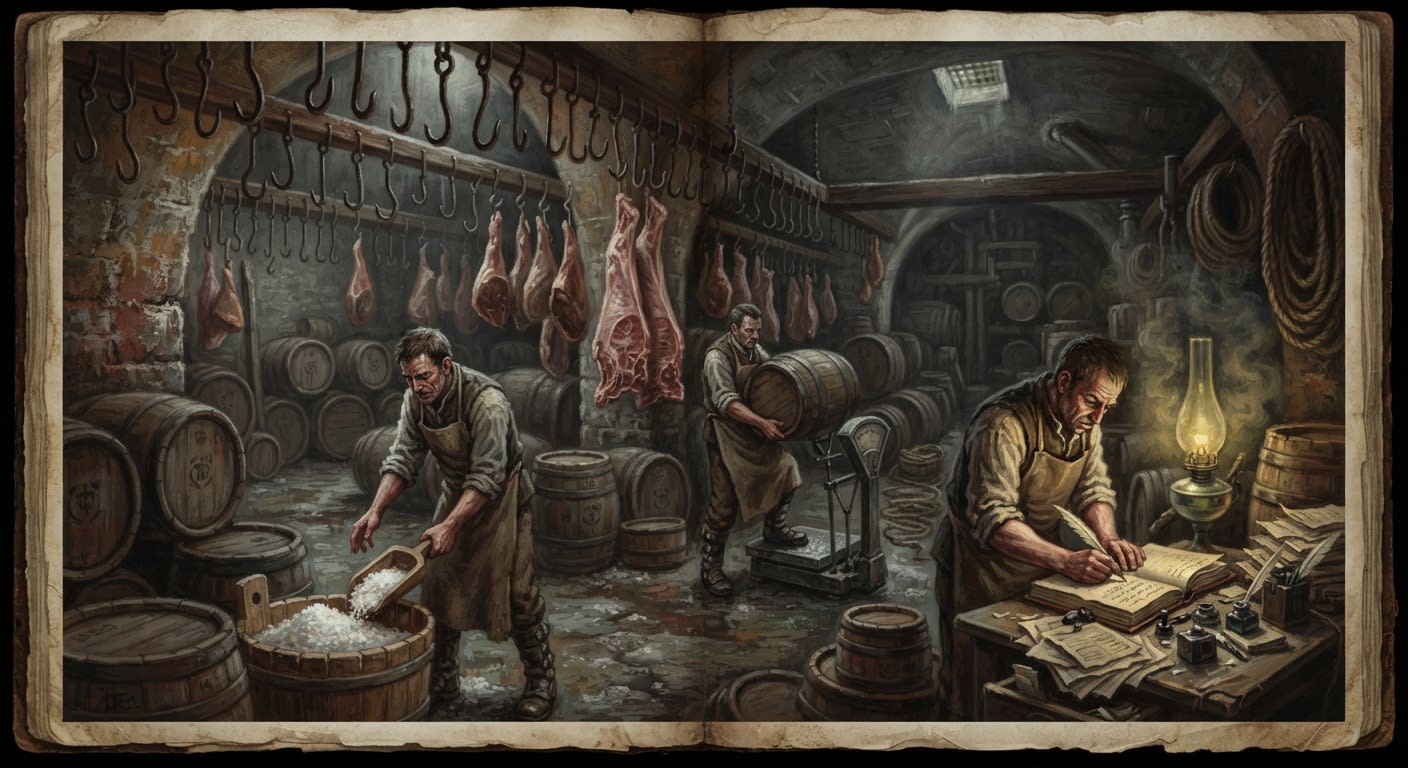
The cellars are what they were. Salt crusts the stone to shoulder height. Iron hooks still hang in rows from the vaulting, and barrels stand in ranks like a chapter waiting for a bishop who will not come. The air stings eyes and throat, and a visitor who breathes through the mouth tastes the room for an hour afterward. Fish goes in wet and comes out as supply. Pork goes in as a pig's misfortune and comes out as a garrison's winter.
In A.S. 180 the Synod burned forty years of harbour records, and it could have burned the cellars with them. It kept them, because only a man who has never wintered on the eastern road would burn a salt cellar. Lübeck supplies Bastion-Königsberg and Bastion-Brest along the northern corridor, and no fortress holds its wall through February on fervour alone. The brine had to keep working. What had to stop was the brotherhood that had learned to pickle debts, names and correspondence in the same vats.
So the Synod purged the room of its congregation and kept its liturgy. The Compact's benches were carried out. Its minute-book went upstairs to Records. Tables arrived, and scales, and lamps with glass chimneys, so that no one could say the ledgers were illegible for want of light. Everything else stayed, the hooks included. Salt has no loyalty to its owners. It serves whoever pays for the cask.
#On Approved Error
The factors keep books that look human, which is harder than it sounds.
In Lübeck a perfect ledger is an accusation. The Bureau of Purity looks at spotless accounts the way it looks at a saint whose relics refuse to decay on schedule. Something is being kept too well, and whatever keeps it well must answer for its methods. The Salters taught the city that tidy brine accounts could hide a debt, a favour on the roads, or a person. Purity learned that lesson with a convert's zeal. The factors, who wish to go on eating, learned the counter-lesson.
A compliance clerk therefore supplies each factor ledger with its imperfections. There is a brine thumbprint on the third leaf, and a correction scratch in the cod tally. One figure is transposed, then corrected in a different hand with the small, irritable flourish of a man who dislikes his colleague. There is a water-ring from a mug that was never set down. These errors are drafted, scheduled and inspected. They exist so that when Purity turns the pages, it finds a clerk and not a cipher.
The remaining controls are the Compact's own devices, turned outward. Brine concentration codes were once a private grammar of debt. Now they appear only on printed forms that Tithes can read without a key. Tide allowances were once a pleasant fog in which a cellar could lose nineteen measures of salt and a broker's debt in the same fortnight. Now they need two signatures from two men who dislike each other by assignment. Hospital transport salt goes on the scale before the cart is loaded and again afterward, so any difference must be explained in pounds, which are harder to pray over than percentages.
#On What Survived the Compact
At its last quarter-roll before the Smoke, the Salters' Compact counted nineteen voting members. Four entered private contracts under approved preservation factors. Three left for relatives in Danzig who denied being related to them. Two were listed as ill. One took monastic vows. Five signed the dissolution instrument. The last four survive only as scraped places in the minute-book.
The four who took contracts brought their hands with them. The Synod did not want their brotherhood, but it could not afford to relearn curing from a pamphlet. So the methods survive with their teeth filed down. The old concentration tables remain, stripped of their second meaning. So does the old instinct for telling whether a cask sweated honestly or was helped. So does the old knowledge of how much salt a body needs to travel.
That last knowledge matters most, because the factors hold two contracts the Compact once used as cover. Hospital preservative moves under Bureau seal and is weighed twice. Corpse salt goes out for the battlefield returns, so that the dead of the eastern bastions reach their families recognisable enough to mourn. Under the Compact, the hospital cart and the embalming store were ways of moving a man who had not agreed to be called cargo. Under the factors, both categories are legal, logged and dull. The Synod calls this reform. It has also kept both categories on the books, which a cynic might call storage.
The approved preservation factors are private contractors who took over the salt trade after the Salters' Compact ended harmlessly through insufficient membership.
Clarified. The factors are private contractors in the sense that a leashed dog walks itself. The Compact's membership became insufficient after interventions filed under no issuing office. The factors were approved to inherit its supply and forbidden to inherit its fellowship.
#On Oversight Without an Office
Four Bureaus believe they govern the factors. Records holds the reconstructed brine books and admires the coincidences in them. Tithes holds the salt surcharges, the harbour dues and the audit calendar, and thinks the factors its best-behaved tenants. Purity holds the fear that keeps the ledgers stained. Each is right about its share.
The rest belongs to the Bureau of Shadows, the office that does not exist and yet sent eleven Night Wagons out of the harbour between final peal and third hour in A.S. 180. What it owns is the absence around the factors. Its auditors visit no office, because there is none. They sign no register, because a signature would admit that someone came. Clerks report a dryness at the foot of the stair, a candle flame leaning toward nothing, a page turned in a book no one was reading. They enter it as cellar draft. The phrase has become customary. Clerks invent customs when the alternative is testimony.
SHADOW EXTRACT — SALT CELLAR ANNEX, FACTOR SUPERVISION Factor roster changes since A.S. 180: ███ Enquiries regarding guild status, logged: ████ Hospital covers retained under seal: ██ Corpse-salt weight variance, eastbound returns: ███ lb; unexplained: ██ Former Compact hands under contract: ████ (retained for utility) Instruction: keep the trade alive. Permit no fraternity. Rotate the roster before it learns to remember.
#On the Present Use
Winter comes to Lübeck every year, and every year the factors are ready for it. The brine is mixed to form and the pork is packed. Naval stores go down to the quays counted and stained. Barrels roll east to Königsberg, or past Warsaw to Brest, some under seals that nobody on the route wants to break and nobody at the far end discusses. The dockworkers load those barrels with particular care and no curiosity. The Synod has never bought better compliance for less.
The Grain Merchants became a tariff chapel. The Coopers became a school that teaches children volume and quiet. The Salters became a lease. Of the three, the lease is the most honest, because it claims no piety. It promises only that the room will go to whoever can keep the salt moving and forget who moved it before.
The Compact's sin was never the salt. Salt taught its keepers to preserve, and men who preserve things end by preserving one another. Take away the one another, and what remains is a service.