
#On the Bay and the Western Shore
The Bay of Biscay is the Atlantic's great wet elbow. It bends between the western French shore and the northern coast of Iberia, and it has never once asked the Synod's permission to be rough.
The shores are ours, and every map agrees on that. The French coast running south from Brittany and the Iberian coast running west toward open ocean both lie in Zone 1, the western heartlands. Here the Sagittal Line is a rumour brought in by conscription officers, and a Sin-General is something seen in a broadsheet engraving. Behind the shore lie grain country, salt country and vine country. Aquitaine sends the Garonne down toward estuary fog with barges on its back. The harbour towns keep their courts, customs sheds, fish-halls and saints, and they keep all of them damp.
The water is another matter. Zone colour stops at the tideline. No Bureau has sealed a boundary across the open bay, sounded it to the satisfaction of Records, or persuaded it to hold still for an inspection. The bay lies west and south of the Channel, beyond the narrow crossing where Calais and Dover glare at one another like rival sacristans. It is a different sea with a different temper. Its reaches are wider and its swells longer, and it is administered chiefly by weather.
The Line is very far away. The next convoy window is not.
#On the Cargo That Goes East
On the Biscay shore, safety is a logistical term, and it is earned in brine.
The French seaboard sends salt, rope, timber, cured fish and sailors. The Iberian ports add cork and wool. The Atlantic plate records the most instructive of these goods, and I repeat the example because it smells: a barrel of Biscay herring, salted under a harbour court's seal, turns up weeks later as a ration line at a bastion depot. The Atlantic account gives three weeks for that barrel. I certify that barrel and no other. The sea keeps its own timetable and files no copies.
Follow the barrel. It is packed on a quay that stinks of gut and tar, stacked on wet boards and branded with the court's mark. Then a clerk enters it in a harbour ledger. His vellum has been treated against damp, and it curls anyway. After that the barrel waits for a manifest, a berth, an escort and a change in the weather. Then it goes aboard beside other waiting things: western grain, coal, net-cord, medical stores, chain, and pilgrims with their licences sewn into their coat linings. Diplomatic pouches go too, bound for places where Synod ink must meet British ink and pretend to enjoy it. Not all of this begins on the Biscay shore. All of it depends on the water behaving long enough to be crossed.
The Bureau of Tithes counts the barrels at the quay. The Bureau of War counts them again at the depot. Between the two counts lies the bay, which keeps no ledger at all.
#On the Bells That Escort It
The ships that bring the barrel through are mostly British.
The British Crown is an independent allied sovereignty. It stands outside our jurisdiction and never signed the Concordat, and it owns a navy whose competence the Bureau of Doctrine treats as a pastoral inconvenience. The Royal Fleet answers finally to King-Warden Aldric III at Canterbury. It lists the Bay of Biscay among its principal theatres, alongside the Channel, the western approaches, Gibraltar and the western Mediterranean. These are neighbouring waters and in no sense the same water, and the Fleet does not confuse them. Its patrols run from the Dover Strait down to the bay. The Bureau of War credits it with roughly three hundred warships of several types. With rare wisdom, the Bureau declines to guess how many are in the bay on any given morning.
The approaches to Biscay are less controlled than the Dover Strait, and the Fleet's own account admits as much. Out there it works by patrol loops, convoy windows, concealed watch stations and informant routes whose names do not survive Synod copying. A British escort captain tells a Synod master to wait for bells. The master objects, and the cargo waits all the same. It drips on the quay while the rope swells, the tar softens and the purser composes his grievance in three drafts.
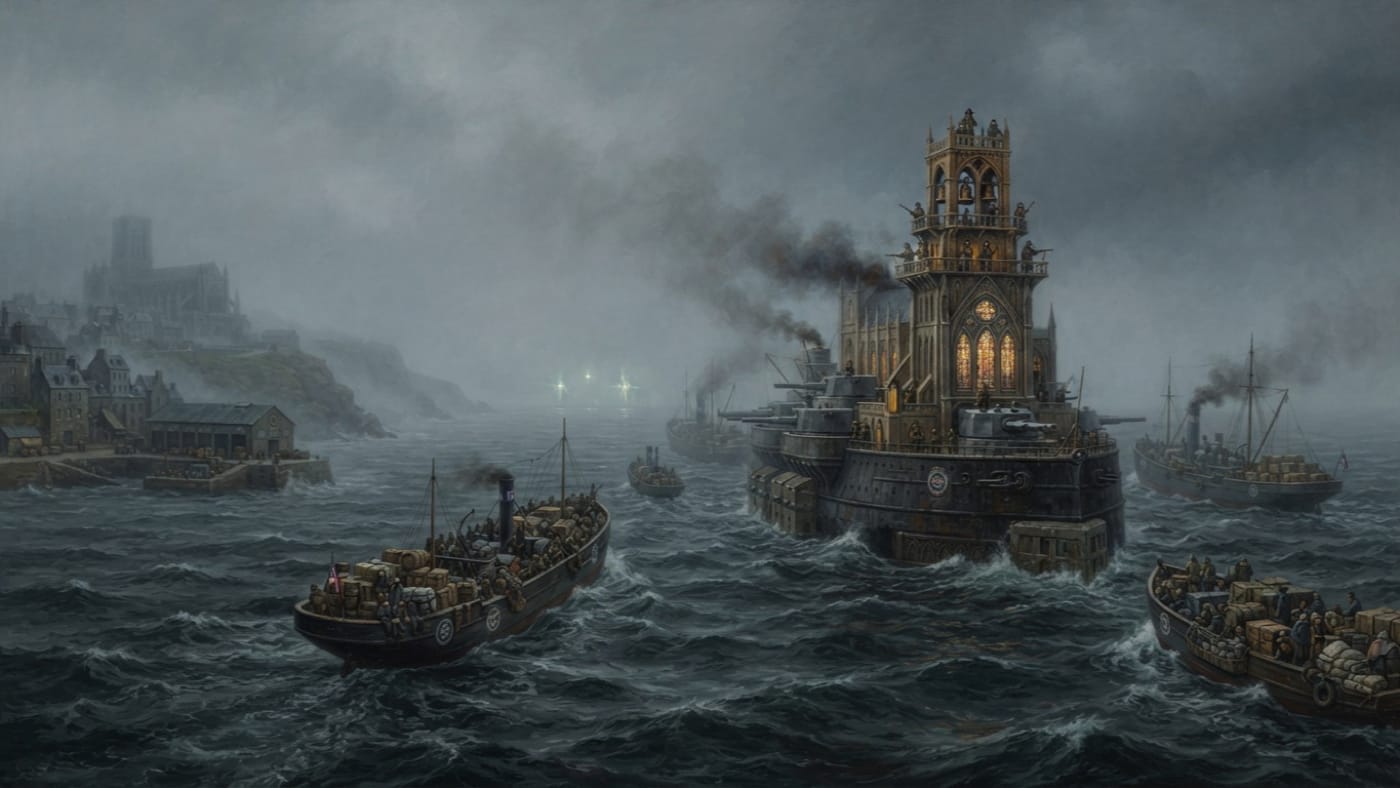
Then the silhouette comes up out of the grey. A Cathedral Ship on escort cannot be mistaken for anything else. Guns line the hull. The chapel sits amidships with its windows lit. A bell-tower rises above the quarterdeck, where a sane continental architect would put nothing heavier than a flag. Below the waterline runs the reliquary-keel. The British decline to explain it, and our Bureau of Engineering continues, at great expense, to fail to copy it.
Each part has its work. The guns deter pirates, who are theologically simple. The chapel keeps the crew in order, takes in the wounded and hears judgment from its altar steps. The keel gives the hull a documented resistance to sorcerous attack. The reports say resistance, and the Bureau of War has learned not to write "immunity" in anything a widow might read. The bells belong to the Lantern-Ringers, Britain's armed sacristans, who keep alarm and cadence and hold the tower stair with bronze maces. In Channel conditions, fog has been measured receding under their sequences. No Synod instrument has recorded whether it does the same off Biscay, over longer swells and in front of fewer clerks. The British have not volunteered an answer, and their bell schedules remain withheld.
A Bureau of Doctrine position paper described British convoy assistance as "auxiliary maritime support."
Corrected in the sealed War annex to the Cathedral Ships entry. Losing British convoy cooperation would cut western grain throughput by a classified fraction. Doctrine may keep "auxiliary" for use in sermons.
#On False Lights and Uncounted Water
Most of what drowns a man in Biscay is ordinary. The bay turns out gales with a craftsman's pride. There are long swells that open seams, shoals, collisions and fire in a hold of lamp oil, along with pilots drunk on the wrong night and masters who would not wait for bells. None of this calls for a file in the Bureau of Shadows. It calls for caulking, patience and the fear of the Creator, applied in that order.
Then there is the other ledger.
The Atlantic plate records false lights on open Biscay water. That attribution is the whole of the record: lights on the open bay that no vessel, harbour or beacon accounts for. The same passage speaks of bells answering from places with no tower, and of manifests arriving dated in advance. Those reports belong to the wider ocean and its paperwork. The passage does not place them in the bay, and I will not tow them there to improve a paragraph.
No source names what burns out on that water. No creature has been certified, no drowned city catalogued and no cause filed. The thing beneath Calais is called the Undertide, and it belongs to Calais and its chalk. The bay has not been assigned to it, to any Sin-General, or to any other named horror of the northern seas. Until Records rules otherwise, a light is a light, and Records has said nothing.
A sensible master counts his hulls at dusk and again at dawn. If the numbers agree, he says nothing to anyone carrying a notebook. If they disagree, he says less.
#On Jurisdiction and the Present Passage
Every quay on the Biscay shore flies a Synod seal. Every harbour court brands barrels under our authority. Customs is ours and tithe is ours, and so is the fish-stink on the harbourmaster's cuffs. Then the barrel goes up the gangway, and the sovereignty stays behind on the quay.
Out on the water, a Cathedral Ship keeps the convoy under a crown that never signed anything of ours. Dutch pilots from the Netherlands turn up in some logs of the western approaches, and they know fog roads marked on no Synodal chart. Dutch underwriters price the convoys before our clerks have finished counting them, and Dutch rope invoices carry three ports' worth of gossip folded between the lines. None of this makes the Dutch masters of the bay. It makes them its accountants, which Strasbourg finds harder to forgive.
The Synod condemns the British rite from the pulpit and waits on British bells at sea. In A.S. 199 the Lantern Way was reclassified from Schismatic Heresy, Category Two, to Non-Standard Observance, Diplomatically Accommodated. The theology did not move an inch. The western convoys moved a great deal, carrying grain, chain, pilgrims and cured fish, and they weighed on the question among other considerations the Bureau declines to rank. I record the order of events and leave the reader to decide who persuaded whom.
As of A.S. 201, trade across the bay continues and the British patrols continue. The approaches remain less controlled than anyone in Strasbourg would like to say aloud. Proposals for a Synodal squadron of our own sit in a drawer beside forty years of similar proposals, curing gently like the herring.