
Sources are read and the facts are checked. Here's the article.
#On the Western Province That Thought Distance Was Mercy
Aquitaine lies about as far from the Sagittal Line as a province of the Synod can get without falling into the Atlantic. Its geography makes this sound like a privilege. The Garonne runs broad and brown through wheat, orchard, pasture and vine, collecting barges from Toulouse and carrying them toward estuary fog and the sea. The rain arrives off the ocean already bored. Chapels sit low among the fields and don't bother looking up at the weather. A boy born there could grow to thirty without seeing a Sin-General, a bastion, or a fog that wanted him personally.
For roughly the first century of the Synodal reckoning, Aquitaine reasoned from this that distance was a kind of absolution. It was mistaken. Strasbourg does not measure a province in leagues. It measures a province in sons.
The province is Synod-held and western, Zone 1 by any honest map. It is loyal on paper, damp in practice and watched with the mild attention a clerk gives a drawer he has never found locked. The Bureau of Records keeps its parishes. The Bureau of Tithes keeps its grain, wine and hides. The Bureau of Conscription keeps something closer to a grudge. The old ducal memory survives in a few family names, a few church floors and a certain stiffness of neck at tax interviews. None of it is prosecutable. That is the problem.
#On River, Field, and Household Arithmetic
Every Aquitanian household once kept two ledgers. The first belonged to the parish and recorded baptisms, marriages, burials, and the dues owed to whichever authority currently held the pen. The second was kept in the head of the eldest woman in the house. It recorded which field floods in March, which cousin owes a ploughshare, which son has the better hands for grafting, and which son could be spared to the river if the harvest failed. The Synod has spent ninety years trying to reconcile these two books. It has succeeded with the first.
Before A.S. 110, Aquitaine gave the Church what western provinces had always given: tithe, bell-dues, processional attendance, a few vocations, and a large amount of patient complaint. Its young men worked vine rows, threshed barley, drove sheep along the dry ridges, poled barges on the Garonne and mended nets where the river met the salt. Their hands were made by plough-handle, pruning-knife, oar and rope. None of these tools is a rifle. The Bureau of War later learned that each one can be taught to become one.
#On the A.S. 110 Muster
The First Continental Levy reached Aquitaine the way weather reaches a harvest: late enough to feel unjust and early enough to ruin everything. The cause lay some fifteen hundred miles east. Gluttony had consumed Brașov proper. Velkara's host had laid fifty thousand drowned Ash-Fodder across the Danube as a causeway. Wrath had burned the Thracian passes. The feudal levies of the border principalities had stopped existing. Strasbourg answered with a decimal point under the joint seal of War and Doctrine: one son in ten from every household between the Baltic and the Tagus. Refusal was to be treated as apostasy.
No Aquitanian had seen Brașov. Few could have found it on a map without a priest's help. They received the decree anyway, read aloud from church steps in a Strasbourg accent that made even the numbers sound foreign.
The records keep the provincial contribution in four words: farm-hands from Aquitaine. They stand in the muster lists beside Dalmatian fishermen's sons, Rhine stonemasons with chalk still on their knuckles, and the vintners' boys of Burgundy. The clerks were pleased by the variety. It suggested a continent answering as one. Conscription later stopped recording where the boys came from and recorded only where they went, which is the more honest bookkeeping.
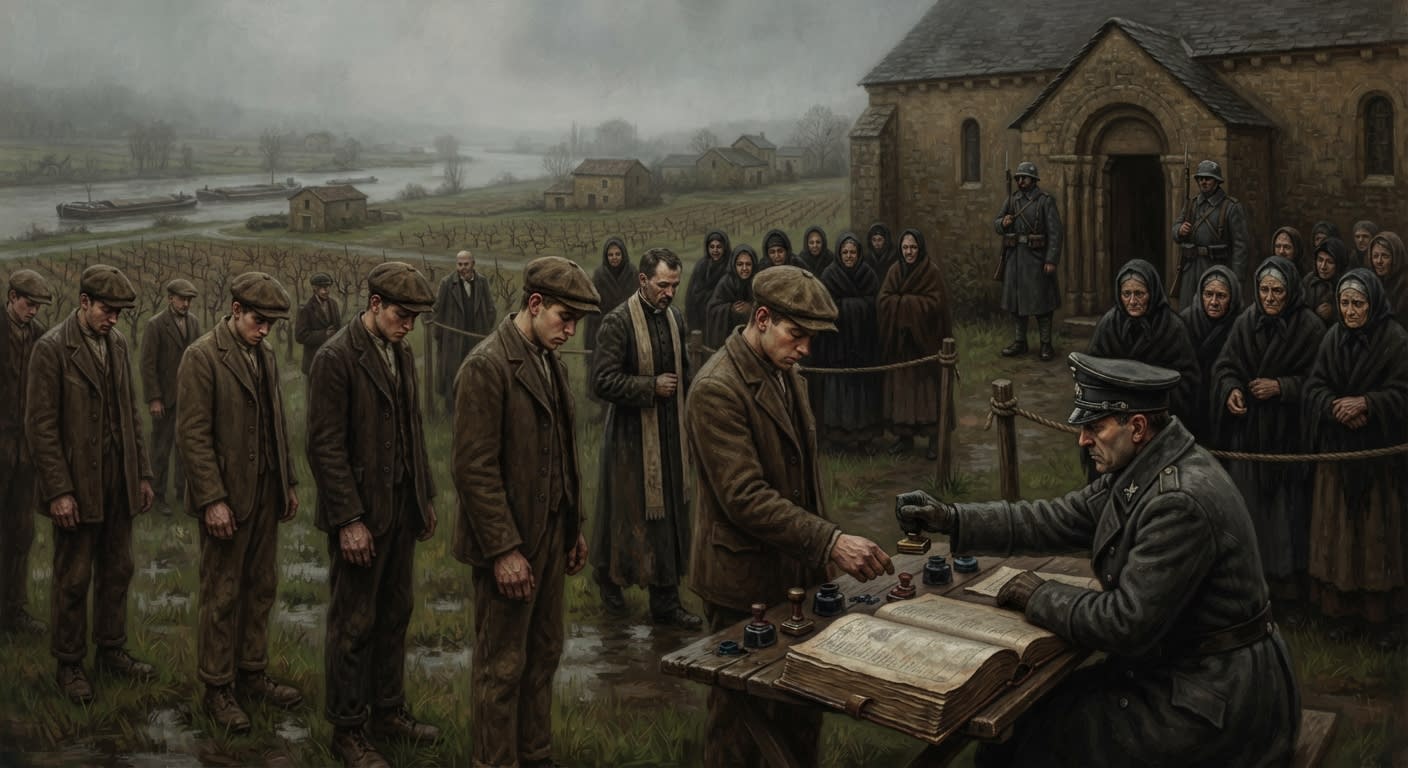
Musters happened wherever a field was flat enough for a table and near enough to a church for a bell. Boys stood in the wet grass in their field clothes. Mothers stood behind a rope until the second bell. An Assessor pressed the Triune Knot onto each wrist in ink that lasts nine days. A field chaplain heard confessions at a rate calculated to keep ahead of the rain. Then the columns turned east. Some went to catechism-barracks at Metz, some down the southern roads to the Citadel of Lyon. None came back as quickly as they had left. Many didn't come back at all.
Early Levy summaries recorded the Aquitanian musters of A.S. 110 as "completed in good order and without incident."
Corrected. The musters were completed. "Good order" referred to the table arrangement. The incidents consisted of absent sons, late sons, sons who became daughters in parish rolls between the reading of the decree and the arrival of the Assessor, and one bridge over a Garonne tributary that collapsed with suspicious timing. The chaos of the first muster across all provinces led to the constitution of the Bureau of Conscription in A.S. 112. Aquitaine contributed to that chaos with a thoroughness it has never shown for tithes.
#On Evasion and Provincial Courtesy
Burgundy hides its sons in cellars, and Languedoc sings its grief in the wrong key and waits to see who notices. Aquitaine has a gentler method. It delays, misroutes, miscounts, and apologises for all of it with such rural courtesy that the Assessor rides away feeling he has been offered soup.
The province's methods, as Conscription has catalogued them, are these. The harvest exemption, claimed each autumn for boys whose labour is essential, although no Aquitanian harvest has ever found a boy inessential. The river disappearance: a son goes downstream on a grain barge and turns up three parishes away as a nephew, a hired man, or a widow's lodger with no memory of his own surname. The cousin exchange, in which a household of three sons lends one to a household of one, and both return correct ratios to the parish. The sudden monastic vocation, discovered in a youth who until the previous week had been known mainly for poaching. The false stillbirth. The late baptism. The coastal cousin who has "gone to sea" and whose name the harbour registers have never heard.
The Bureau of Purity reads all this as organised concealment. Records reads it as defective rolls. The Bureau of Mercy reads it as a pastoral emergency and prints leaflets. Aquitaine reads the leaflets politely at the church door and uses them to light the kitchen fire. The later Nursery Levy Decrees narrowed the gaps by pulling registration toward the cradle, and the Pale Kin networks widened them again. The province tends to learn each new rule roughly as quickly as Strasbourg can print it.
BUREAU OF CONSCRIPTION — DISCREPANCY NOTE, GARONNE DISTRICT Parish: ████████████ (river parish, lower Garonne) Finding: recorded male infant deaths across two generations exceed the provincial expectation by a factor of ████ Supplementary finding: eleven burials entered for boys whose graves could not be located; four entered twice under different mothers Cousin transfers into and out of the parish in Levy years: ███ Disposition: roll corrected; parish priest reassigned; ██ households entered for Purity review; cemetery survey deferred on account of flooding
None of this ever amounted to rebellion. Aquitaine doesn't throw cobblestones. It doesn't kill Assessors, even from the wrong Bureau. When the Levy comes, the province hands over sons. It hands them over slowly, in the wrong number, via the longest road, with its regrets. The Bureau still gets its boys. It gets them late and a few short, which in Strasbourg's arithmetic counts as a crime of degree.
#On Present Condition
As of A.S. 201 the province is productive, obedient and quietly resentful. Its grain feeds depots it will never see. Its wine goes east in casks stencilled for officers' tables and fever wards. Its hides become boots, straps and cartridge pouches. Its sons still stand on the wet muster fields every Levy year, ahead of low stone churches, while mothers wait behind the rope and the brass stamp comes down on each wrist. The Seventh Renewal of A.S. 185 sealed the true ratios. Aquitaine doesn't know its own number, and its families behave as if it were higher than the public figure.
The province is still classed as a safe heartland. In the Synod, safety has always meant taxation, rationing, bells, tithes, and the Levy.
The Great Ledger of Souls lists the province as compliant. The Index Damnatus lists very few Aquitanians, because the province avoids being interesting. The Levy tables list a steady shortfall that no audit has explained. The missing boys are downriver, in orchards and monasteries and harbour lodgings, or in graves that flood each spring. Records will keep counting, and so will the mothers.