
#On the Third Friday
"Look north before speaking." — First rule taught to recruits at the Ravelin of Vigilance
The Bone Walk is the soldiers' name for a procession that the Bureau of Relics files as the Perimeter Reliquary Circuit of Saint Iselda, Northern Work Segment. A femur attributed to Saint Iselda is carried along the parapet of the Ravelin of Vigilance, the First Outer Ravelin of Bastion-Constantinople, on the third Friday of each month. That is the schedule. Performance is a separate document. Shelling postpones the Walk, and missing Relics paperwork postpones it with more ceremony. At the southern anchor of the Sagittal Line, a schedule states what the Church intends to do, and the enemy has never signed it.
Vigilance looks north across the Knife Mile toward Zone 5 of No-Man's-Land. It is a low work, crouched for low guns, and its stone carries the ash scars of years the Bureau of War prefers to number rather than name. The men posted there watch mud that moves, wire that shifts without wind, and craters that have learned to imitate familiar voices. When the femur passes, those men stand straighter. The Bureau of Relics has written that this is the only evidence it requires. I have checked the file. It still requires nothing more.
#On the Bone and Its Filing
The relic rests in a brass cradle lined with red felt. It is a femur, the long bone of the thigh. A soldier who has carried a wounded comrade knows exactly what it weighs and does not need a Bureau to tell him. Its current registered designation is Femur-Iselda-Constantinople-A, authenticated for perimeter use. The final letter is the most candid character in the designation, since an A lets the reader expect a B.
The Bureau makes no claim that the bone came out of Saint Iselda's body. It claims that the bone is hers in the eyes of the Ledger, which is a narrower and better-defended position. The doctrine behind it was settled at the Fourteenth Doctrinal Congress in A.S. 147, while the Reliquary Schisms were filling basilica naves with duelling bishops and surplus thighs. The Congress declared that all femurs are authentic if notarized. The Edict of Authentication carries the logic to its end: the writ confers authenticity, authentication confers sanctity, and the Bureau confers the writ. Under that rule the Constantinople femur is Iselda's. Whose skeleton it once supported is a question for the Bureau of Medicine, which keeps asking it and keeps having its letters filed under heresy.
So the bone carries three separate claims. The Bureau recognizes it, and that recognition is a fact of administration. Its provenance is an assertion with a paper trail attached. Its effect on the men is a set of reports that no office has managed to explain. Merging the three is how Schisms start, and I decline to start one in a low-priority article.
An older Bureau of Relics catalogue described the Iselda femur as "the left femur, complete and singular."
The claim of singularity is withdrawn. A Marseille audit produced a second left femur attributed to Saint Iselda, and a Turin chapel produced a third. All three hold certification. The Codex draws no anatomical conclusion from this arithmetic, and the Bureau of Medicine is asked to stop sending diagrams. The Constantinople bone keeps its designation and its post.
#On the Perimeter Circuit
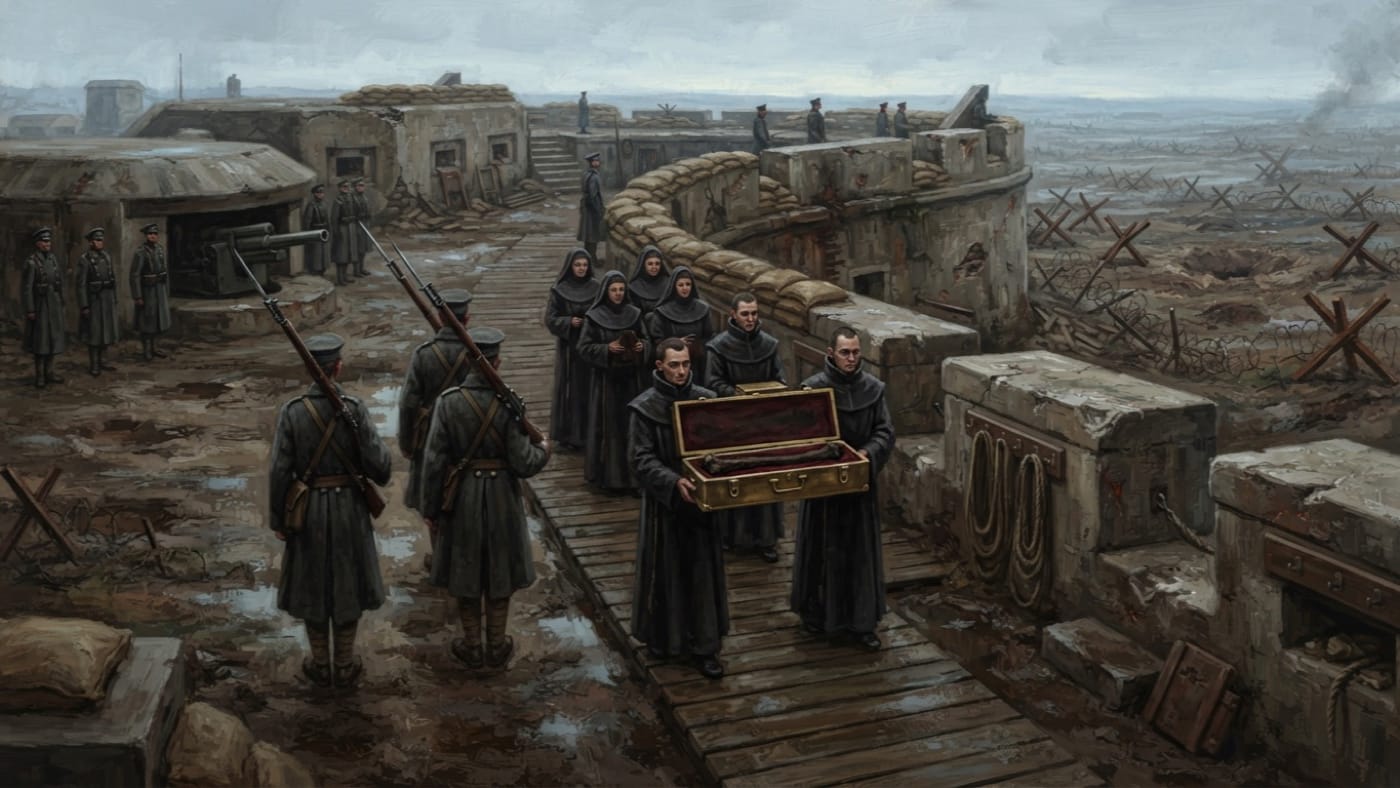
The Walk starts at the inward chapel after First Peal. Two Relics custodians carry the case. Four sergeants of the Bureau of War walk ahead of it with rifles unloaded and bayonets fixed. An empty rifle with a blade on the end is a liturgical instrument in every respect except the paperwork, and the sergeants carry theirs with the stiffness of men who would like to be told which drill applies. Behind them a chant crew hums the Iseldan measure. The Codex holds no text for the measure, and I will not write one. If Doctrine has never approved its words, nobody can be burned for singing them wrong.
The case then follows the parapet. At each gun deck it is presented to the low guns, which are trained for flat fire across trench lips and mud swells. At each watch niche it is presented to the sentries, who keep their eyes north while they straighten. At each powder recess it is presented to the magazine, which is a sentence I am proud to put in the Codex. At each impact scar it is presented to stone that has already been hit. Hook boards hang beside every third embrasure with extraction ropes coiled on numbered pegs, because men at Vigilance get dragged into the ground and have to be pulled back out of it. The bone passes the ropes on its way. Nothing in the rite instructs the custodians to slow down at that point, and nothing needs to.
At the outermost parapet, facing the open northern ground, the custodians turn the case northward toward No-Man's-Land and hold it there for exactly forty-seven breaths. The Codex does not record whose lungs set the count. I suspect the sergeants', and I suspect their breathing runs faster facing north than facing the chapel. Beyond the parapet lie wire, bayonet-hedges and salted mud that will be moving again by supper. The bone faces it. Nothing in the record says the bone glows, speaks, stirs or drives anything back. It is shown to the enemy the way a writ is shown at a gate.
No document I have seen sets out what happens after the forty-seven breaths. No closing peal is recorded and no finishing station is named. The case comes back from the north and the ravelin goes back to watching.
#On the Evidence of the Watch
Each trade on the ravelin reports a different benefit. Sentries say their sight is clearer for one watch after the Walk. Gunners swear the low guns hold elevation more steadily. Bellmen of the Bureau of Bells report that the small signal clappers strike more cleanly. Each claim belongs to the men who made it, and none has been extended to every observer, every gun or every bell on the Line.
The Bureaus have each read these reports to suit their own budgets. The Bureau of Medicine calls it mass suggestion. Relics calls it grace. War wants the Walk continued and has no interest in which of them is right, provided the guns hold. The Bureau of Doctrine approves the procession and certifies no particular miraculous mechanism. Some will call that cowardice. I serve the Bureau, and I call it the finest kind of survival available to the institution.
The finger-bones in the trench niches elsewhere on the Line are recorded as glowing when the enemy approaches. Nobody has recorded Iselda's femur glowing. It is carried, shown and turned north. After that the men do the rest, or grace does, depending on which Bureau is paying for the felt.
The Walk matters most after a bad night. A rope team goes down below the second stake row and comes back short. A sentry spends six hours staring at lights in the mud and loses his sister's name. In the morning the chapel opens, the sergeants form up and the bone comes along the parapet. The Walk recovers nobody and buries nobody. It gives a frightened, sleepless man a reason to straighten and look north again for one more watch. War calls that readiness. I have stood on that parapet in the cold before First Peal, and readiness is a generous word for it. The men stand up anyway.
#On Custody and Continuance
Readers keep confusing three separate schedules. The finger-bones in the Line's reliquary niches are rotated quarterly by Relics custodians travelling in armoured waggons. Standing Order 88-R, as revised in A.S. 182, requires frontline relics to be re-authenticated weekly, after a monthly interval proved catastrophically optimistic. The Bone Walk is monthly. If a clerk mixes up any two of these cadences, a chaplain somewhere ends up holding a bone that no longer has valid paperwork.
The weekly cadence exists because of Velmora. She is the Covetous Serpent, and her counterfeit traffic reaches into every sector, Constantinople included. A counterfeit relic does more than fail. It performs counter-miracles, and the faith of everyone within earshot of its invocation sours. A forged femur paraded past exhausted sentries would teach them to distrust the one ceremony that tells them to look again. To prevent this the Bureau posts Counter-Relic Examiners along the southern Line. Their simplest instrument is the Candle Proof: a taper is lit beside the relic, and the flame leans toward a genuine bone and pulls away from a forgery. The protocol is published. It gives the procession its certification, and the custodians give it its two pairs of hands.
The Bureau holds that the three filings protect the bone. The soldiers hold that the bone protects them. Neither party has proposed testing the other's claim, and I endorse that restraint.