
#On the Flemish Roads
Flanders has never been short of pilgrims. Its parishes are damp, its harvests anxious and its confessors overworked, and people living that way will walk toward any shrine that promises drier ground for the soul. Before the Harmonized Routes Edict, these walkers left the country between Bruges and Antwerp in parish bands and family clumps. They went on roads that older law had laid down and older stone had kept, and somewhere along those roads they met the Brotherhood of the Blessed Foot.
The Brotherhood managed the Flemish pilgrim traffic. That is the phrase the Bureau of Pilgrimage uses, and I keep it because "managed" is a verb roomy enough for a great deal of private enterprise. It was a guild, self-appointed and self-financed, one of eight private road authorities that had carved the pilgrim routes of the Church into competing fiefdoms before Strasbourg took the knife away from all of them.
Beyond that, the file thins. It enters no founding year and names no founder. No chapter-house appears in any register I have been shown, and I have been shown most registers. The Brotherhood's guild-master answered the summons of A.S. 123, and nobody preserved his name. What survives is a description of conduct. The conduct is enough.
#On the Crossroads Fees
"...tolls at crossroads it did not own, on routes it had not built, for protection from threats it could not name." — Bureau of Pilgrimage, account of the founding
I have read a great many indictments, and few are as well built as that sentence. Each clause takes away one ground for the fee. By the end the fee stands alone in the road with nothing beneath it but the Brotherhood's nerve.
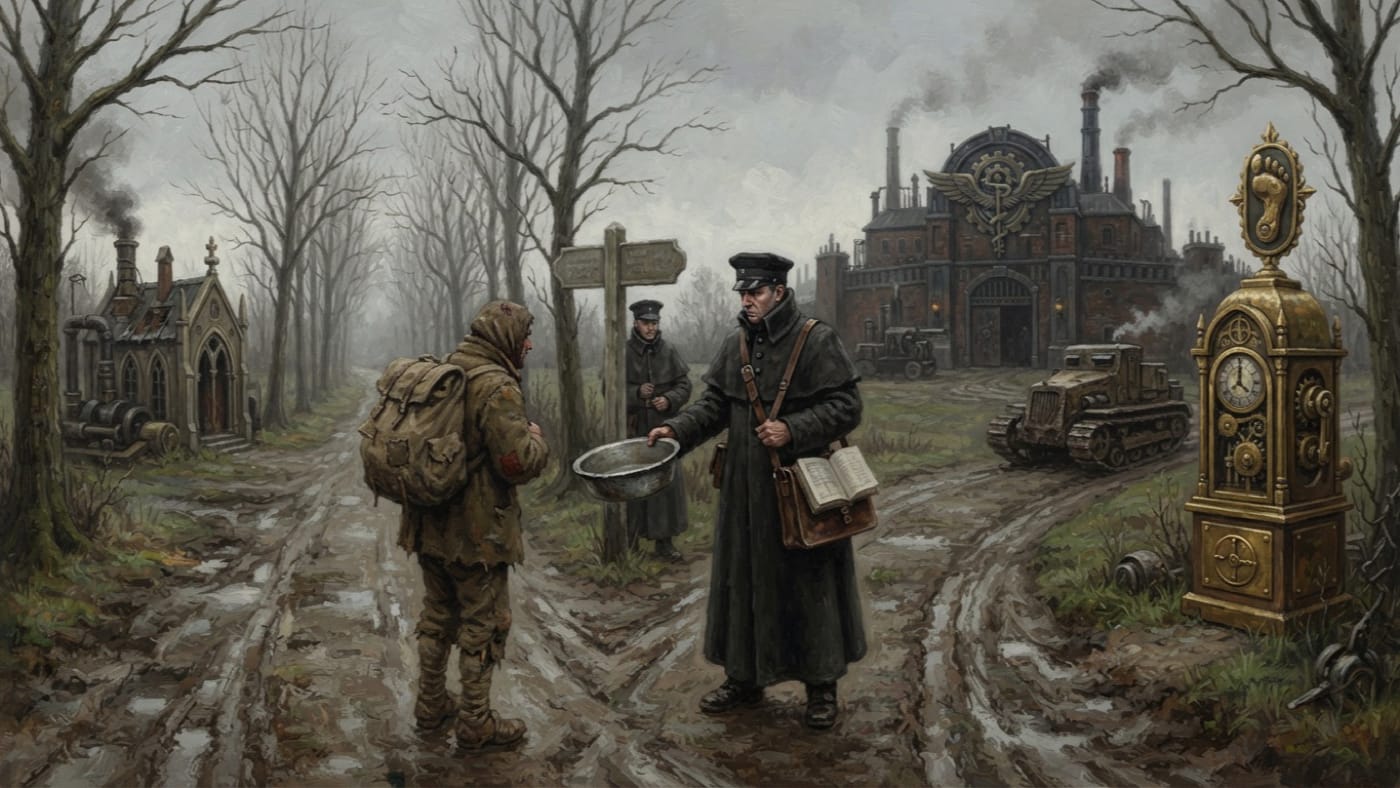
Look at the crossroads the way a pilgrim met it. He has been walking from his parish since before Lauds, and his boots have taken water at every rut since the last village. Two roads branch in front of him. One leads to a shrine and one to a ditch, and the stone that ought to say which is which has lost its lettering to the weather, or never had any. At exactly that point, where his ignorance is greatest and turning back costs most, a brother of the Blessed Foot stands with an open purse and an account book. He offers direction, passage and protection, all for one fee that cannot be divided.
No surviving instrument shows the Brotherhood owning the ground or building the road. The protection is the masterstroke. Protection from what? Wolves, brigands, the Great Deceiver, the weather? The account does not say, because the Brotherhood never said. An unnamed threat cannot be disproved, and a threat that cannot be disproved can be charged for forever.
The rate is lost. So are the list of roads, the number of crossroads and the count of pilgrims who paid. The Bureau's account keeps the principle and throws away the arithmetic. In any other office I would call that negligence.
The neighbouring guilds were no gentler. The dossier of Saint Edras records that his Carpathian confraternity levied crossing fees and sold approved foot-rags, and the guilds at Santiago charged pilgrims twice and then three times for the same road. Those sins are filed under their own names. The Blessed Foot's distinction is purity of method. The record credits it with no hostel, no escort and no rescue from any ravine. It leaves the Brotherhood a crossroads, a purse and a straight face.
#On the Other Guilds and Santiago
The trade swelled after A.S. 120, when the Danube turned at Belgrade and Europe set out walking toward the miracle. The Flemish parishes sent their share. Every extra pair of feet passed an extra crossroads, and every crossroads had its brother.
Eight guilds divided the roads. The Guild of the Golden Sole held the Rhineland approaches. The Confraternity of Saint Edras held the Carpathian passes. The Peregrine Brotherhood ran the Iberian coast with enough armed escorts to embarrass a minor prince. The Tongues of the Blessed Way worked the roads around Santiago. Three smaller fraternities held scraps not worth naming. The Blessed Foot held Flanders, and nobody else wanted Flanders badly enough to fight for it.
In A.S. 121, three of those guilds brought processions to Santiago on the same feast day: the Tongues, the Peregrine Brotherhood, and the Edrasians through a proxy house. The Riots of Santiago followed. Forty-one pilgrims died and the shrine was damaged. The Blessed Foot was not there. The record names no Flemish brother among the marshals and no Flemish fee among the doubled tolls.
It made no difference. The Bureau of Purity reported that the affair "reflected poorly on the organisational capacity of the private devotional sector," and Strasbourg read that sentence as the description of a whole class. Santiago's dead were filed as precedent, and the precedent applied to all eight guilds.
#On Litigation and Harmonization
The eight masters were summoned to Concordat Hall in Strasbourg in A.S. 123. The Synod that summoned them had stood formally since A.S. 90. Its founders had been in their graves for decades, and the Edict was the work of their offices. The masters came expecting negotiation. They got licensing terms.
The order of surrender is recorded in the dossier of Saint Edras, in the passage on the confraternities that borrowed his feet. The Golden Sole surrendered first. The Blessed Foot attempted litigation and was audited into penitence. I quote the account whole because that sentence is everything the record holds.
Suing the Holy Bureaus at Strasbourg has a particular shape. The court sits under the authority that drafted the law, and the law in dispute is the one under which the court sits. Sooner or later a clerk asks the plaintiff, politely, to produce his title. The Brotherhood had come to defend its right to collect at Flemish crossroads. A right has to rest on something: a charter, a deed, a grant, a road built by one's own labour. The Bureau's description of those crossroads already contains the answer. By going to law, the Brotherhood put its claims in front of auditors, and auditors are the one audience before whom an unnamed threat is worth nothing.
"Audited into penitence" is all the dossier gives. It does not say which petitions were filed, what the auditors totalled, what penitence was imposed or on whom, and I will not supply any of it. I note only how elegant the phrase is. The Brotherhood asked for judgment and received an accounting. I know no surer road from plaintiff to penitent.
The masters' fates are recorded only as a group. Three signed and became route inspectors at waystations so remote that exile came with a desk. Three refused and were immured in the foundations of the new southern headquarters at Marseille. That building has groaned for seventy-eight years, and Pilgrimage classifies the noise as settlement. Two fled to England, where the British Crown keeps its collection of useful irritants.
No source says which group held the Blessed Foot's master. Litigation followed by penitence fits a man who later signed. It fits equally well a man who later refused, and a tedious enough audit would send anyone toward the Channel. I leave him unassigned. He may be in a mountain relay station, in Marseille limestone, or in an English lodging-house complaining about the bread. The Ledger declines to guess, and so do I.
Older Bureau summaries date the Harmonized Routes Edict, and with it the end of the Flemish guild roads, to A.S. 38.
Corrected. The Edict was ratified at Concordat Hall, Strasbourg, in A.S. 123. In A.S. 38 the Bureau of Pilgrimage did not exist and the Belgrade surge had not begun. No record says whether the Brotherhood existed at that date. The Edict that ended its authority certainly did not. A separate figure of A.S. 238 appears in one descriptive survey. It is later than the present year and needs no further comment.
#On the Remaining Authority
The Edict ended the Brotherhood's independent authority in A.S. 123 and replaced it with machinery. Every Flemish crossroads that once had a brother and a purse now sits under Bureau licence. A pilgrim leaving Bruges wears a token on his coat. A Route-Stamper inspects it at the waystation desk, and the Bureau of Records files his route. The Peregrine Wardens, constituted under the same Edict, ride the roads carrying seals that can void a licence at the roadside. The fee survived. The threat acquired a name, a tariff and a uniform.
Nothing current is filed on the Brotherhood itself. The Bureau has reported no chapter, no membership roll, no successor house and no purse hidden under a chapel floor. If brothers of the Blessed Foot still stand at any crossroads in A.S. 201, they stand there without a file, and in the Theocracy that amounts to standing nowhere.
The Bureau of Pilgrimage collects at those same crossroads today. It does not own them either; ownership belongs to Records. The difference is that Pilgrimage holds a charter saying so.