
#On the Settlements at the River
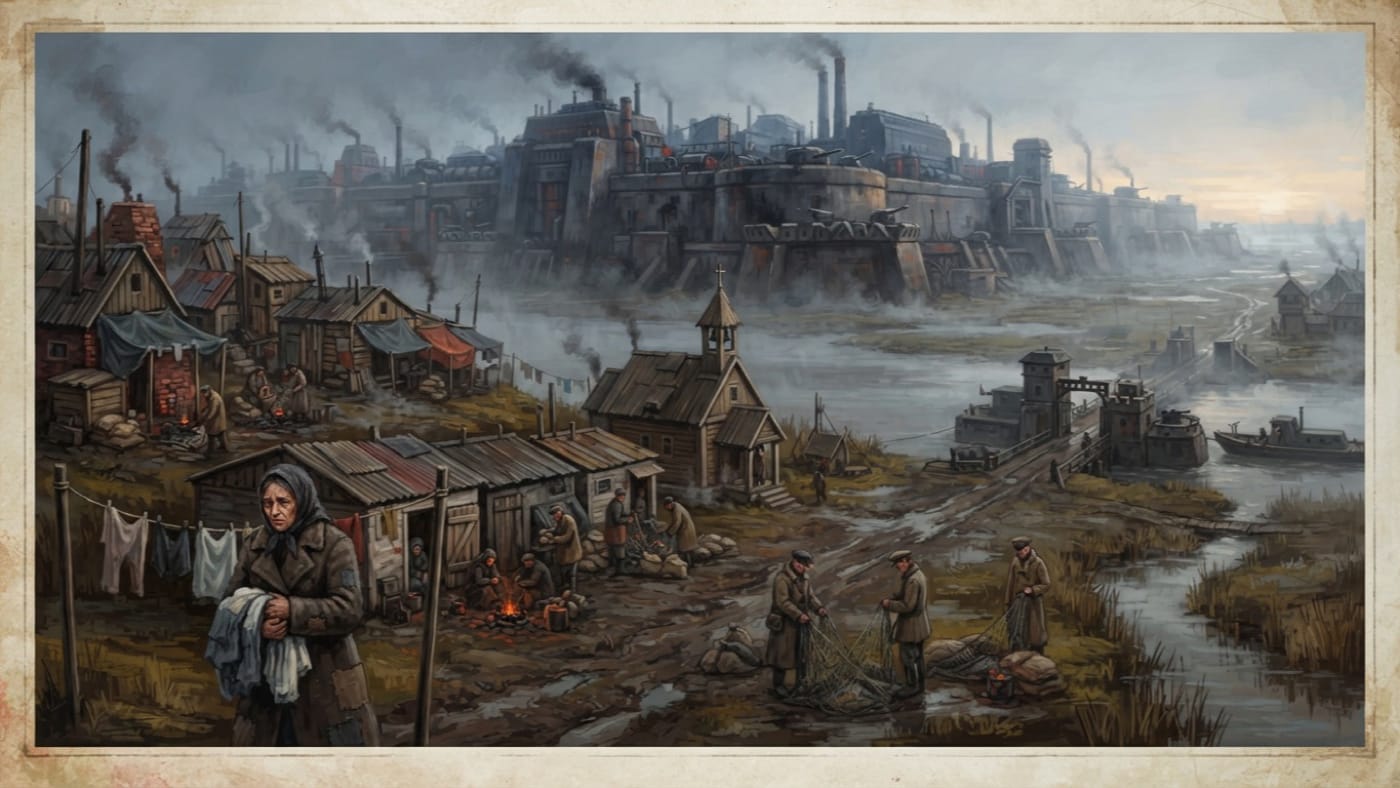
"Bug River settlements" is a phrase the Codex uses the way a widow uses a dead husband's coat. It covers what remains and keeps the shape of what is gone. No charter made them a district, and no Bureau constituted them. The words gather the villages, farm hamlets, ferry places and parish clusters of the Polish lowlands along the Bug River, the natural moat of Bastion-Brest in the northern sector of the Sagittal Line. Some of them still stand. Most are now corrections.
The Line runs north to south. West of it lies the territory the Synod calls its own. East of it lies the contested strip and the things that contest it. The Bug sector is the flattest and most exposed reach of the whole spine: marsh approaches, floodplain, reed ditches, river mist at dawn, ice against the pylons in winter and fever in the wet months. A settlement there had no ridge to hide behind and no gorge to narrow its danger. It had fields, a parish and a long view east.
Three things must be kept apart, because the Bureaus confuse them whenever confusion saves ink. The fortress is Brest, a Zone Four bastion and the lock on the river. The receiving city is Warsaw, a Zone Three staging city on the Vistula. The settlements are neither of these. They are the people who lived between the water and the war before either one acquired an office. What became of them is filed in at least three places, and none of the three agree.
The phrase enters the Codex through Standing Order 14-W/3, which lists Poles from Bug River settlements among the people Warsaw absorbed when it was supposed to send them away. That is a strange place for a population to receive its first acknowledgment: the annex of an evacuation order that never evacuated anyone.
#On What Remains Beside the Water
The published account is brief, and I will not fatten it. The Bug villages are mostly absent now. A few remain as service hamlets west of the works. They have laundry lines, ration sheds, fever huts and small chapels where river saints compete for patronage with the official military blesseds. These hamlets live off the fortress as sextons live off a cathedral. They wash what the garrison soils, store what the convoys drop and nurse what the marsh infects.
Absence must be stated carefully, because the Bureau of Records states it carelessly. A village can be absent because its houses burned, because its ground went under water or wire, or because its people walked west. It can also be absent because Records reclassified the land as Zone Five and filed the place as gone while some of its inhabitants were still drawing water from its well. The ledger does not distinguish. It keeps one column for "no longer present," and the drowned, the departed and the administratively dissolved all go into it together.
Nothing in the record gives these settlements a common death. There was no single burning, no single order and no evacuation commander whose name could be carved on a tablet. There was the Sundering of A.S. 45, then the Great Retreat, then a defensible Line hardening around A.S. 65 to 68, then more than a century of pressure, flood, reclassification and drift. The settlements thinned the way a register thins in damp: first a corner, then a column, then a page.
Some names survived. They survive in Records corrections and in household memory. They survive on Warsaw street corners, where families cluster by lost parish, and in the bunk rows of Brest, where men from the same flats sleep near one another by habit rather than by assignment. The village is gone from the map and present at supper.
#On Crossing and Classification
The Bug allows lawful crossing at one useful place, and that place is a fortress that has learned to hear sins. Anyone who passes lawfully through Brest meets the apparatus. The Bridge Tribunal checks confession receipts against seal stamps, the Crossing Bureau issues and corrects identities, and gun-cantors inspect absolution tokens. Papers without a matching confession are suspect. Persons without papers are worse. The fortress has a term for them, "nameless persons," and treats them as cargo it is forbidden to carry.
These rules belong to the bridge. They do not prove that every river hamlet kept a seal office, or that every displaced family came west over the Brass Ribs. Some families came by other roads, some by illegal skiff, and some by staying where they were while the map moved around them. Whatever their route, the documents they carried were judged by standards drawn up at Brest and copied westward.
The river is cruel to documents. Paper sweats near it, ink beads and seals soften. A manifest from the eastern approach arrives smelling of vinegar and rot. A family can survive the loss of its village with every member alive and still arrive with every paper ruined. The crossing writ is illegible. The baptismal entry sits in a parish chest that is now under water. The confession receipt came from a booth whose register cannot be found. The people are present, and their proof has drowned.
That is the real injury of classification. Fire takes the roof. Records takes the remainder, slowly, by demanding evidence of a place it has itself declared no longer exists.
#On Warsaw's Reception
Warsaw is where most of the river's people stop being geography and become a queue. The city never planned to receive them. The Bureau of Settlement issued Standing Order 14-W/3 in A.S. 95 and told Warsaw to move its own population west. The Order was revised in A.S. 130 and suspended pending review in A.S. 160, and in A.S. 201 it is still suspended, forty-one years on. It has spent its whole life asking Warsaw to shrink while the river kept sending the city more people.
The arrivals came by cart, ferry, rail siding, the roads of the Polish Corridor, and rumour. Not all of them reached Warsaw. Some stopped along the corridor and became households in the signal hamlets, where the corridor keeps them as a hem keeps burrs. The rest went into Praga and the eastern districts, where rooms are cheap because the rent allows for the sound of the front. They found sheds, canteens, coal nests and borrowed lofts, and they opened bakeries without anyone's permission.
They share those streets with other displaced people: farming families from the flats between the Vistula and the Line, garrison dependents, discharged soldiers, and refugees from hamlets whose origins nobody has recorded. Settlement lumps them all together as "eastern arrivals." The lump is convenient. It is also why a Bug family and a garrison widow can stand in the same queue for twenty years without the Bureau being able to say which of them it failed first.
Reception is where lost documents turn into hunger. The Bureau of Mercy keeps four wards in Warsaw, and all four are full. The Mothers of Plenty give rations to registered dependents, and Warsaw's registration requires a valid crossing writ, a current tithe receipt and a confession certificate dated within the quarter. Picture a family whose writ dissolved in river damp, whose parish no longer collects tithe, and whose last confession was heard in a booth east of the water. That family falls outside the category before it reaches the window.
The city puts them to work anyway. In A.S. 200 the yards of the Northern Corridor sent 1.8 million metric tons of freight forward from Warsaw, and they sent it on the backs of people the ledgers cannot fully name. The yard does not ask whether a porter's grandmother came from a dissolved parish. It asks whether he can lift.
Herta Stoltz has been Resident-Director of Settlement for nineteen years and holds custody of the suspended Order. She has resisted evacuation with arithmetic: the workers it would remove, the beds that do not exist, the children without crossing writs. She governs none of the river settlements and founded nothing. She has simply counted their survivors more honestly than the forms allow, and in Warsaw that passes for policy.
An earlier Warsaw entry stated that the city "has grown by a quarter of a million" since the Order was issued and that its population "has not changed significantly in forty years."
Corrected. Growth from three hundred thousand in A.S. 95 to seven hundred and fifty thousand now is four hundred and fifty thousand, nearly twice a quarter-million. At the suspension in A.S. 160 the population stood near six hundred thousand, and an increase of a hundred and fifty thousand souls is not "no significant change" in any arithmetic taught west of the Vistula. The Bug families are part of that increase. Neither edition counts them separately.
#On the Present Residue
As of A.S. 201, the condition of the Bug River settlements can be stated in four lines and qualified in four hundred. A few service hamlets remain west of the works, where they wash, store, nurse and pray in the river's shadow. Most of the villages are absent, through fire, flood, wire, departure or reclassification, and the record cannot reliably say which. Their people live in Warsaw, in Praga, along the corridor and in the bunk rows of Brest. Their names survive best where the Bureau least intended them to: in margins, in kitchens, and in grudges over fields that now have wire through them.
The pressure east of the river has not lifted. The Nameless Tide presses on the Bug sector, and the hamlets west of the works live under the same mist as the garrison. No document names the Tide as the destroyer of the settlements, and I will not supply one. The Bureaus have enough fiction without mine.
The Synod's categories still lag behind. Settlement files these people as provisional. Records still demands the documents its own reclassifications destroyed. The Bureau of Passage counts them at the convoy gate and loses them at the ration window. And at every siding and bakery, the northern supply system depends on the labour of people classified as passing through.