
#On the River Position
Chain Gate One is a length of forged iron and the two cliffs that hold it. Everything else at the position (the batteries, the tunnel mouths, the men standing in the fog with their collars turned up against regulations) exists so that the iron stays where the sappers put it.
The Iron Gates are where the Danube is most humiliated. The river arrives broad and confident from the upper plain, and the Carpathian basalt squeezes it into a black channel so narrow that two barges can barely pass abreast without scraping stone. The sappers of the first garrisons surveyed this channel with the dour thoroughness of men who expected to die in it. They found two places where the cliffs pressed so close that a chain boom could be strung from rock to rock without needing, as the Irongate survey reckons it, more than eighty yards of forged links. They named the two positions Gate One and Gate Two. Engineers have never been poets, and the Codex is grateful.
A chain across a river is a simple argument. A fleet coming down the gorge has to stop at the iron. Once it stops, it sits under three hundred feet of rock-cut gun emplacements, with cannon batteries on both cliffs and a current that does not care whose hull it is pushing. Hold the chain and you hold the river. Hold the river and you hold the mid-continental approach, which is what the Romans, the Ottomans and every clerk since have understood about this gorge.
Gate One is not a bastion. It has no walls of its own, no market, no chapel and no resident population. It is a position of Bastion-Irongate, fifth of the seven bastions of the Sagittal Line, with Bastion-Sibiu to the north and Bastion-Shipka to the south. The Line runs north and south. The river crosses it. At Gate One the Line has strung iron across that crossing and dared anyone to object.
#On the Works and Their Dependence
"Sing, or the stone sings for you."
The reader who has toured the parent article will want to merge the river chain with the mountain's other gates. The Codex forbids it. The pressure doors are interior works that seal one compartment of the tunnel complex from the next, and Commandant Sorn has charges laid behind them. The Intake Gateworks is where permits are checked and lungs are tested. The Snowmouth Gate is the outbound exit on the mountain's western face, where the pine is gathered for tea. Gate One is none of these. It is the river's gate, and the river keeps its own counsel.
What the river chain shares with them is the cliff. The emplacements that cover Gate One are cut into the same basalt as the Transit Spine, and the tunnel mouths that open on the gorge open onto the same bored and breathing complex. The guns are served from the mountain. The men who serve them sleep in it, eat in it and draw their heat allocation from it. That is why a description of Gate One that leaves out the mountain describes nothing.
The mountain needs sound. The Great Hush of A.S. 94 settled the matter: nine hours of silence, pressure doors failing one after another, the Third Lung collapsed, three thousand recorded dead, and eleven months to dig them out. Since then the crews of the Choir Nave have sung around the clock in rotating eight-hour watches, and the acoustic channels cut through the rock carry the chant to every seal in the complex. A battery on the cliff face above Gate One is a battery with a hymn behind it. If the hymn stops, the battery no longer has a cliff.
Earlier Bureau of Engineering reports describe the chant system as "supplementary to conventional bracing."
The characterisation has been withdrawn; see Bastion-Irongate. The correction concerns the mountain. The chain across the river is iron held by iron, and no Bureau has yet proposed otherwise in writing. I note the phrase "in writing" for the record and decline to elaborate.
#On Passage and Authority
Gate One has no commandant of its own. It needs none, because the Irongate already has three, and between them they leave no room for a fourth.
Commandant Hadrik Sorn commands the military garrison: the tunnel gates, the pressure doors and the compartment-denial charges laid along the main bore. The guns that cover the river are garrison guns and answer to the garrison's chain of command. That chain ends at a man who sleeps in his uniform.
Cantor Ys Varr presides over the Choir Magistracy and its voice-licensing, which determines who among the twenty-two thousand souls of the bastion is warm, fed and permitted to stay inside the rock. A gunner on the cliff above the river is a gunner first. He is also a throat with a tier, and his tier is reviewed.
Seal-Broker Lysa Murne runs the permit desk of the Breath Office: quarantine clearances, gate passes, convoy manifests. The chain decides whether a hull goes through. Her seal decides whether a man does, and her seal is quicker.
So passage through the gorge is not, in the end, a matter of water. It is a matter of paper, and after paper, of the body: whether the lungs hold a flame bent long enough, whether the voice holds a harmonic long enough, whether the manifest agrees with the cargo and the cargo agrees with the manifest. The Codex does not publish the inspection order at the river, the hours of the watch, or the tariff, if there is one. The garrison knows them. The enemy would like to.
#On the Enemy Opposite
Morwen, the Weeping Host, Sin-General of Envy, holds the Danube approaches opposite the Irongate. A chain across a river is built against fleets. Morwen does not send fleets.
Her war is replacement. A sentry's relief arrives an hour early, wearing the sentry's face. A sapper's partner starts speaking in another man's cadence. A platoon goes on with its duties three days after the men in it were stacked behind a pressure door. That last case is the Incident at Sector Nineteen. It happened at Sector Nineteen, inside the mountain, and the Codex will not move it to the river for the sake of a better paragraph.
Set this enemy against Gate One and the whole difficulty is plain. The boom stops a hull. It cannot stop a lieutenant whose papers are correct, whose scar is in the right place and who knows the name of the right dog. Eighty yards of links and both cliffs' batteries can be made useless by one man walking calmly through a tunnel mouth under a name the garrison trusts.
The Bureau of Purity answers with Mirror Discipline, adopted after Sector Nineteen in A.S. 193: three seconds of reflection at most, warped tin in the latrines, and any reflective surface larger than a hand-span within three hundred yards of the perimeter shattered on sight. From the gun ledges above Gate One a man looks down on the Danube. On a still grey morning the river is the largest mirror in the Southern Theater, and no Bureau has yet worked out how to shatter it.
The Ledgers of Self keep a dossier on every man stationed in the mountain: appearance, habits, confessed sins, how he holds his mess-tin. The Ledger is definitive. The Ledger is also a document. When two claimants recite it equally well, the garrison has a protocol, and the protocol is not merciful.
#On the Recorded Condition
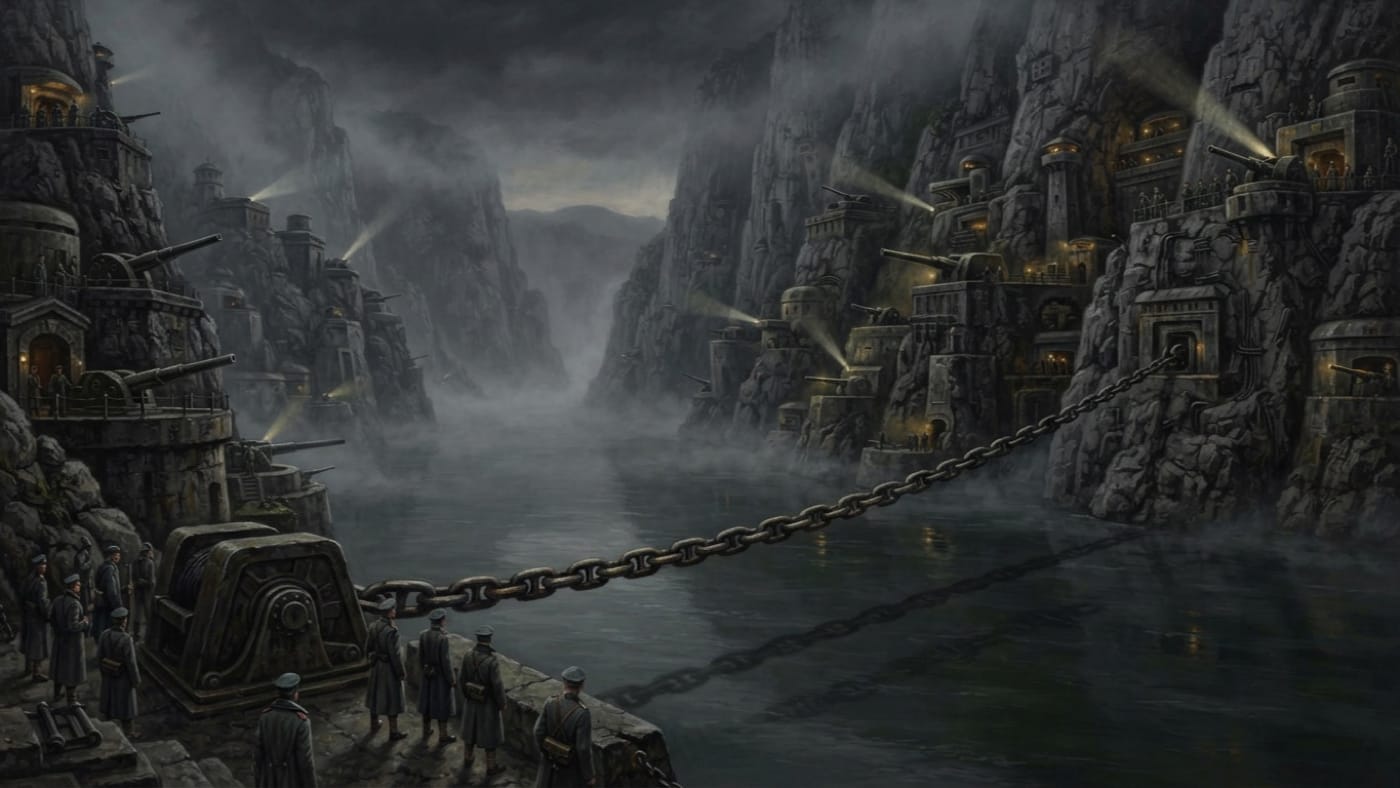
The parent article carries a plate of this position: Chain Gate One, southern aspect, from a Bureau of Engineering survey dated A.S. 198. It shows black basalt walls, tunnel mouths, gun emplacements cut into living rock, the boom stretched across the water, and grey fog lying on the river at dawn. "Southern aspect" names the view. It does not mean the gate belongs to one bank. The chain has two ends, and both cliffs are garrisoned, and have been since the first permanent works went in on the southern face in A.S. 67, with the northern face following six months later. Those dates belong to the bastion. The Codex records no separate year in which Gate One's iron was first hung, and it will not invent one to fill a blank in the infobox.
The engineers who first worked this gorge were Church frontier engineers working under provisional authorities, decades before the formal Synod of A.S. 90. The Bureau of Engineering's later claim to them is retrospective. The Bureau has never been shy about claiming things retrospectively.
The A.S. 201 assessment of the Irongate, sealed by the Bureau of Doctrine, records the bastion's status as ENDURES. Gate One is part of what endures. The chain is up. The batteries are manned. Behind them the crews of the Choir Nave are singing the third watch. The mirror between the cliffs lies flat, and so far nobody has looked into it for longer than three seconds.