
#On Industrialised Grace
"Songs never run out of powder." — attributed to the Bureau of Orison and Song
Industrialised grace is my phrase, and I will defend it before any tribunal that cares to sit. The Choir-Engines have no colours, no general and no barracks chapel where they toast their own valour. The name covers a class of apparatus and the people fastened into it. The Bureau of Rites licenses them as a sanctioned order of miracle, listed with the Bell-Litanies, Reliquary Fire and the Ledger-Bindings in the catalogue I set down under Miracles and Sorcery. Once licensed, they pass to the War Directorate of the Bureau of Orison and Song, which manages them as a quartermaster manages boots: by count, by wear, by replacement schedule.
Other offices crowd in between the licence and the battlefield. The Bureau of Conscription supplies the voices. The foundries of Essen-of-Hymnsteel supply the housings, the bell-cannon throats and the reliquary fasteners. The Bureau of Records supplies the arithmetic. No single office holds the whole engine, and every one of them has signed for some part of it.
The doctrine is old and simple. A miracle is power drawn through a material conduit by the Creator's permission, with the cost charged to the faithful who invoke it. A Choir-Engine is that doctrine bolted to a chassis. The voice is the invocation. Bronze, bone and hymnsteel are the conduit. A mortar or a burrowing hull delivers the result. The Creator grants the miracle and the singer pays for it. Doctrine adds that Creation itself comes through unharmed, and I record that clause in the Bureau's own words, at its dictation.
#On the Sunken Choir
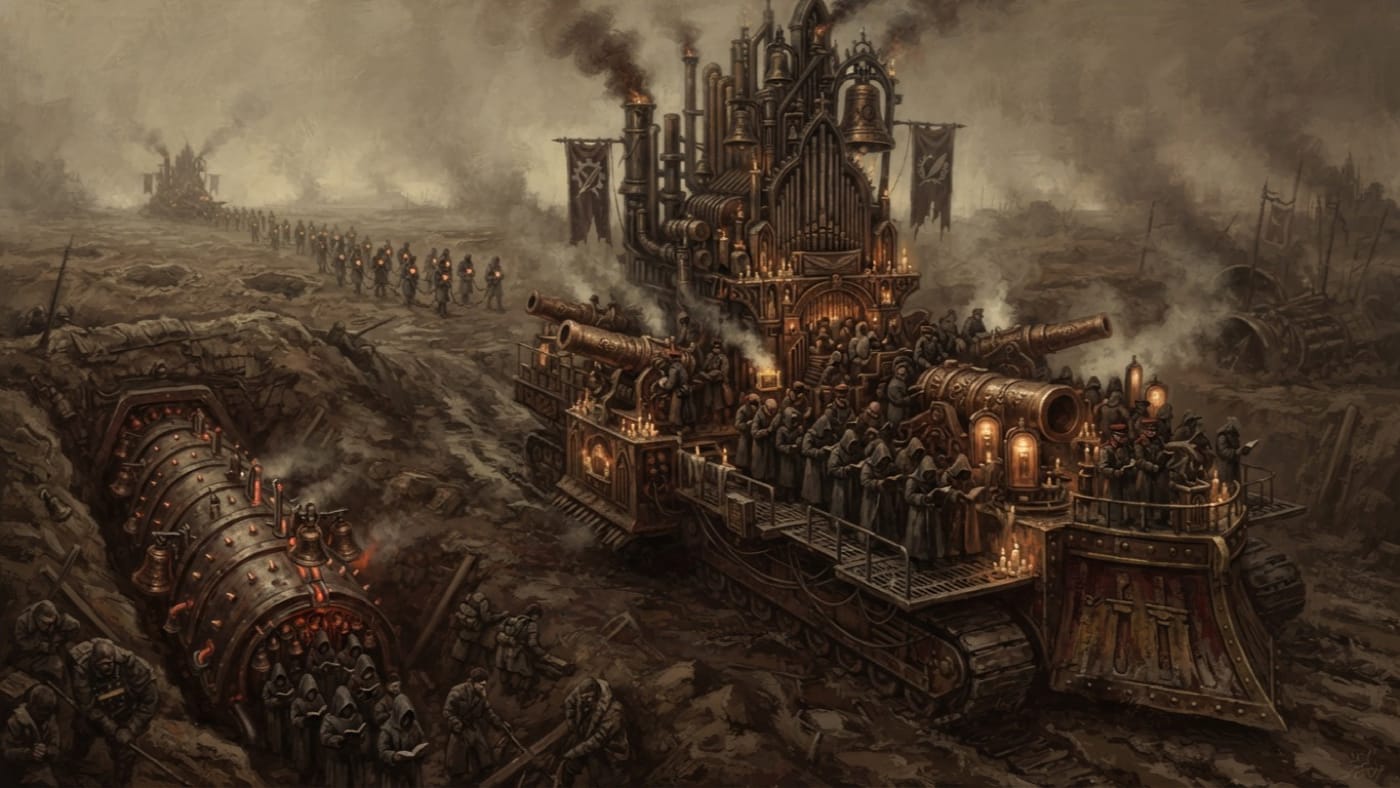
Older papers call the Sunken Choir a drone-tunnel. Newer ones call it a hymn-drive. The sappers who dig beside it use either name depending on whether it has moved that week. In its mobile form it is an armoured hull studded with iron bells that crawls through mud and clay below the enemy's works, with a choir wired into its throat. In its fixed form it is a gallery of singers dug into the sub-strata. In both forms it sings downward. The notes split trench timbers, cave in saps and fold bunkers into the clay. Men standing above it feel their teeth loosen in the gum and their pulse fall into a rhythm that is not their own. The soldiers call this earth-sickness. The Bureau calls it "sub-harmonic salvation."
The singers are boys whose throats have been surgically fused into resonant chambers. They are deafened on purpose so their own voices cannot unsettle them, and they take their cues by reading lips by candlelight in air thick enough to chew. The soot rots their eyes in time. Those who finish a tour come up with mouths still trembling on half-phrases that never resolve. Doctrine calls this "holy residue." The War Directorate's term is "spent casings," which at least has the merit of describing the inventory.
The engine also brings down friendly works, and the Line's own accounts say so. Our saps fall in with it at roughly the rate the Bureau of Purity convenes heresy trials. Some Choirs have sung their own roof down and buried themselves in sanctified mud with the crew still chanting inside. The Sagittal Line keeps deploying them anyway. Nothing breaks a stalemate like the earth suddenly giving way under the enemy.
STAMPED ERRATUM — BUREAU OF ORISON AND SONG, OFFICE OF THE WAR DIRECTORATE
Corrected pursuant to Third Quarterly Review, A.S. 200:
Sunken Choir personnel are classified "Liturgical Combatants, Voluntary" under Bureau of War Instrument 44-K. boys is replaced in all copies by "calibrated vocalists of appropriate developmental stage." The Bureau of Mercy's objection of A.S. 198 is noted and dismissed.
#On the Processional Arsenal
The Processional Arsenal is the Synod's habit of mounting a shrine on a gun platform and sending it to war. Shrine-barges work the rivers, rail crawlers the permanent way, and pontoons the crossings the engineers have not yet finished. Its most famous example is the Pilgrim's Ladder, a gutted diesel landship crowded with mortars, choirs, banners and pilgrims. When it moves, the pipes, the mortars and the psalmody all sound together in one bellow. Mortarmen kneel between bursts to light candles in niches black with soot. The choirs kneel at the rails.
The Shrine-Deck Crew work the guns by a fixed rite. Each crewman speaks his number at the start of the shift instead of his name. The Ward-Chalker renews the ring of chalk, ash paste and relic pins. The metronome bell is struck three times, and the choir and the recoil rigs are brought into step with it. Powder and shot go in by the bar of the hymn. The volley is fired on the sanctioned toll and no earlier. Shot type, time, purpose and authorising seal go into the ledger before the smoke clears, because an uncounted shot, as the decks put it, is a sin with legs. Then the barrels are swabbed, and any irregular round is confessed as a fault.
Three offices hold the rite together. Choir Runners carry cues the length of the deck. The Cadence Caller stands between voice and gun and answers for both. The Ordnance Deacon holds the seal, and with it the power to end a career with a single signature.
The machinery is not where the danger lies. The danger is cadence. A faltering choir, a dipping banner or a crew that misses the measure can drop a shell short into the pilgrims marching behind. A charge can go off in the lower holds. The hymn can come apart into a discord that leaves soldiers clutching their ears and bleeding from the eyes. Cut the hymn off altogether and the guns lose their count. When a volley lands between tolls, the crews say the deck goes hollow, as if something had answered it. Nobody aboard hums between tolls.
#On the Chorus Absolvers
The Chorus Absolvers show that the category reaches beyond hulls. They are elite choirs chained together and sent forward on foot, with vox-relics strapped to their chests that throw holy frequency across the field. Their hymns rattle the teeth of anyone in range and rupture lungs, the singers' own included. They sing until the vox-relics burn and the hymn turns into a scream, and the Directorate's register records the scream as a sustained note.
The War Directorate explains the chains as formation discipline. I have not asked what else they keep in order. No surgeon's hand has been recorded on their throats, and I record none. In this formation the singers themselves are the engine, and there is no hull to take the damage first.
#On the Expenditure
Every Choir-Engine draws from two columns. The material column is easy to read: diesel and boiler coal, shells, chalk, wax, relic pins, saint-ash, and hymnsteel poured at Essen under metered chant. The human column goes in by another hand. It covers hearing, eyes, throats, lungs and years. On the decks the choirs' throats are dosed with bitter tincture at day's end, and the singers drink black tea and spit once over the rail. At Essen the calibration singers are filled by a voice tithe on certain classes, and their quarters smell of boiled herbs and throat-blood.
Faults travel down the supply line. A single altered cadence in a pour-stanza can leave a flaw in a casting that no inspector will see until it fails. Bell-cannon throats have come back from the Line cracked in the same place. Safety records at the foundries are kept with a care that does not always extend to accuracy. A current procurement mandate demands more hymn-driven siege engines. Orison refuses to raise the tempo without what it calls "liturgical stability," and Engines threatens forced conscription if it will not. Records profits whichever way it goes.
The Bureau of Mercy objected in A.S. 198 to the treatment of the Sunken Choir's personnel. Two years later the Third Quarterly Review reclassified those personnel as volunteers, and production went on without a day's delay. The Bureau of Conscription has assured the Synod, on the record, that boys remain plentiful.
#On Interference and Continued Service
Grace and sorcery do not cross blades when they meet. They interfere. A Processional Arsenal once drove its drones into the Vales of Stagnance and flooded Syrion's fog with psalm. The torpor lifted, and soldiers shook themselves awake in mid-stride. Every listener aged by months in a single afternoon. Beardless boys grew whiskers, and grey came into hair that had been brown at noon. The Bureau of Rites has never said why the listeners paid the bill instead of the singers alone. The Synod ruled the sacrifice acceptable.
The Sunken Choir draws counter-sorceries the way a lamp draws moths. They include tremors forged by Wrath, Lust's perfume-fogs rising through the fissures it opens, and mirror-vents that throw its own hymn back at it. A Ladder caught in a Silence Dome loses its hymn and then its count. The Bureau of Engineering once circulated a memorandum noting that high-pressure reliquary events correlate with new Wound-Sites. The memorandum was confiscated and its author reassigned. Doctrine ruled the correlation coincidental. The Choir-Engines continue in service.
As of A.S. 201, the order stands licensed, managed and funded. Its supply of singers is replenished by Conscription, and its losses are reconciled by Records. The War Directorate has reported no shortage that a revised classification could not cover. It has requested additional hulls.