
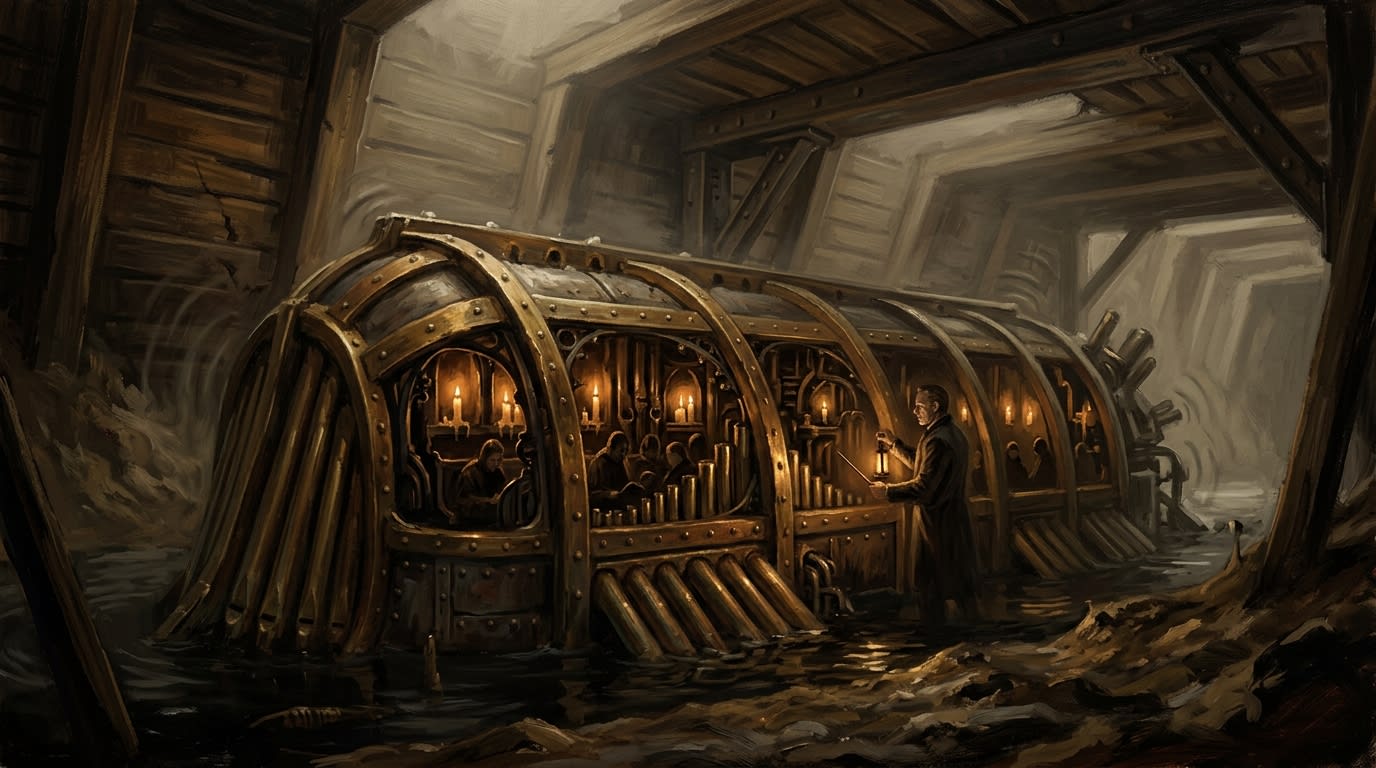
#On the Engine Beneath the Hymn
The Sunken Choir is a Choir-Engine, which is to say an atrocity granted sufficient paperwork to become equipment. It belongs doctrinally to Miracles and Sorcery, operationally to the War Directorate of the Bureau of Orison and Song, anatomically to the Bureau of Conscription, and morally to that locked drawer in every institution where the useful sins are kept until victory needs them.
It is called a choir because it sings. It is called sunken because it sings underground. These two facts, placed beside one another, have permitted three Bureaus to avoid saying the third: the singers are boys whose throats have been cut, sutured, braced, and tuned into resonant chambers so that a note, sustained under pressure, may persuade enemy tunnels to die.
The machine itself resembles a mobile burial chapel forced to crawl. Armoured plates, mud-screws, bell-studs, relic-bone vibration pins, sump drains, candle slots, and a narrow output throat run through its belly. The boys sit in iron collars along the drone-tunnel, backs fixed to hymn-boards, mouths held at sanctioned aperture by silvered braces. A conductor, usually deaf in one ear and pious in neither, watches their lips by lamp and beats time against a copper rail. The rail carries the rhythm into the hull. The hull carries it into clay. The clay learns obedience.
#On Harmonic Collapse
Enemy saps are patient heresies. They move below battle, under wire, beneath prayer, past graves, past latrines, past roots that have drunk enough soldier-blood to acquire opinions. The Great Deceiver's diggers learned early that a wall may be spared by ignoring it and placing violence underneath. The Sunken Choir answers this discourtesy with sound.
A Choir does not merely make noise. Noise is tavern work. It emits a sub-harmonic psalm tuned to soil density, timber age, bone content, groundwater pressure, and the tolerances of whatever enemy architecture is being corrected. Too low, and the trench above sickens without breaking. Too high, and the Choir cooks its own throats in the first minute. Properly tuned, the note travels through mud like a writ through frightened clerks. Supports shudder. Brick dust falls. Prayer niches crack. A tunnel roof accepts the argument and comes down.
The men above call the effect earth-sickness. Teeth ache. Blood beats in the ears. Nails loosen. Rifles hum against palms. Candles grow short blue tongues and bow toward the ground. Veterans at Bastion-Brest know the first tremor and lie flat with mouths open, because a closed jaw will betray its owner by keeping his teeth. Recruits stand. Recruits learn. The Bureau issues cotton wads and a pamphlet. The cotton is useful.
The first formal deployment recorded under current doctrine occurred after the Concordat of Strasbourg, when the early Line works discovered that eastern sapping outpaced surface artillery. Prior experiments had been conducted in quarry chapels, wine tunnels, collapsed monasteries, and one municipal drain beneath Metz whose rats sang for six weeks afterward. The Bureau calls these trials. The rats left no signed consent.
#On the Boys
The vocal cohort is selected before the voice breaks. The term is “selected,” and the reader will observe the delicacy with which a terrible verb kneels before a prettier one. Parish registers are reviewed for pitch, lung depth, dental spacing, obedience marks, and family tax arrears. A boy with a clean treble and a father behind on tithe enters the Lord's service with admirable speed.
Surgery fuses selected throat structures into reinforced resonant chambers. The medical drawings are precise, almost tender, which is worse. Deafening follows, officially to preserve the cohort from feedback trauma, practically to ensure the boys cannot hear themselves becoming instruments. They learn by lip, lamp, rod, and vibration. They sleep in warm rooms beneath Orison houses, fed broth through silver tubes during recovery. The Bureau of Mercy objects at scheduled intervals and files its objections in black-edged folders. Production continues.
Earlier Orison manuals used the phrase “boys packed into drone-tunnels.”
Corrected by Third Quarterly Review, A.S. 200. Approved wording: “voluntary liturgical combatants arranged within resonant service architecture.” The correction improves nothing except the conscience of the man reading it aloud.
Those who survive a tour do not speak. Some whistle. Some move their lips in sleep. Some press their hands to walls and smile when distant wagons pass. The Sunken Choir 9th Drone-Team survived three collapses, emerged entirely mute, and received promotion as a unit. Promotion consisted of better blankets, a brass plaque, and continued service. The plaque is polished weekly by a child too young for selection, which the Bureau regards as humane sequencing.
MERCY OBSERVER'S NOTE — 9TH DRONE-TEAM, POST-COLLAPSE III Subject A-7 placed both palms on infirmary floor at 03:12 and began silent response pattern. No audible sound emitted. Floorboards vibrated in antiphonal cadence. Three patients beneath adjacent ward suffocated when ceiling plaster descended into their mouths. Observer recommendation: remove floor. War Directorate response: promote cohort; restrict observer.
#On Failures of Soil
The Sunken Choir succeeds often enough to remain holy. It fails often enough to remain bureaucratic.
Soil resents sanctity when sanctity is delivered by auger. Chalk carries differently than clay. Wet loam eats the lower notes. Mountain stone returns the hymn like an insult. Morwen's mirror-vents have turned Choir notes back upon their own chambers, reducing vocal cohorts to red foam and leaving Orison engineers to classify the event as enemy sabotage with a perfectly steady hand. Maldrake's Wrath-forged tremors have struck at the same moment as Choir deployment, producing collapses so wide that both front lines vanished and the maps gained a blank space no clerk wished to measure.
The old Lore Book preserves three examples from a later and less geographically corrected tradition: Kraków, Metz, Thessalonica. The names remain useful though the dating has been brought under stricter discipline. At Kraków, a Choir brought down observatory, barracks, and southern trench in one groaning descent; survivors reported Magnificat tones from underground after the engine was already buried. At Metz, Envy's counter-song drowned the Choir in its own hymn and two Covenant battalions with it. At Thessaloniki, a Choir operated seventeen days under Wrath pressure, collapsed a hammer-host sap, and unearthed bones glowing in the rubble.
Records once classified Metz as “enemy sabotage, no friendly doctrinal implication.”
Clarified. Enemy sabotage remains affirmed. Friendly doctrinal implication is now restricted to lessons learned, procurement adjustments, and the blessed mystery by which two battalions may be absent while victory statistics remain intact.
The Bureau of Engineering dislikes the Sunken Choir for professional reasons. It shakes tunnels without asking permission from the men responsible for tunnels. The Bureau of War likes it for equally professional reasons. It kills enemies already hiding from artillery. Orison loves it because Orison loves every machine that proves sound can command matter. Conscription loves it because requisitions are easy when the form requests treble assets instead of sons.
#On the Present Licence
As of A.S. 201, Sunken Choir sections exist beneath several Line sectors, with known training houses at Essen-of-Hymnsteel, Mainz, and the Strasbourg Cloister of Calibrated Breath. Their forward use is heaviest in flat sapping country and least reliable in mountain sectors, though Bastion-Irongate maintains emergency Choir access in case counterkey heresy and enemy tunnelling become indistinguishable, which they often do when everyone is frightened and underground.
The licence is renewed under Standing Order 44-K each quarter. The form requires casualty expectation, soil expectation, voice expectation, Mercy objection, War necessity, Orison seal, and Conscription attestation. The attestation reads, in its most recent revision: “Supply remains sufficient.” It used to read: “Boys remain plentiful.”
The Sunken Choir is filed among sanctioned orders because it preserves the world while spending flesh inside it. Sorcery wounds Creation and calls the wound power. Miracle wounds the obedient and calls the wound price. The distinction is the whole moral architecture of the Synod, and if it appears narrow, kindly remember that civilisation itself often balances on a line no wider than a boy's throat.