

#On Two Irons and the Habit of Confusing Them
Thessaloniki keeps two harbour chains, and for its whole Synodal life the city has called them by the names of the buildings that hold their ends. The Elder chain answers to the western chain-head beneath the Elder Tower. The Younger chain answers to the eastern spit and the Younger Tower. The installation surveys list the Elder as the primary chain and the Younger as the secondary. The names are borrowed. The iron is its own.
This survey, sealed in A.S. 201, takes the chains as its subject: the links, the runs above and below the water, the windlasses that move them, the hands that keep them and the peals that tell those hands when to pull. It does not date their forging. No folio presented to this office fixes the year either chain was made, the smith who made it or the order in which its links were laid. I will not invent one simply because an infobox has a hole in it.
The distinction matters because the bells failed and the iron did not. An office that cannot tell the two apart will spend a century learning the wrong lesson from that fact.
#On the Links Above and the Links Below
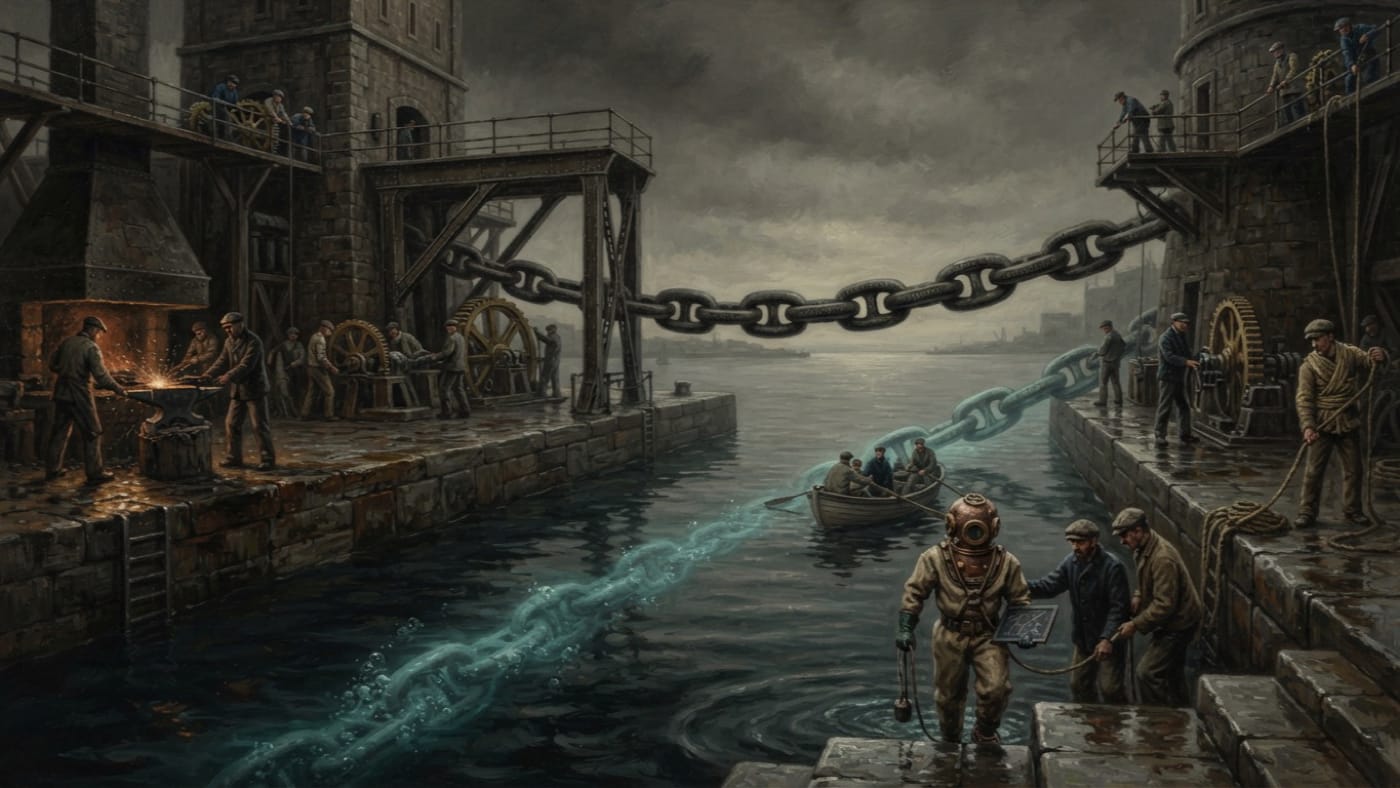
The working iron has two conditions. Above the water, the visible run hangs where gallery walkers can reach it with mallet, chalk and oil. Below it, the submerged run goes where only divers follow. Each link is large enough to smash a cart. Each carries psalm-script cut into its face, and each wears corrosion in patterns the Chainwrights read the way a confessor reads a penitent's hands.
The published accounts describe the gate as arcing over and under the harbour between the two towers. They do not say how two chains share that span: whether they run side by side, meet at a joint, lie at different depths or answer separate windlasses on separate days. I have asked. The Custodians answered with the look they keep for questions that would be dangerous to answer correctly and expensive to answer wrongly. The course of each chain is left blank in this record, and the blank is honest.
The labour around the links is better documented. Forge crews on the forge piers inspect pins, collars, hinge plates and sacrificial bolts. Windlass men wake the gears before the harbour wakes. Rope Hands keep the lashings. Oil Pages haul grease along iron walks where the rail is the only theology anyone trusts. Tower hands scrub off salt that will be back before supper. The psalms on the links were cut to be read by water and touched by divers. The clerks who admire them from the Ledger Steps admire them from a distance their tailors chose.
#On the Passage and Its Peals
The bells keep the schedule. The chains do the work. Inland writers confuse the two more often than they make any other mistake.
The dawn peal runs lower then higher, and the harbour opens. The dusk peal runs higher then lower, and the harbour seals. The storm peal sounds both, dissonant enough to stop conversation in the chandlers' shops. When the peal authorises motion, the windlass crews move the iron. When it authorises nothing, the iron stays where Kosta's people last set it. In the whole history of the port, no bell has ever lifted a link. A bell only tells the men who do.
Lawful passage under the chains needs six witnesses: Bell, Chain, Ledger, Tide, Pilot and Eye. Bell authorises the hour. Chain hums under the weight of the hull. Ledger records the claim, and the Harbor Ledger Office keeps it. Tide permits the physics. Pilot answers for the route. Eye is the Custodian posted at the gate's throat, who watches whether a ship comes in as its papers say or as its draught confesses. The Bureau of Records treats Ledger as the senior witness. The Chainwrights treat it as the easiest to forge, and Records has never answered their reasoning.
The chain's hum goes into the logs as the second witness, and here the institutions and the harbour part company. Records calls the hum a registration effect. The Bureau of Rites holds the chains to be consecrated instruments and the hum to be their answer. The Custodians call it information, and they stop any ship whose hum lags behind its hull. Each party keeps its own book. Only one of them is standing on the iron when it matters.
#On the Matronate's Veto
The submerged run is inspected by the Diver-Matronate, whose authority over that iron is independent of every dry office in the city. Divers go down with scraper, lamp, weighted line, palm slate and link gauge. They test the psalm cuts for corrosion and feel for stress through the palm before any instrument admits it. A Diver-Matron may end a descent without asking anyone. A Diver-Matron may condemn a link from the water and force a harbour hold before a Chainmaster has signed the reason.
This arrangement offends the hierarchy and keeps ships afloat. I have read the complaints of superiors overruled from below the waterline. They are eloquent, aggrieved and dry.
#On the Silence and What the Iron Kept
On the evening of 14 Ashmonth, A.S. 198, Andros Pell struck the Elder bell and heard nothing. Katerin Liss struck the Younger and met the same absence. The clappers moved. The instruments registered force. The air carried no tone. The Silence of Thessaloniki had begun, and for seventy-two hours the chain-gate protocol had no voice.
Kosta held the gates open and did not wait for permission. Runners went to the Ledger Steps. Crews stood at the windlasses. Divers were readied. No vessel passed beneath silent iron without witness. The harbour did not panic, because the Custodians gave it tasks, and tasks are the only sedative a port will accept.
Sera went down to the submerged links. By Sera's report, the iron kept the dawn-and-dusk sequence the bells had dropped: lower then higher in the morning, higher then lower in the evening, for all three days. No surface instrument detected any of it. The published accounts rest the finding on Sera's palms, with supporting testimony from Quarantine and the Refugee Sheds. Meanwhile Nenos refused all passage on the grounds that the sea was listening too hard. The vessels under Nenos's guidance survived.
What moved the links is still unestablished. Harbour talk and Custodian precaution both name the Drowned Choir. The Bureau of Doctrine's determination on the event names no examiner at all. I drafted that determination, so I know exactly how little it says.
On the fourth dawn the bells came back with their tones exchanged: the Elder sounding the Younger's note, the Younger sounding the Elder's. The reversal belongs to the bronze. Each chain kept its name and its chain-head, and nothing in the record suggests either one took the other's place.
#On the Present Survey
In A.S. 201 both chains are working. Ships pass under them by peal, permit and six witnesses. The bells ring in each other's voices. The windlass crews have learned to hear the reversed notes as the correct instructions, which is more than several Bells inspectors have managed.
The chains sag by small measurements. Officials dismiss the figures, and the Chainwrights, by their own account, dream about them. Sera reports shifts in the hum patterns of the submerged run. Nobody has shown that any of this foretells a failure, and nobody has shown that it is harmless. It is observation, logged and argued over by the people who hold the iron and the people who hold the forms.
Auditors are expected under the present acoustic suspicion. They will ask whether the Custodians can prove what the chains did during the Silence. They will ask whether gate command should pass to the Ledger Office in any future failure. The Custodians will answer the first question with Sera's slates and the second with silence, and the harbour will go on opening at dawn, lower then higher, in whichever bell's voice the bronze now prefers.
"Between them, the chain arcs over and under the harbour." — Custodians of the Chain, On the Towers, Links, and Daily Labour.
Corrected for this survey. Thessaloniki keeps two chains, the Elder and the Younger, distinct in name and in chain-head. The singular was shorthand, and shorthand is how inland clerks lose count of iron.