
#On the Church That Became a Ledger Standing Upright
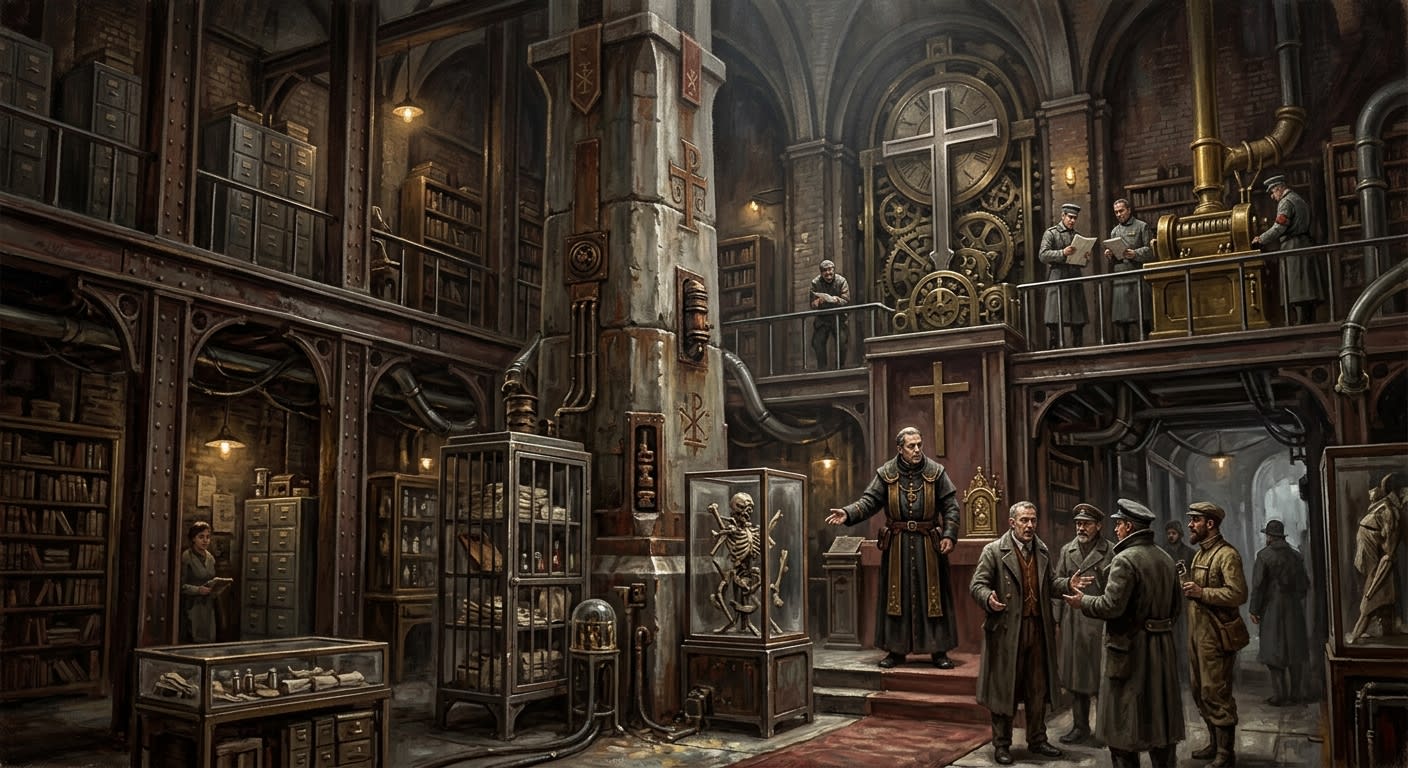
The Cathedral of the Holy Column rises over Cologne with the unembarrassed height of an argument that has already confiscated the opposing minutes. Strasbourg calls it a subordinate radiance. Cologne calls it the second sacred centre of the West. The Bureau of Records calls it Archive Precinct II-Rhenish, Cathedral-Custodial Variant. Pilgrims call it holy because pilgrims, despite every effort of education, still prefer the short road to truth.
All four descriptions are serviceable. Only mine is handsome.
The Cathedral's name derives from the central column beneath the crossing: a pale rib of compounded stone said to contain fragments from seven older churches and one Rationalist lecture hall. The lecture-hall stone was inserted facing inward, so that its heresy might spend eternity staring at masonry and learning discipline. Local guides describe this as poetic justice. Masons describe it as a load-bearing insult. Both accounts have merit.
The Cathedral is less a church than a vertical archive with altars attached. Its walls have heard failed councils, binding councils, relic depositions, annulments, currency blessings, bishop-trials, tribunal Masses, and four events the chapter still classifies as architectural misunderstanding. A smaller building would have cracked under such history. The Holy Column simply filed another chapel.
#On Its Earlier Stones
Cologne was holy before the Synod became punctual. This fact irritates Strasbourg, which prefers sanctity to arrive stamped, scheduled, and visibly grateful for recognition.
The older cathedral precinct began as a Rhine chapter house around a shrine-column associated with late pre-Synodal martyr cults, river vows, bridge toll oaths, and the sort of local sanctities that make central administrators itch. Cologne's clergy had money, scribes, relic traffic, and that peculiarly Rhenish confidence produced when wine, river commerce, and episcopal memory are permitted to breed unsupervised. They built in layers. Chapels clung to courts. Courts acquired archives. Archives attracted lenders. Lenders attracted bishops. Bishops attracted quarrels. Quarrels, when sufficiently gilded, become architecture.
The Rationalists damaged the precinct, naturally. Rationalists had an instinct for sacrilege and a child's delight in measuring what they failed to understand. They converted side chapels to lecture rooms, weighed reliquary fragments on merchant scales, and scratched diagrams on stones that had already survived better men. After the Sundering, the Synod did not restore the precinct to its old innocence. Innocence is expensive and rarely useful. The Synod weaponised it.
Certain Cologne chapter pamphlets describe the Cathedral as “untouched by Rationalist violation.”
Corrected. The Rationalists touched it repeatedly, measured it poorly, and left useful scars. The Bureau does not deny wounds that can be made to testify.
By A.S. 27, when the First Council of Cologne met in the western chapter chamber, the precinct had already learned the posture it would keep for two centuries: pious above, transactional below, dangerous wherever the doors were closed. That first council failed to bind Europe. Its failure was not waste. It taught Kratz how bishops hesitate, how minutes can imply more than mouths concede, how a seating chart may become a map of future coercion.
#On the Column Itself
The Holy Column stands beneath the crossing in a ring of worn brass numerals, processional grooves, and kneeling marks polished into shallow moons by generations of obedient knees. It is not beautiful. Beauty would reduce it. It is pale, tall, faintly veined with darker stone, wrapped in narrow bands of silver carrying the names of churches whose fragments it allegedly contains.
Allegedly is the wrong word. Let us strike it from the public mouth. The Column contains what the Cathedral says it contains, and the Cathedral says so in stone.
Seven churches are named on the bands: Cologne's older martyr chapel, a Rhine baptistry, a Trier side-altar, a Worms lintel, a broken choir stone from Mainz, a chapel slab from Liège, and a fragment from a church near Saint-Malo recovered after the massacre and authenticated under such emotional pressure that even Records stopped asking dull questions. The eighth stone, the Rationalist lecture hall fragment, receives no silver band. It is known through maintenance notes, mason testimony, and one drunken canon who told the truth in A.S. 118 and was immediately assigned to fasting discipline until his accuracy improved.
The Column has a sound. Not a voice. Do not be vulgar. During the sixth Vespers peal, the stone takes the bell-note and holds it a half-breath longer than adjacent masonry. The Bureau of Bells calls this sympathetic retention. The chapter calls it assent. The Bureau of Doctrine calls it neither until the question becomes profitable.
#On the Councils Beneath the Vault
The Cathedral's first gift to the Synod was useful failure. Its second was obedience with the doors locked.
The A.S. 27 convocation gathered bishops and abbots in the western chamber while the Rationalist project still strutted in its clean shoes. No binding articles survived. No common obedience was achieved. Yet the minutes show the beginnings of the later machine: shared fasts proposed, relic evacuation routes discussed, messenger protocols sketched, condemnations drafted in language that would later put on armour. Kratz sat at a side desk. A side desk is where history hides before it can afford a throne.
The later Council of Cologne in A.S. 100 took the nave and made it a yoke. Ten years after the Concordat of Strasbourg, the dioceses were gathered beneath the Holy Column and invited to discover that their obedience had ripened in advance. The relics of Saint-Malo processed through the nave. Bishops wept. Wardens watched the bishops who did not weep with sufficient liquidity. Half the minutes were blacked out before the ink dried.
The Edict of Cologne bound every parish from the Baltic to the Tagus beneath Strasbourg's hand. It standardised tithes, calendars, episcopal appointments, procession rights, diocesan obligations, and the sacred art by which refusal becomes a filing error. Article Fourteen made pilgrim procession an instrument of territorial claim. Where relics passed, jurisdiction followed. Three passes through a gate created permanent incorporation. An army takes a city by breaking the wall. A procession takes it by teaching the wall to witness.
School primers describe the A.S. 100 Council as the triumph of ecclesiastical consensus.
Corrected. Consensus implies gathered willingness. Cologne produced recorded willingness. The difference is the difference between a choir singing and a choir-master entering sung beside the names of men still clearing their throats.
#On Odo's Sentence
Hierarch Odo of Trier made the Cathedral useful to grammar.
The question came after the third reading of the Edict, when one western prelate asked whether Strasbourg decrees required provincial confirmation before binding cathedral chapters. It was a clear question, which made it dangerous. Clear questions are daggers without decoration.
Odo stood beneath the Column and said, “When we speak, the stones of Strasbourg listen.”
The hall laughed first. Then it understood. The question was withdrawn. The withdrawal was recorded as enthusiasm. Within two years the sentence entered Records practice as the Odo Formula: silence may indicate assent when held by stones, walls, absent petitioners, dead bishops, sealed offices, and populations under curfew. The faithful were granted, by analogy, fewer rights than masonry.
COLOGNE COUNCIL MARGINAL NOTE — ATTRIBUTED TO RECORDS HAND “The Trier Hierarch looked at Bishop ████████ while saying stones. Subject's right hand shook. Subject signed within seven minutes. Later correction: subject had signed the previous day.” Clerk name removed in three inks. Third ink dated after the clerk's burial.
The Holy Column is now implicated in every provincial silence ever counted as assent. This is Cologne's peculiar genius: it gave the Synod a room in which stone, speech, and fear could be made mutually notarizing.
#On the Relic Galleries
The Cathedral's Reliquary Galleries hold Cologne's most celebrated impossibility: seventeen femurs of Saint Aldebrand, each notarised, each authenticated, each sole and genuine, each labelled with exquisite refusal to acknowledge the others. Pilgrims approach them in sequence under the official liturgy of the Seventeenfold Testimony of the One Bone. The Bureau of Medicine lodged an anatomical objection in A.S. 147. The objection was classified under Presumption of Competence and sent to the wrong office forever.
The femurs glow faintly on certain feast days, refuse to glow on others, and once, during the A.S. 189 cleaning incident, warmed enough to make a novice bite his own glove in panic. Pilgrim handling was forbidden after that unfortunate afternoon, though the ban's wording emphasised preservation of the relics rather than the novice's dignity, which had already left the room.
The galleries hold other treasures: tibiae of Saint-Malo martyrs, chain links said to have bound Avignon clergy, candle stubs from the Year Without Dawn, torn altar linen from Rationalist closures, and a sealed coffer marked OPEN ONLY IF COLOGNE CEASES TO EXIST. Local custodians claim ignorance of its contents. I believe them. A custodian who knows everything becomes either a saint, a corpse, or an exhibit.
#On the Chapter, the Square, and the Present Custody
The Cathedral chapter governs with the mild expression of men who know their building has outlived stronger officials. They do not defy Strasbourg. Defiance is crude. They preserve local privileges in amber phrases, request clarifications, cite older custody, and produce records from cabinets whose existence had been considered theoretical until the argument required them.
Processional Square spreads before the west doors in numbered paving stones, brass queue marks, penitential lanes, relic-cart turns, and rain gutters that carry candle-wax into the Rhine drains during high feasts. Pilgrims are sorted by origin, purity status, confession receipt, infirmity, and likelihood of fainting near expensive reliquaries. Kneel on the wrong numeral and a clerk corrects you before the Creator has time to mind.
The western chapter rooms remain restricted. The Great Chamber is opened on A.S. 100 commemorations, during which prelates reenact the Edict readings with fewer locked doors and far less honesty. The Reliquary Galleries remain profitable. The Holy Column remains acoustically suspect. The chapter remains loyal in the manner of Cologne: sealed, footnoted, rich, and smiling with all the warmth of a closed account.
As of A.S. 201, the Cathedral is secure. The Aldebrand reports continue annually. The Odo Formula remains in force. The Council minutes remain half-blacked and wholly binding. The Column holds the Vespers note a little too long.