

#On the Office in the Present Register
Countersignature: Front Prelate or War Registrar. (Burn Directive 7-C, standard sequence, line six)
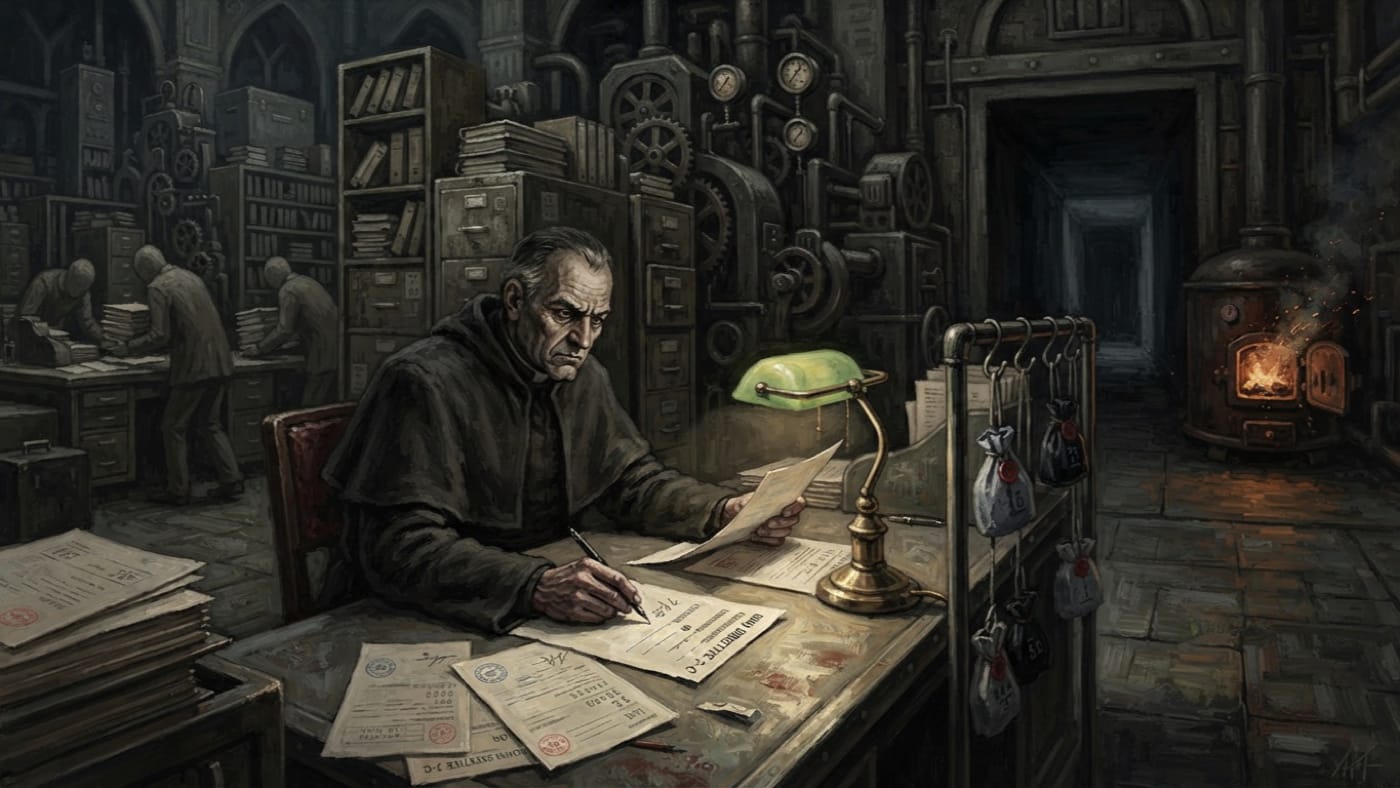
This survey was compiled in A.S. 201, which the secular almanacs insist on calling 1911 CE. Its subject is an office whose holders the record declines to name. In the papers of the Trench Courts, the War Registrar appears as a signature: bundle numbers above it, a date beside it, a hand at the foot, and after that a furnace that may lawfully open. Whatever else the office does elsewhere, this is the act that survives it. The act is enough to frighten every clerk on the Sagittal Line.
The profession's own lists give the fuller style, Synod War Registrar. They place it among the political patrons of the Trench-Court Clerk, beside the Front Prelate and the Judge-Delegate. The same lists answer the question every junior clerk asks sooner or later, which is who can ruin a man with one signature. The War Registrar is the first name given. That is a reputation, and it is also a job description written by the people underneath it.
I will not manufacture what the surviving papers do not supply. They record no first incumbent and no letters of appointment. They give no grade in the military establishment, no seat, no salary and no complete list of powers. The Front Registrar of the clerical ladder is a senior clerk and a different creature entirely. Anyone who confuses the two titles will be corrected by both, and the Front Registrar will be the ruder.
#On the Mandate Inherited
The office works inside a machine built after the Uncounted Winter. The Bureau dates that catastrophe anywhere from A.S. 87 to A.S. 91, depending on which file is speaking, and I leave the dispute where I found it. The arithmetic is not in dispute: fifty thousand dead without attestation. Under Synod law an unattested death is a legal fog. Widows could not remarry and children could not inherit. Pensions stalled, fraud multiplied, and the Bureau of Records learned that a corpse without paperwork goes on making trouble long after it stops making noise.

In A.S. 91 the Trench Courts were constituted under the Joint Mandate of Records and the Bureau of War. The same settlement codified the Contradiction Doctrine and issued Burn Directive 7-C. The Directive's command phrase, Cauterize on Receipt, is the shortest law the front obeys. Clerks would sit at the wound and write: name, unit, vow, bequest, statement, category. The Ledger would never again lose fifty thousand men by accident.
Instead it would lose their sentences on purpose, under countersignature. That is the point at which the War Registrar enters the documents.
I mean the documents and no more. A.S. 91 dates the framework: the courts, the Doctrine and the Directive. It does not date the office. The record does not tell me whether a War Registrar existed before the Directive named one, under that title or another, or whether the title was cut to fit a line on a form. I have searched with the diligence of a man paid by the folio. The title appears where a signature is needed, and I can cite it nowhere earlier.
#On the Bundle Before the Signature
The countersignature is the last clean thing in a dirty sequence, and it means nothing apart from the sequence that feeds it.
That sequence begins at a plank table under a lantern, where a dying man says something the war cannot afford. The bell did not ring. The captain ordered the retreat and then called the dead cowards. The ration sacks were sold. Some of these sentences are true and some are morphine, and the Doctrine does not pretend to know which. It asks a narrower question: does the sentence strike the approved account at a joint? Ordinary fear fails that test, and a boy begging water fails it worse. Grief is filed as grief. Contradiction is the sentence that, if repeated, would move a regiment, expose an officer, or teach a trench to doubt the bell.
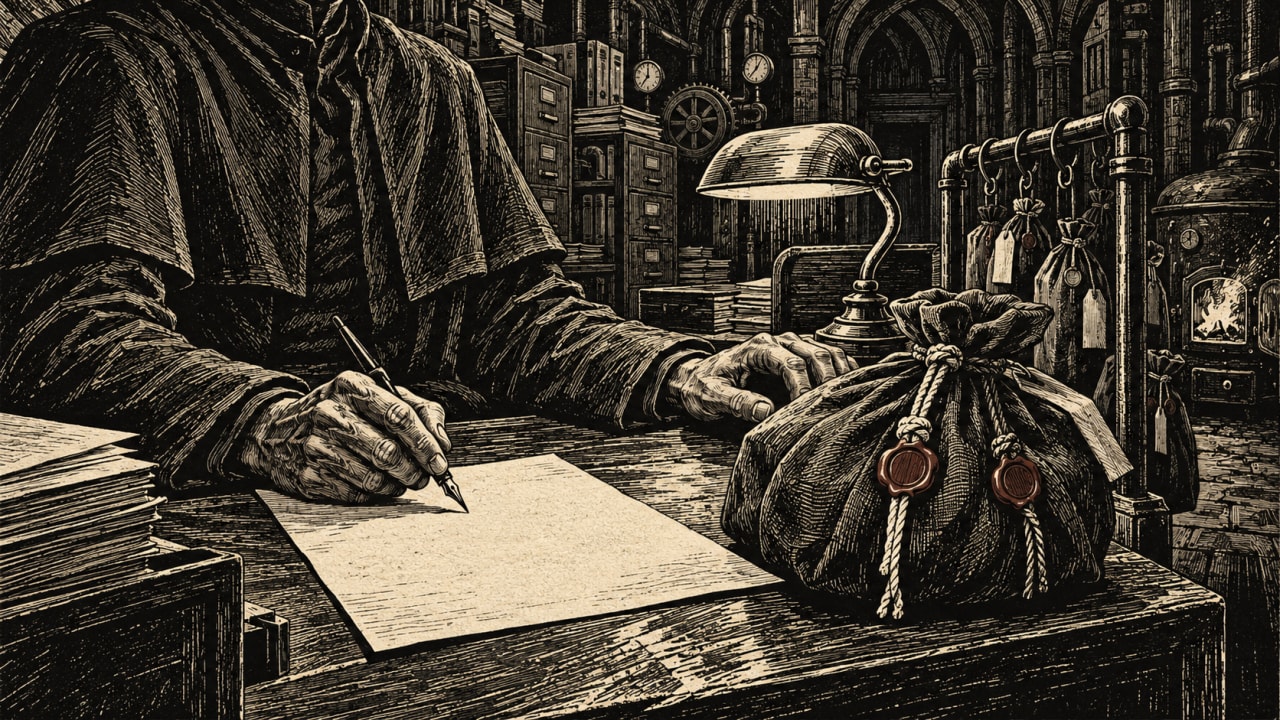
The clerk marks that sheet with sector code and doctrinal severity and seals it in the contradiction pouch. The pouch is waxed cloth, grey or black by sector, with a coded slash beside the unit designation that is deliberately unlike the ordinary Records stamp. Its mouth closes with two ties. One cord belongs to the clerk and the other to the supervisor, and each man answers for his own knot.
Keep that figure separate in your mind, because it causes confusion in the rear. Two ties on a pouch are a matter of custody: they record who closed the sack. They have no bearing on how many officials must sign the order that burns it.
The pouch receives a bundle number, and the number enters the register with no summary of contents. A courier carries the sealed object and its number, and his docket records the transfer. Nobody tells the courier what he carries. A courier who finds out has changed his profession from transport to evidence.
Meanwhile the man's death proceeds through its own channels, which is the Doctrine's one real kindness. His attestation stays in the ordinary ledger. Under the profession's best practice, his bequest slip travels apart from any confession, and his effects go on their own list. He can be dead in law, his widow notified and his boots reissued, while his accusation still hangs on a hook in wax.
Then comes the order. It is a single sheet carrying bundle numbers, a date and the authorising signature. It gives no description and no reason.
This is the document the War Registrar signs, and it should be described exactly. The sheet carries no summary of what it destroys. That is a fact about the sheet. It does not prove that the signatory never reads testimony, never asks to see a bundle, or never refuses. The papers do not say whether any War Registrar has opened a pouch before signing or sent one back. The form has simply been built so that nothing on it requires the signatory to do either.
#On the Alternative Countersignatories
The rule is written down twice, in two documents meant for different readers, and both say the same thing. In its standard sequence, Burn Directive 7-C gives countersignature to the Front Prelate or the War Registrar. The Contradiction Doctrine, describing the pouch, sends the sealed bundle by courier for countersignature from the Front Prelate or the War Registrar. Either hand makes the furnace lawful. So far as anything is written, that "or" is the whole constitution of the matter.
By its title, one office belongs to the Church's field ministry. The other carries War in its name. The Directive treats them as interchangeable at the foot of the sheet. It says nothing about how they divide the work, whether by sector, by convenience or by who happens to be awake. I have read no table allocating the work between them, and I would distrust one that turned up now.
I have seen one burn order bearing both signatures. I set it beside the rule, and I do not let it swallow the rule. The record no longer says where or when I saw it. I will not borrow a date from my tour of Bastion-Przemyśl in A.S. 196 simply because it is the date I have to hand. The sheet gave no reason for its two names, because burn orders give no reasons. A disputed bundle, an officer of awkward rank, a nervous season, two officials who wished to share the credit: any of these would explain it, and the sheet chose none. One sheet proves only that one sheet existed.
Count the hands, then, since the Bureau prefers them uncounted. The clerk hears and classifies. The supervisor ties the second cord and reconciles tags against bodies. The courier carries. The Contradiction Custodian checks wax, ties, code and damp, then chooses a route. An attendant feeds the iron. The judges of the courts hear the living, and the Cadence Examiners take the pages that speak wrongly. On the evidence available, the War Registrar does none of these things. The office authorises them, from wherever it keeps its ink, on the strength of numbers.
#On What Reaches the Order
The order sees bundle numbers. What becomes a bundle number is decided lower down, and that deciding is where the money lives.
Rubric Clerks compress. A long accusation becomes a severity code and a thick confession becomes a category. The queue moves, and the widow's pension moves with it. Record-True Clerks preserve. They keep exact wording and hide duplicate slips under their blotters. They delay transfers by pleading damp, shelling, a shortage of wax or a missing courier. The two factions quarrel over what reaches the signature and what can outlive it, and both deliver their work to the same line on the same sheet. In no paper I can cite has a War Registrar declared for either side. The office's allegiance in that schism is unrecorded, and enlisting it is not my business.
Below that line there is a market. A family pays to keep a son's doubt out of the pouch: a mercy seal enters contagious doubt as grief, and the words never reach a hook. An officer pays to have an accusation put in, or to have a bundle burned before audit. At Bastion-Przemyśl, lamp oil has bought reclassification. At Bastion-Constantinople, morphine and a promise do the same business with better manners. The clerks' list of people worth bribing runs to courier chiefs, trench captains, field chaplains and audit liaisons, who are the men one pays to avoid a ruinous signature. The Bureau of Purity knows and tolerates most of it. No document I have seen puts the signatory's own hand on the money, and I will not put it there by implication.
The office's hand does not need to be there. By the time a pouch is numbered, whatever was for sale has already been bought, and the countersignature turns the result into procedure. Once an accusation against a captain has burned under a regular order, nobody can raise it against him again, except a Record-True Clerk with a duplicate and the nerve to use it.
The consequences are paid in paper. A category decides whether a family receives full benefits, reduced benefits with an annotation, or a standardised notice with nothing behind it. A delayed pouch can freeze an inheritance. A hasty one can burn the only witness to a theft. When a bequest slip strays into a confession bundle, and the furnace accounts show that such slips do stray, it can keep a pair of boots in a quartermaster's store forever. The Records Scribe in the rear inherits whichever mistake the front preferred. The burn does not undo a legal death, because the attestation sits in its own ledger. What it undoes is the possibility of argument.
An instructional pamphlet of A.S. 104 described the Doctrine as "the humane preservation of morale-sensitive testimony."
Corrected. Under the Doctrine, preservation lasts from the clerk's knot to the countersignature. After that, the procedure humanely preserves two things: the bundle number and the signatory's good name.
#On Holds and Exceptions
A countersignature makes a burn lawful. It neither makes every burn mandatory nor reaches every bundle.
Routing belongs to the Custodian. Most pouches go to the furnace. Some go rearward for Records review under double seal and courier witness, often because an officer has enemies of equal rank. Some wait under a pension-delay hold until the family notification has gone out, so that the family's bread is not cut off by an accusation still under review. Some go to specialist review. Among the Custodians' own disposition marks is one for officer-sensitive bundles that calls for the Front Prelate's countersignature. "Unless inconvenient," the summary adds, with the candour of a man who expected no outside reader. That mark is a narrow provision for a narrow class of bundle. The summary does not say whether the War Registrar may stand in for the Prelate there as on the routine sheet, and I leave the question as open as I found it.
Cadence Anomaly leaves the ordinary route altogether. When speech arrives in a voice that does not fit its speaker, the exact wording is kept, and nobody repeats it without authority. Routine disposal waits for a Cadence Examiner unless contamination spreads, witnesses begin repeating the phrase, or the page addresses a living person by name. The supplements forbid War officers to "test operational utility." Field clerks report pages that will not catch until a name is spoken aloud, and ash with blue edges. Engineering reports nothing. I report the reports. Nothing in them requires an explanation from me, and I have none I would sign.
The papers do not say what the War Registrar may do against a Cadence hold, a rear-review route or a pension delay. A routine countersignature is a routine power. I decline to inflate it into an override just because the title has War in it.
#On the Present Compilation and Count
This survey closes where it opened: in A.S. 201, 1911 CE, compiled from the papers now available to a Doctrine desk. It records no inspection of the office, because none is on file for me to report. The present count is the only place where the office can be seen in any quantity.
Every licensed Trench Court keeps its contradiction pouches apart from its ordinary ledgers, and inspectors count the pouches first. The rest of their questions follow the number. How many pouches hung, and how many left? Which courier carried each one, and under whose countersignature? How long was the delay, which furnace log received the entry, and which ash drawer? The furnace is a squat iron box with a hinged mouth and a drawer, and the ash is cooled, weighed and filed as administrative waste. The register, the courier docket and the furnace log each hold the number. The Custodian's pouch index and ash drawer sheet hold the disposition and the weight. These are related records kept by different hands, and they are not one form. An auditor who reconciles them is reconciling five witnesses who never met.
The signature is the easiest question of all. The name at the foot of the sheet is legible, while the bundles it disposed of are not. The answer is the Front Prelate or the War Registrar, and on one sheet I saw, both. Any of these answers satisfies the column.
For the purposes of this compilation, the office is disposed of as follows. It exists in the register as a hand. It is attested at the foot of the routine order as the Prelate's alternative, and once beside the Prelate's. Its holders, its origin, its seat and its remaining powers are not entered, and this survey enters none of them on its behalf. The clerks never needed a survey. They already file the office under the heading their own lists gave it, the signature that can ruin a man, and I find nothing in the papers to amend.