
#On the Document
"Rendered for fortification use." — the standard wording of the destruction certificate
Form R-14 is the Standard Destruction Certificate of the Saint-Bone Melter trade. It is the last thing written about a relic before the relic becomes something nobody needs to write about again. Other hands and other paper settle, upstream, whether a bone may burn and whether it was ever holy. R-14 comes afterwards. It records, in the past tense, that certain fragments have gone through the kiln and the slaking pit and come out as sanctified mortar, and that the devotion they used to draw must now find another object.
The sheet is short. Measured by the wall it helps to mend, its consequences run the length of the Sagittal Line. Measured another way, they last as long as a shrine-keeper's memory, and the Bureau keeps no ledger for that.
#On the Origin
The Synod did not create the destruction certificate out of a love of forms, though I would not swear that no such love was involved. It created it because it had too many bones and too few sound walls. Battlefield harvests, ossuary surpluses and authentication backlogs produced more fragments than any shelf could hold, and the Line's appetite for lime had no bottom. At Bastion-Constantinople, during the Cracked Ring Sieges, walls sealed with bone-lime held where common mortar failed. The correlation became policy. In A.S. 96 (1806 CE) the Bureau of Tithes published the Saint-Bone Melting Acts and made the practice lawful. In A.S. 142 (1852 CE) the Purity Kiln Decree fixed the hymns and the heat.
R-14 was born somewhere in the paper between and after those two instruments. I cannot say where. I can certify no date for the form's first issue, and I will not invent a name for its drafter. The text reproduced below carries the notation Revised A.S. 198, which is 1908 CE. The plate accompanying the parent entry calls this the thirty-second revision. The Bureau has not explained the revisions, and the archive has produced none of the earlier texts. I record the number as I found it, with the respect owed to any document that has been revised thirty-two times and, in its present state, still ends on the sentence about the wall.
#On the Operative Clauses
The first sentence carries the material facts. The fragments arrive on the form already turned into a number. The extract I reproduce has no field for a saint's name. I have not seen the complete printed sheet, and I will not tell you what is in the parts I have not seen. Three verbs follow, all completed: calcined, slaked, incorporated. The undersigned confirms that mortar exists and that it was made to the specification of the Bureau of Rites. The certificate does not say the mortar has gone into a wall, and it says nothing of any mason's inspection. The wall appears only in the final sentence, in the future perfect, which is the tense the Synod uses for things it intends to be true.
The second sentence is theology, and its author is the institution, not the person holding the pen. The sanctity contained therein is hereby redistributed. The word "therein" assumes a containment that the undersigned has no means of proving. That person can swear to heat, water and aggregate. The holiness was assessed and graded earlier, by a Relic Authenticator, or by nobody, depending on which crate you mean and how busy that decade was. The doctrine says sanctity moves from the reliquary into the structure. R-14 repeats the doctrine and signs off on the lime.
The third sentence is the tenderest on the form, and it is written like a notice that a reading room has closed: no longer available for devotional access. The fourth calls the event a permanent reclassification. I admire the phrase without reservation. The bone is gone, and the Bureau has described this as a change of category. There is nothing left to reclassify back.
#On the Batch Desk
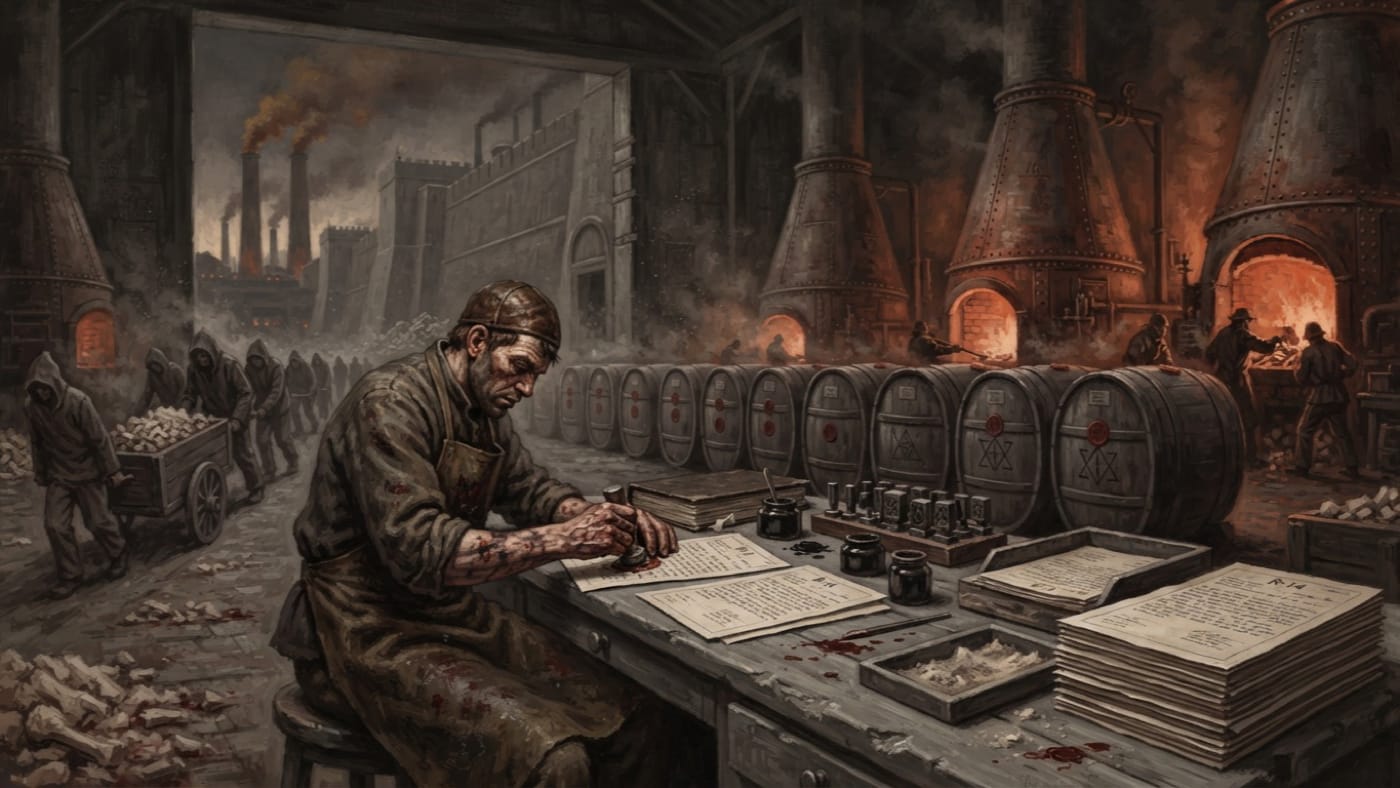
Certificates are written at the end of the day, during what the trade calls paper reconciliation. By then the slake pits have been sealed, the barrels stand in a row, and the shelf is grey with grit that gets into the ink, into the wax and into the cracks of the writer's knuckles.
The papers lie side by side, and none of them can stand in for another. Provenance tags came in with the crates. Intake classification sorted the fragments into renderable and protected. The batch log holds the ratios. Purity marks record compliance. The barrel seals are pressed in wax and carry the kiln number, the date, the Melter's personal stamp and a ward-line compatibility code that tells the receiving mason where the mortar may go. Those markings belong to the barrel, and I will not move them onto the certificate to make it look more complete. The bone-tags and ossuary registrations of a Ritual Bone-Stamper belong to yet another office and another drawer. R-14 is written last, because it can only certify what the others have already accounted for.
Here the arithmetic gets unpleasant. The kiln has already eaten what it ate. If the tags say eleven fragments and the log says nine, the certificate has to agree with something, and the person writing it has burned hands, a convoy at the gate and a petition from a shrine lying on the same shelf. The Melters write these certificates. The trade's middle rank includes Batch Scribes. The form names only "the undersigned" and does not say which rank must sign.
#On the Thirty Days
"Objections should be filed with the Bureau of Relics within thirty days."
The objection goes to the Bureau of Relics, which is correct. Relics holds custody and authentication, so a dispute over what a fragment was belongs there. The kiln yard answers to Rites for its specification, to the Bureau of Engineering for its standards and to Purity for everything else. None of them is named here.
What the clause leaves out deserves equal attention. It does not say when the thirty days begin, whether at the burn, the signature or the moment a shrine-keeper learns that the bone has gone. It does not say who must be told, or what a successful objection would win. I list these gaps and leave them unfilled. I have no ruling to fill them with, and a Hieromnemon who makes up an appeals procedure to finish a paragraph deserves to be the first one subjected to it.
Meanwhile the mortar moves. Rites holds that sanctified lime loses its efficacy when exposed, so the barrels must be covered, carried and applied within an operational window that the record does not state and that has nothing to do with the thirty days. Convoys leave. Masons point the seams. The objection period runs beside all this, an administrative process attached to a physical one, and the physical one does not wait.
Then the last line: After thirty days, the wall will have set. I have heard it called cruelty. I call it candour, set in type. It is the Bureau's joke and the Bureau's schedule in the same sentence. Taken as a technical promise about curing, it is worth exactly as much as any sentence printed on a form. It also tells the shrine-keeper the plain truth: the femur will not come back.
That does not make every objection pointless. The bone cannot be returned, but the classification that sent it to the kiln can still be questioned. A Melter who rendered protected stock is not made innocent because the mortar is dry. Grief should know where its objection is going, and the clause tells it.
The breach also has to be repaired. I state this without irony, because irony would be cheaper than the truth. A cracked curtain wall at the demon hour does not care how dear the reliquary was, and the people behind the wall would not thank us for sentiment. The certificate gives that need an approved vocabulary. Plenty of necessities have been given worse.
#On the Limits of Paper
R-14 cannot make a fragment eligible. Protected stock means fragments that are named, venerated or politically owned, and it stays protected whatever is written after the burn. A certificate filed over a protected bone is a confession on a printed form.
Nor can R-14 detect a lie told with the correct stamp. The trade knows two-batch blending, in which a forbidden fragment is "diluted" across several barrels, and seal mirroring, in which a correct stamp is pressed onto a barrel swapped in mid-convoy. A certificate can be accurate in every clause about a batch that is false from start to finish. That is why the trade has the insult "Wall-Liar": a person whose stamps claim a purity the batch cannot prove.
An earlier edition of the Saint-Bone Melter entry attributed the Purity Kiln Decrees to the Bureau of Purity.
The Decree of A.S. 142 was issued jointly by the Bureau of Rites and the Bureau of Engineering. The Bureau of Purity wrote its enforcement provisions. No part of this correction tells us who drafted Form R-14, and readers should not infer authorship of the form from authorship of the Decree.
When a batch behaves strangely, the paper gives way entirely. Black lime is described in the trade one way and in the parent entry another. I am not going to settle the difference here. The protocol for it is the same either way: quarantine the batch, seal the pit and send for a Purity Fume-Inspector. No destruction certificate clears suspect mortar. The Fume-Inspector decides what happens next, and whatever that decision is, nobody discusses it at the batch desk.