
#On the Proposition
Q. Are the Creator and the Great Deceiver one? A. That question is not in the Index. Recite Article One.
The entry on the Creator calls this the Heresy of the Complicit God. The present folio follows the current rule of narration and calls it the Heresy of the Complicit Creator. The reader is to understand one proposition under two titles, which is one more title than the Bureau admits the thing possesses.
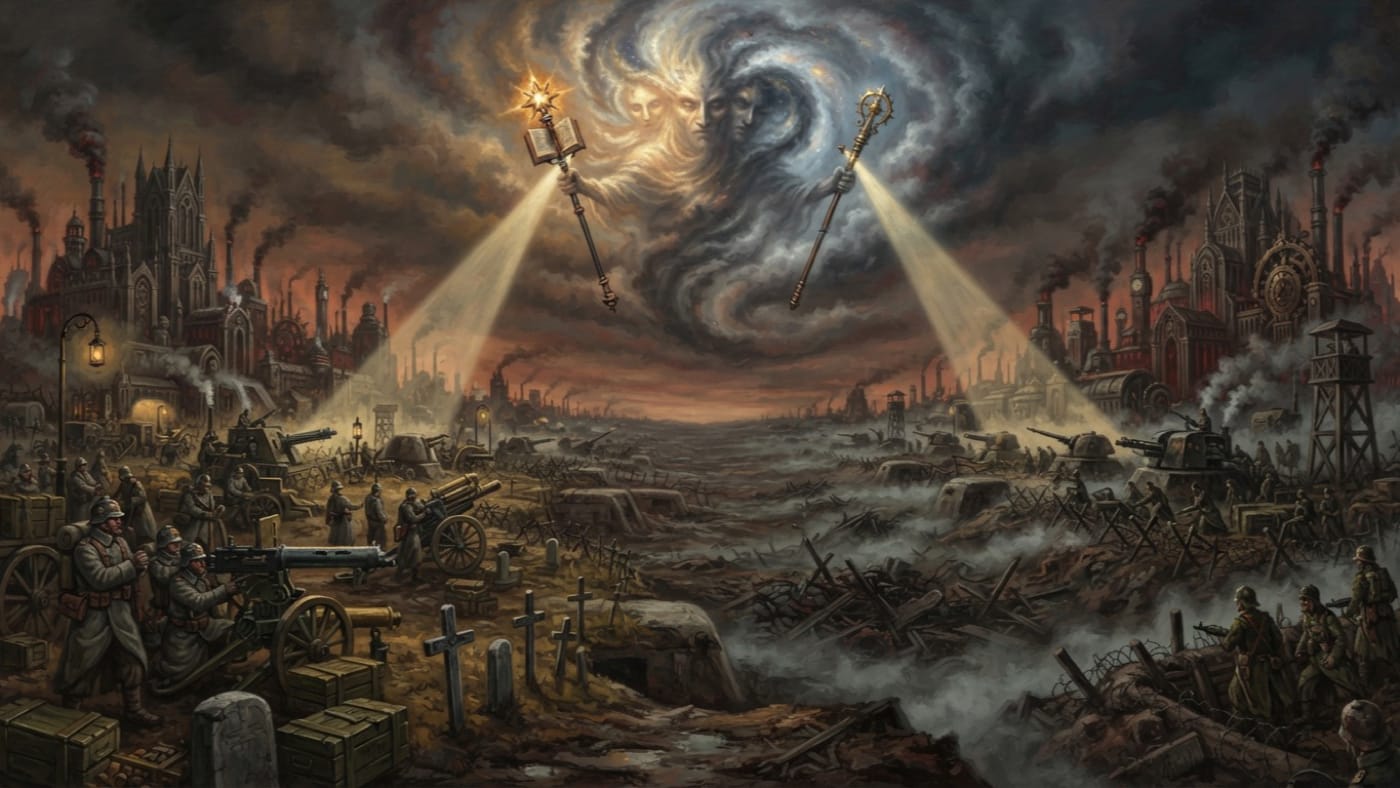
The proposition comes in two forms, and the Bureau of Doctrine condemns both with equal heat. The first holds that the Creator and the Great Deceiver are the same entity. The second thinks itself subtler and holds that they are two aspects of one entity, a single hand signing two names. Both reach the same conclusion. They say the war fought along the Sagittal Line for one hundred and fifty-six years is a performance, staged for a purpose the proposition itself does not claim to know.
The Bureau of Purity classifies the proposition among the heresies of the divine nature, and prosecutes it accordingly.
I am instructed to state that I have never encountered this heresy. I state it. I state it at the head of an entry written entirely about it, in a codex the faithful may read, under a seal certifying that the subject does not exist. Any reader who finds this arrangement strange has not worked long in Strasbourg.
#On Permission and Identity
The orthodox account already concedes more than the timid suppose. The Third Position, which Doctrine currently maintains, holds that the Adversary exists by divine permission. It holds that his existence is purposeful, and that the purpose, revealed at the Sundering, is to give mankind a foe worthy of mankind's faith. The faithful are therefore not asked to believe the Adversary crept into Creation unseen. Earlier catechisms blamed his presence on the Rationalists' sins, or on a breach opened by mortal hubris. The present catechism admits that he is allowed.
Permission joins two parties. The Third Position seats the Creator as examiner and makes the Adversary the examination: set, permitted, endured, and finally withdrawn in the fullness of perfect faith. Throughout, the examiner and the paper remain distinct. One may be petitioned against the other.
The Complicit proposition takes away the second chair. It seats the examiner across the table from himself and has him write the paper, sit it, and fail the candidate with both hands.
The consequences are not academic. Prayer for deliverance, under the proposition, goes to the party one asks to be delivered from. A choir that gives up its years to a relic pays into the same treasury the sorcerer robs from the far side of the Line. And the Synod's whole warrant rests on standing between: between grace and the Lie, the faithful and the fallen, the bells of Bastion-Königsberg and whatever answers them out of the fog. Take one party away and the Synod stops being a mediator. It becomes an usher.
The proposition does not say why. It offers no motive, no scheme, no appointed curtain. This is the most irritating thing about it. A heresy with a motive can be refuted by refuting the motive. A heresy that shrugs is much harder to brand.
#On the Evidence Adduced
The proposition's entire evidentiary estate is resemblance, and the Bureau supplied all of it. Every resemblance the heretic cites is printed in an approved manual.
First, the silence. Under the Doctrine of the Inaudible Voice, ratified at the Fourth Doctrinal Congress in A.S. 104, the Creator speaks in a register the mortal ear has not yet learned to hear. Synodal scholars describe the Great Deceiver, by contrast, as tireless: present in every blood-oath, every sorcerer's bargain, every hissed blasphemy. The heretic sets these side by side, one voice that never speaks and one that never stops, and suggests a ventriloquist.
Second, the answers. Relics glow. Bells ring with no hand on the rope. Consecrated ground holds where unconsecrated ground gives way. When the reliquary of Saint Aldebrand shattered a sorcerer-lord at the Siege of Vienna in A.S. 95, the event was recorded, notarized, and filed as Miracle, Category One. The proposition does not dispute the event. It disputes the filing. Its point is that one power from beyond the mortal sphere, carried in bone, struck another power from beyond the mortal sphere, carried in flesh, and that the Bureau's only instrument for telling them apart was which side of the field each stood on.
Third, the costs. Doctrine's distinction is exact. Miracles are given and sorcery is taken. A miracle charges its price to faithful bodies and communities, in hunger, in years, in memory, while sorcery charges the surrounding world. Doctrine holds further that grace preserves Creation. Certain engineers, in a note never meant to leave the bench, recorded a correlation between high-pressure reliquary events and new Wound-Sites. The bishops deny it and the engineers mutter it. I record both, and the record settles nothing.
From here the proposition leaps. It sees similar conduits, similar costs, and the same silence at the source, and from similarity it concludes identity. Two coins struck to the same weight were not thereby struck at the same mint. Two wounds of equal depth were not thereby cut by the same blade. Doctrine could make this argument in its own defence, and would, if making it did not require admitting that the question had been asked.
#On the War's Interpretation
The orthodox account of suffering is a curriculum. The war is the examination, and the bells are the sound of candidates passing it. The Creator's intervention is deferred until faith is perfect, a condition preached from the pulpit of the Basilica of the Ledgered Saints and never yet met. Under this account, the dead of Bastion-Constantinople were candidates, and their deaths are entered to their credit. The deferral is cruel. It is also graded.
Under the proposition, the examiner wrote the enemy as well, so the deferral is a stage direction. The rescue never comes because rescue was never in the script, and the faithful who wait for it are an audience that mistook itself for a cast. That is the proposition. I report it the way the Bureau of Records reports a fire: to locate it, not to warm my hands.
Let no reader leave this section with a softer war in mind. The proposition calls the war a performance. It never calls the bayonet a prop. Whatever the heretic supposes about the playwright, the northern trenches still flood in the thaw. The choir that pays for a Cathedral Act still loses its years, and the sentry at three in the morning still dies of his wound rather than of a metaphor. Demons that wear faces in the fog are none the less demons for being, as the heretic alleges, cast. The heresy offers the dead no comfort Doctrine has not already offered. It only takes away the grade.
#On the Unentered Classification
Doctrine defines the permitted vocabulary of Creation in the Index Claritatis, and any word left out of it is heretical by omission. Purity enforces those definitions through the Index Damnatus, with white mantles, writs, and fire. Between them the two Bureaus decide which thoughts may be named, which named thoughts are forbidden, and what follows for the people who think them.
Standing Order 7-A, issued in A.S. 92 and renewed in A.S. 187, declares all heresies concerning the divine nature first-order prohibited. The Order is broad. It covers the class, and a broad prohibition needs no list of members to be enforced.
The neighbouring heresies sit inside that class with their own entries. The Absent heresy holds that the Creator is dead and that the relics run on residual holiness. The Sleeping heresy holds that He sleeps and must not be woken. The Unnecessary heresy holds that the relics need no divine source at all. All three argue about the Creator's condition. The Complicit proposition argues about whether the Adversary exists as a separate party, and so about whether the Bureau needs to exist. The other three can be entered, numbered, and graded. This one cannot. Entering it would acknowledge it as possible, and a Bureau whose office is to stand between two powers does not register the possibility that there is only one.
The Bureau of Purity classifies the proposition among the heresies of the divine nature, and prosecutes it accordingly.
Corrected. That sentence, in the section of this entry titled On the Proposition, credited Purity with a classification it has not made. Standing Order 7-A prohibits the class and enters no member of it under this name. The sentence is withdrawn. The proposition remains prohibited and remains unclassified, and every reader who has reached this line is to hold both conditions at once.
#On What the Record Permits
The record permits three statements, and I enforce all three. The Creator is. The Creator is not the Great Deceiver; this is the first of the negative definitions, taught to every child who can hold a slate. The Adversary exists by permission, not by oversight.
The record does not permit a demonstration that the proposition is false. A demonstration requires a hearing, a hearing requires a docket, and a docket requires an entry. The Bureau has refused to make that entry, on grounds this folio has set out at a length its censor considers generous. So the identity question stays where Doctrine has placed it, outside the Index, outside the ledger, and outside this entry, which you have now finished reading.
Any cadet who brings me the question will get the answer printed under the first heading, a second recitation of Article One, and a quiet afternoon in which to reflect on the difference between a question and a career.