
#On the Roads Behind the Last Lock
"The Hintermark roads" is a plural that clerks use as a singular. No highway carries the name. No milestone announces it, and no surveyor has ever been paid to agree on where it starts. The phrase covers the whole worn network of supply ways running west of Bastion-Constantinople, through the orchards and foundry-towns of the Hintermark, toward Sofia and the larger southern system that keeps the Sagittal Line's southern anchor fed. Ask a carter which road he drives and he will name the town at the far end of his day. Ask the Bureau of War and it will name the fortress at the far end of everyone's.
Rail carries the bulk. Sofia's terminus sends trains southeast toward the Hintermark and Constantinople, and the region's coal and pig iron ride east on them by the trainload. The roads carry everything rail won't stop for: the village without a siding, the orchard gate, the foundry yard three miles from the nearest platform, the levy boy whose name was added to the roll on a Tuesday. A train is a sermon delivered to a cathedral. A wagon is a priest walking door to door, and the Hintermark has a great many doors.
#On Freight and Maintenance
The loads are recorded and dull, which is how one knows they matter. Coal goes to the Harbor of Chains. Pig iron and rivet stock go to the Foundry Quarter, along with overflow work that the Quarter's own furnaces cannot take at capacity. Foundry labour goes wherever it is told. Levy replacements go to the fortress. Coffin timber goes everywhere, eventually in both directions. Orchard fruit, thin and faintly sooted, goes into the supply economy beside preserved goods brought in from the coastal villages, which belong to the hinterland trade without belonging to the Hintermark itself, a distinction the villagers guard more jealously than their fishing rights.
Keska smelts and reworks. Edremit casts boiler throats, rivet stock, furnace collars, and casing rings. Between and around them, smaller places burn charcoal, sort scrap, and cut boards, and every one of those outputs has to reach a road before it can count as output.
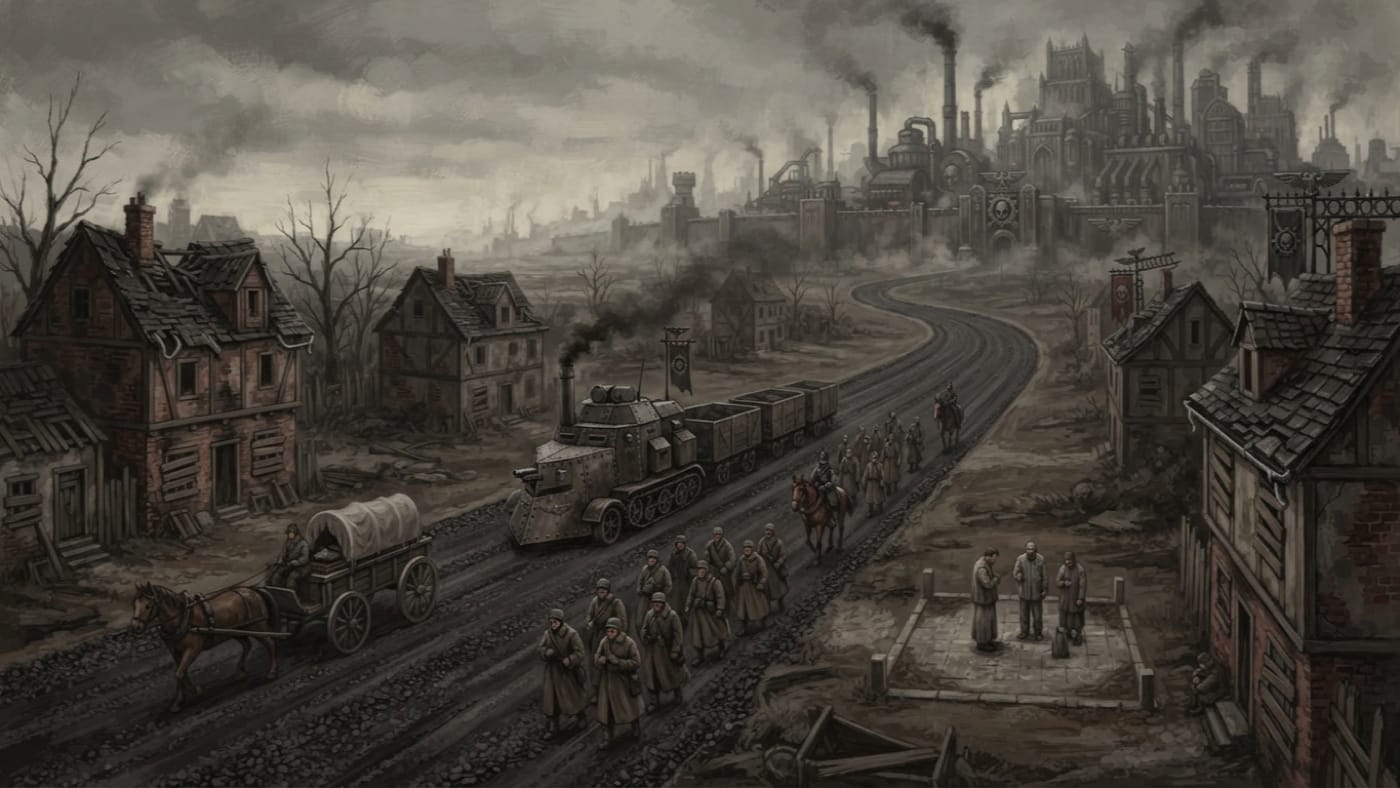
War maintains the roads, and maintains them well. The southern corridor has few better. Ruts are filled, drainage is cut, and broken stretches are relaid before the frost can make a habit of them. War wagons have priority. Nobody on these roads needs this explained twice, because the first explanation usually arrives at speed, with horses.
The houses along the verges get no such care. Roof slate cracks and stays cracked. Chimneys lean toward the road as if hoping to be requisitioned. A widow whose gutter has hung loose since her husband's last leave can watch a War crew re-grade the camber outside her window in a single afternoon, and she will have the sense not to ask whether the crew also does gutters.
Inherited supply primers describe the Hintermark roads as coal roads serving the Harbor of Chains.
Corrected. Coal is the freight the primers could spell. The roads also carry metal, labour, levies, coffins, and fruit, and on the return run they carry whatever is left of the men.
#On the Franchises
Maintenance is one authority. Passage is another. In my published account of Constantinople I reported that the Pilgrims' Court controls three of the four main road franchises west of the fortress. I stand by the figure. The fourth operator appears in no file I have been shown. That is either a clerical gap or a professional achievement, and in the Hintermark the two are hard to tell apart.
A franchise does not own the ground, and it does not stop a War convoy. The Bureau grades the road, the Court sells the right to use it for everything War isn't currently using it for, and the carter pays both: one in tithe and levy, the other in coin or favour at a gate whose keeper knows his mother. The arrangement is untidy and it works. In the southern corridor those two qualities usually travel together.
Other ledgers ride the same roads. The Widow's Syndicate runs ash-credit through seven Hintermark villages, lending against funerals that haven't happened yet and collecting against ones that have. The Black Ledger operates through the region, Keska included, and a recovered second-book fragment from A.S. 199, attributed to Shadows intercepts, lists households, pressure points, and access routes. I give the word "routes" the attention its compiler clearly intended. I do not conclude from it that every gatekeeper is a cell member or every carter a courier. Most of them are men who would like to be home before dark.
#On the Boundary Tables
Mandate 188-A redistricted the Hintermark, Constantinople's eastern terraces, and seventeen rear-echelon settlements in a single act. The Administrative Redrawing of A.S. 188 displaced or reclassified some forty thousand civilians across that whole scope. That is a census of grief, and it should not be read as a count of road traffic or a tally for any single valley. Households were taxed twice. Levy quotas attached themselves to empty cottages. Families walked the same roads they had always walked and arrived, under the new tables, in a different Zone from the one they had left that morning.
Keska fell through the tables entirely. For eleven months the foundry-town had no Zone. It also never missed a shipment. Wagons left its yards under War seal, rolled down roads the Bureau of Settlement couldn't assign to any jurisdiction, and delivered metal from a place that officially wasn't anywhere to a fortress that officially needed it. The roads did not close. They had no instruction to close, and no office existed that could have sent one.
The correction came in A.S. 189. The Keska packet was reconciled, the Zone was restored, and the arrears were sorted into columns tidy enough to frame. The ground took longer to settle than the paper, and in places it is still settling.
#On the Personnel Returns
Every road posting ends up in a folio. Drivers, escort details, grading crews, levy columns walking east and what comes back west: their transfers, discharges, casualty abstracts, return amendments, and pension corrections all reach the Sofia Filing Annex in time. There the Bureau of Records does the work that keeps the southern corridor's books from openly contradicting themselves. That work is real and it is needed. A widow's pension depends on whether a clerk can reconcile the man who left Keska on a manifest with the man who came back on a cart, or didn't come back at all, or came back under someone else's number.
The roads are not the corridor's strangest source of paperwork. The Annex also files the 14th Bellwarden Cohort sergeant who walked into fog near Bastion-Shipka in A.S. 181 and walked out in A.S. 196 with his rations still fresh. That happened near Shipka, in Syrion's country. It did not happen on a Hintermark road, and I will not move it there for the sake of a better paragraph. It does sit in the same building, though, and sometimes in the same drawer, as a Hintermark driver's ordinary discharge, because the southern corridor keeps one set of books, and the clerk who sorts the impossible case in the morning sorts the ordinary one after lunch.
Superintendent Horvath's protections stop at the Annex wall. A road man who is lucky enough to be reassigned under Code Seventeen gets the desk, the lamp, and the quiet. Nobody else on the network gets the courtyard tomatoes.
#On Present Condition
As of A.S. 201 the Hintermark roads are in excellent repair. War grades them, the Court franchises them, the Syndicate lends along them, and the Ledger keeps its own notes on them. Coal, iron, rivets, and boys move east on schedule. Coffin timber moves in every direction at once. The Bureau of Tithes counts the freight, and the Annex counts the men.
The villages keep their memorial squares swept, because the road crews sweep right up to them and stopping there would look ungrateful.
Disposition: the network is fit for service. The communities it runs through are noted for the record.