

#On the Directorate and Its Charge
This is a survey of the Hymnal Directorate as it stands in A.S. 201 / 1911 CE, compiled from published files on its present custody. It records no founding, because nobody has shown me one. The Directorate is one of three arms of the Bureau of Orison and Song, which people in a hurry call the Bureau of Orison. Its charge is printed hymn authority: which words, notes, breaths and silences the Church may lawfully sing. It holds the Master Hymnal Plates and the stanza registers. Everything else it does follows from holding them.
Its siblings keep separate rooms. The Broadcast Directorate owns reach: carriers, repeaters and the delivery of the Orison Hour. The War Directorate owns the voice that kills. Hymnal owns the text. When a curfew prayer goes out over copper, its wording descends from a Hymnal Plate and its transmission belongs to Broadcast. Owning the words gives Hymnal no say over the copper. Broadcast men have told me so, in terms they did not intend for publication.
The Bureau's charter belongs to A.S. 92. The Directorate's own founding year, founders and charter text have not been published, and I decline to compose them.
Earlier Codex filings placed the Bureau's charter under "A.S. 92, Concordat Ratification."
Corrected. The Concordat of Strasbourg belongs to A.S. 90 / 1800 CE. The Bureau's Living Word charter belongs to A.S. 92 / 1802 CE. These are two instruments, two years apart, and neither one dates the Hymnal Directorate.
#On the Vault and the Witnesses
The Directorate keeps its steel in the Vault of Tuning, in the north range of the Cloister of Calibrated Breath at Strasbourg, Zone 2. The Plates lie in drawers under linen, wax seals and custody ribbons. I give no count of the drawers. Nobody has given me one, and a survey that counts what it has not seen is a forgery with good posture.
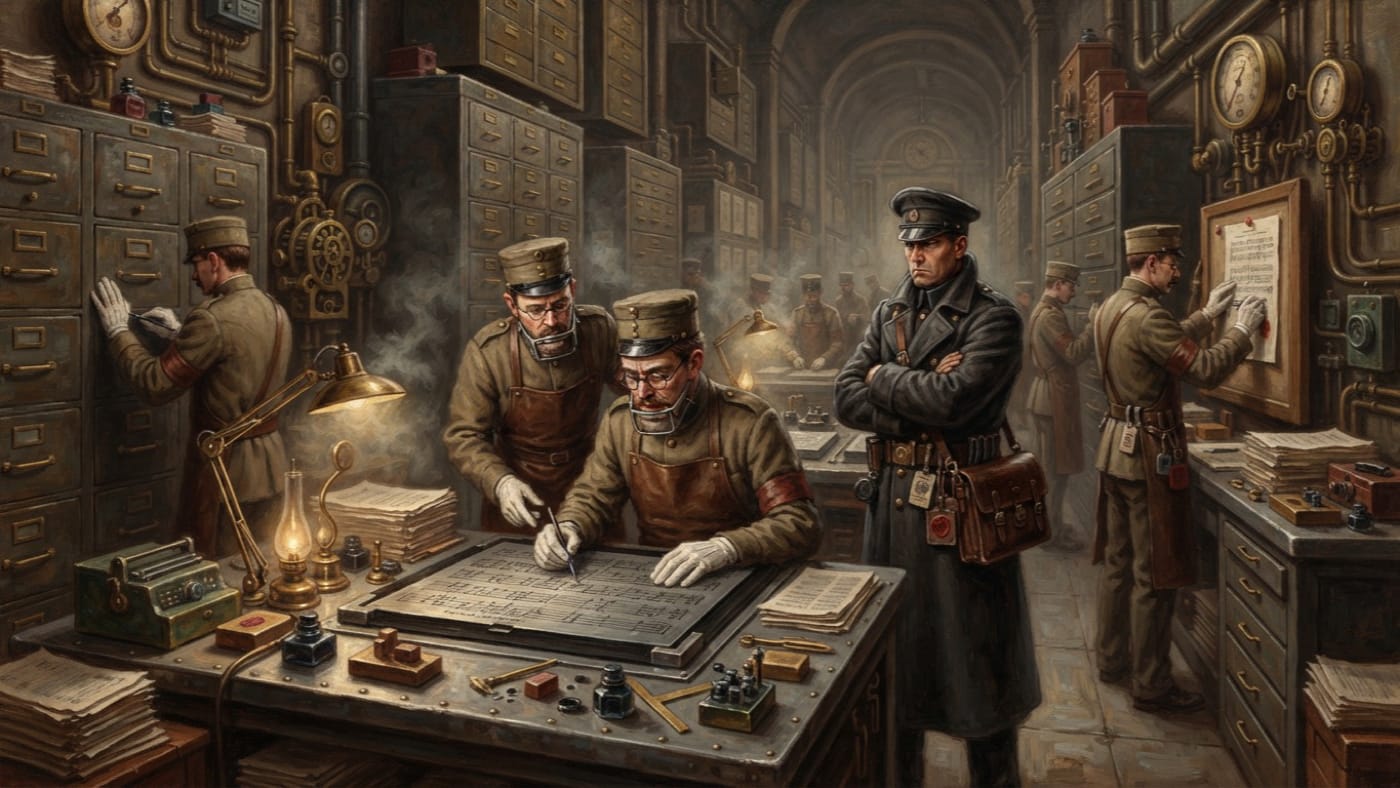
Admission is paperwork followed by humiliation. Three Orison seals must sit together on one instrument. The Bureau of Doctrine must countersign it. A Provost then searches the petitioner, hands, cuffs and mouth. The Bureau of Records sends a custody witness, whose task is to watch Orison's people handle Orison's property and write down that they did. The Directorate does not say which desks press the three seals.
Inside, the work is done in pairs. A Cantor-Scribe reads the engraved notation in gloves, breath turned aside from the steel. A second checks each mark against the Plate: interval, pause, syllable weight, stress, measure and approved silence. A rubbing made without a witness has no standing. Doctrine's countersignature attends wherever the procedure requires it.
The arrangement trusts nobody alone. Suspicion is shared among four offices, so that no single hand can carry a Plate's meaning out of the room unwatched. Whether four suspicious offices make one honest room, I leave to sterner auditors than myself.
#On the Descent of the Authorized Copy
Nobody sings from steel. Authority reaches a mouth by descent, in fixed order: Master Hymnal Plate, witnessed master rubbing, distribution sheets, local copies. The local copies are the hymnbook, the choir slip, the barracks card, the transmission packet and the furnace stanza. Each stage takes a seal, and each seal asserts that the stage above it was obeyed.
On a printed hymnal, the parent Bureau's imprimatur is wax in the binding, a stamp on the colophon and a serial number that matches the master register at the Cloister. I give no specimen serial. I have seen none published, and the register is not mine to quote.
Three offices divide the labour, each with its own verb. Cantor-Scribes read, copy, compare, witness and sign. Their ordinary licence permits neither composition nor correction. A scribe who improves a breath mark has committed the very offence the chain exists to prevent. Hymnal Auditors take copies in use and hold them against their authorized versions. They sort wear from working annotations, and a sealed revision from an unexplained change, and they sign what they find. Stanza Marshals prosecute the deviations the Auditors find. The record grants them that verb and nothing more. It names no judge, no sentence and no executioner, and I will not lend the Marshals a gallows nobody has shown they own.
A seal certifies descent. It cannot certify accuracy. Suppose a distribution sheet carries a misread interval. Every copy made from it inherits the error along with a perfectly genuine seal. The wax is honest and the note is wrong, and a provincial choir holding that sheet has no way of knowing it.
#On the Stanzas in Use
The published files name parish, war, industrial calibration, funeral, orphanage, penitential, broadcast, curfew and execution Plates. They also attest drawers marked Mercy and Restricted, and dormition measures sung in orphanages. I give these as examples found in the record. They are not a catalogue, and the Directorate has published no classification code for me to recite.
Grouped by use, they serve four masters. Civic worship takes the parish, feast and funeral stanzas: the morning hymn and the graveside response. Military and broadcast service takes the war Plates and the curfew packets, along with the casualty rolls and ration prayers that Orison Signal Engineers push through copper on Broadcast's authority. Industrial calibration takes the stanzas sung over cooling metal. Care and punishment take the orphanage, penitential and execution Plates. These share a building and, I suspect, a polishing cloth.
Follow one week's sheets out of the north range. A parish cantor in the Rhine country receives a feast hymn, a transmission house receives a curfew prayer, and a calibration hall receives a pour stanza. All three carry the same kind of seal from the same register. If the cantor's copy is wrong, a congregation sounds like cattle at vespers. If the calibration copy is wrong, the error goes into a gun.
#On Drift, Correction and Liability
At Essen-of-Hymnsteel, the Directorate's paper becomes metallurgy. In A.S. 110 the Tri-Bureau Compact bound Engines and Furnaces, Records, and Orison and Song together over the city. Calibration choirs in the Hall of Measures sing descendants of the industrial Plates over Hymnsteel as it cools. Bell-cannon throats, hymn-drive housings and reliquary rivets leave the city carrying what was sung into them. A breath taken where the Plate commands sustain can contribute to a failure under fire weeks or months later. It need not. Many copying slips end in sour singing and a reprimand. The Bureau cannot tell in advance which kind it holds, so it treats every mark as able to kill a gun crew.
Sister Rauth decides which approved stanzas enter Essen's halls and who may reach the industrial descendants. Her authority there is local and considerable. It does not make her head of the Directorate, and it moves no Plate out of Strasbourg.
The Directorate recognizes four sources of drift, though its enemies prefer just one. The first is fatigue, in a tired copyist or a tired choir. The second is accident: a torn sheet, a misread mark, a revision that travelled without its seal. The third is lawful revision, an alteration entered under authority and sealed. The fourth is sabotage, a change made on purpose by a trained hand. On the page all four can look the same. The Auditor finds the discrepancy. Its cause is a separate question, and a Marshal who answers it carelessly prosecutes the wrong desk.
The Mirror Choir makes that question harder. Its cells have no need to reach the steel. They need an authorized sheet, a hand trained to copy it and a seal that looks valid, and the chain then carries their variant with full authority. Some of their variants scan better and are easier to sing than the approved text. That changes nothing. Ease of singing grants no licence, and an elegant correction made without authority is still an unauthorized correction.
The Choir's preaching rests on a point the Codex has already conceded. I have written elsewhere, under Doctrine seal, that the Essen Plates were edited and that Orison authorized the revision. I add nothing to that here. Three questions remain open: what the edit concealed, who made it, and whether it caused, worsened or merely postponed the Resonance Bloom. The Bureau's own memoranda call the attribution of recent Blooms to the Choir "convenient rather than confirmed," and the Blooms are older than the Choir. A heretic who points at a true wound has proved the wound, and nothing yet about the cure.
#On the Present Custody
As of A.S. 201, the Bureau's public position is that the Plates are secure in their drawers and that every breach so far has come in through the copies. I record this as the Bureau's position. The Codex has already published that the steel has a revision history, so the claim of pristine originals is one I attribute and do not certify.
The north range has too few Hymnal Auditors for the sheets now leaving it. Every sheet nobody inspects reaches its choir on a copyist's signature alone. Unauthorized variants persist in parishes, barracks and calibration halls. The Directorate's remedy is more witnesses, more searches and more seals, and all of these need more trained hands. The chain cannot run without such hands. Nor can the Directorate teach a hand to read steel without teaching it to recognize a better note.
The drawers stay shut and the registers stay current. The copies keep going out.