

#On the Directorate's Place
This survey of the War Directorate was compiled in A.S. 201 (1911 CE). That year belongs only to the compilation. The record I am permitted to hold gives no founding year, and this survey supplies none. A.S. 201 marks no inspection, no appointment and no new edition. It is simply the year in which I sat down with four published files, a bundle of registry abstracts and a candle I paid for myself, and tried to work out where one office ends.
The War Directorate is one of three attested arms of the Bureau of Orison and Song, which men on the Line call the Bureau of Orison. Its siblings are the Hymnal Directorate and the Broadcast Directorate. It is a directorate. Its officers sign their letters with flourishes longer than the letters, as though they headed a thirteenth Bureau, but they do not. The Directorate governs weaponised voice and manages the Choir-Engines. These are the sanctioned arrangements by which a hymn is made to do the work of a shell, a sap-charge or a firing order.
On the page its history is short. In practice it is long. The Concordat of Strasbourg settled the formal Synod in A.S. 90. Orison received its charter in A.S. 92. At some point after that, under a seal I cannot produce and by a hand I cannot name, the parent Bureau divided its labour, and one of the divisions was given war. Voice was a weapon long before any charter. Garrison hymns and work-chants never waited for permission. What the Directorate added was a registry.
Orison's charter, and the War Directorate's authority with it, belong to the Concordat year, A.S. 92.
Corrected. The Concordat of Strasbourg belongs to A.S. 90, and Orison's charter followed in A.S. 92. Neither year belongs to the Directorate, whose own beginning is unrecorded. Older Orison text placed the Bureau two years closer to the Concordat than the calendar allows. The error has been corrected in most files and forgiven in none.
#On Jurisdiction and Its Neighbours
The parent Bureau keeps its seat in the Cloister of Calibrated Breath at Strasbourg. The Cloister divides its floors the way a will divides an estate among relatives who despise one another. Hymnal holds the Master Hymnal Plates and the stanza registers. Broadcast holds the carrier rooms, the saint-dust stores, the repeater records and the Clean Carrier archive. War holds the sealed lower galleries. Polite visitors are not taken there. I describe them no further, because no plan of them has crossed my desk and I do not draw rooms I have not been shown.
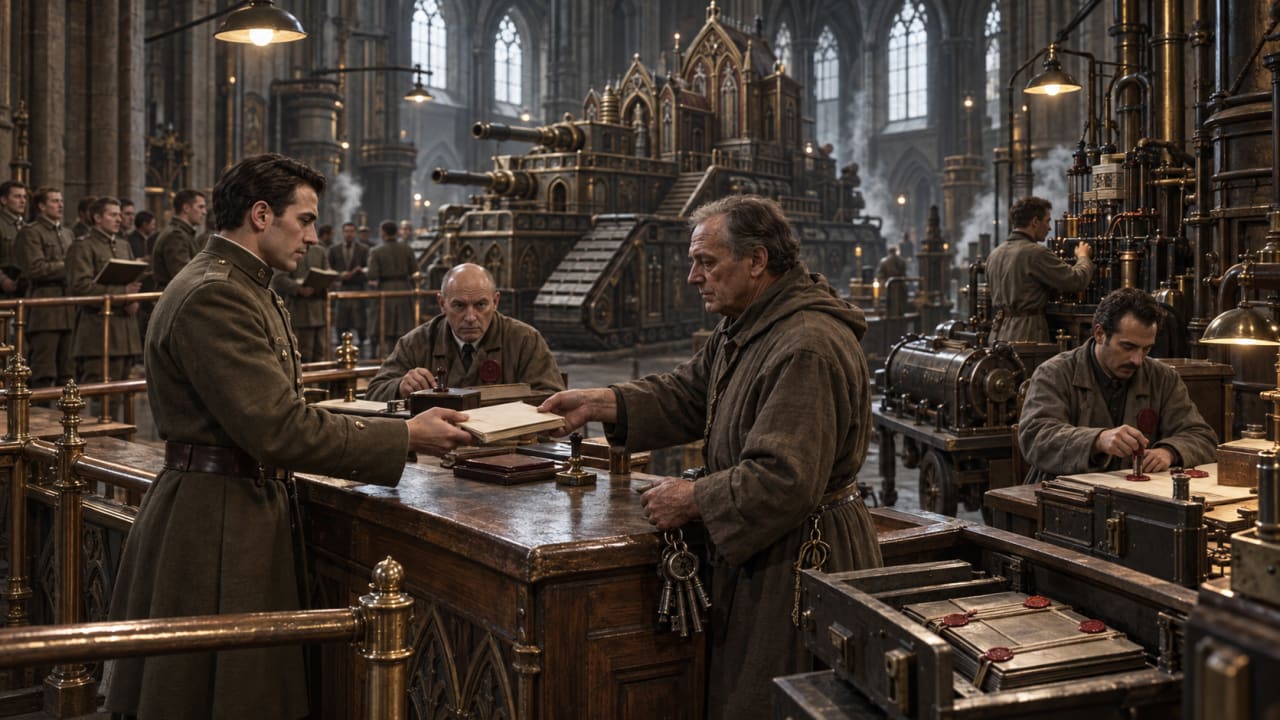
The division matters most in the Plate vault. One drawer there is marked War Directorate. The drawer proves that a military class of hymn exists. It does not give War the keys. The Plates stay in Hymnal custody, under three Orison seals, a Doctrine countersignature and a Records clerk who watches everyone's cuffs. War receives descended copies, as a parish receives its hymnbook, with better locks and worse uses.
Broadcast provides the same kind of service in a different register. The saint-dust carrier, the repeater chain and the hymn sent over distance are Broadcast's craft. When a War operation needs a clean signal to reach a bastion, it relies on another directorate's engineers and another directorate's dust ledger. The arrangement is never described as dependence. It is described as coordination, a word invented by offices that cannot bear to owe each other.
Outside the Cloister walls the neighbours multiply. The Bureau of War wants the guns, the walls and the order of battle. The Bureau of Engineering wants the diesel, the hulls and the casing. The Bureau of Conscription supplies the bodies. Tithes invoices everything, hunger included. Doctrine certifies that the result was always holy. Bells holds the bronze and disputes the point at which a peal becomes a voice. The Bureau of Mercy objects. Objecting is also a jurisdiction, the smallest one in Strasbourg.
So the War Directorate owns very little outright. What it owns is the conversion. Other offices bring the metal, the men, the money and the permission. War turns approved breath into a military effect, signs for the result and files it under Orison.
#On the Voices Entered as Equipment
The Sunken Choir is the plainest proof of what the Directorate administers. It is a subterranean Choir-Engine: an armoured hull that crawls on mud-screws beneath the trench, carrying a vocal cohort in iron collars along a drone-tunnel. The cohort is made of boys whose throats have been surgically fused into resonant chambers. A conductor watches their lips by lamplight and beats time on a copper rail. The rail carries the rhythm into the hull, the hull carries it into the clay, and an enemy sap or bunker gives way beneath a note held past the point of human comfort.

The boys are deafened. Officially this protects them from feedback. In practice it produces a choir that learns by lamp, rod and vibration and never hears what it has become. Friendly trenches overhead suffer earth-sickness: aching teeth, loosened nails, rifles humming in the palm. Some collapses have spread wider than any intended target. The Bureau counts the successes as grace and blames the failures on soil.
Here the division of labour can be seen without a magnifying glass. Conscription reviews parish registers and supplies the cohort. Orison's War Directorate calibrates, deploys and seals. The Bureau of Mercy objected in A.S. 198. The objection was noted, and it did not suspend a single quarter's licence. The licence rests on Instrument 44-K. One published account assigns that instrument to the Bureau of War. Another calls it a standing order renewed each quarter. I record both. The disagreement concerns whose name heads the form. It changes nothing for the boys.
None of this describes Orison's singers in general. The surgery, the age and the collars belong to the Sunken Choir alone. A parish cantor is not a drone-team. A choir standing at an Arsenal rail is not a drone-team. The Directorate's reach is wide enough without crediting it with throats it has not cut.
Sunken Choir personnel: "boys."
Corrected under the Third Quarterly Review, A.S. 200. Sunken Choir personnel are now classed as "Liturgical Combatants, Voluntary," and boys is replaced in all copies by "calibrated vocalists of appropriate developmental stage." Voluntary names the column the Bureau prefers. It records no act of consent by any child.
The Chorus Absolvers show that a Choir-Engine does not need a hull. They are an elite choir chained together, each singer wearing a vox-relic strapped over the chest. Their hymns are recorded as rattling teeth and rupturing lungs, though the governing description does not say whose. They sing until the relics burn and the hymn turns into a scream. The chains are on record. Their official purpose is not: one broad account calls them formation discipline, and the dedicated file finds no instrument that says so. Nothing in the record gives the Absolvers the Sunken Choir's surgery, and nothing gives them a commander, a muster figure or a permanent garrison. The War Directorate carries them on its books, and the books are where my knowledge ends.
#On the Arsenal in Motion
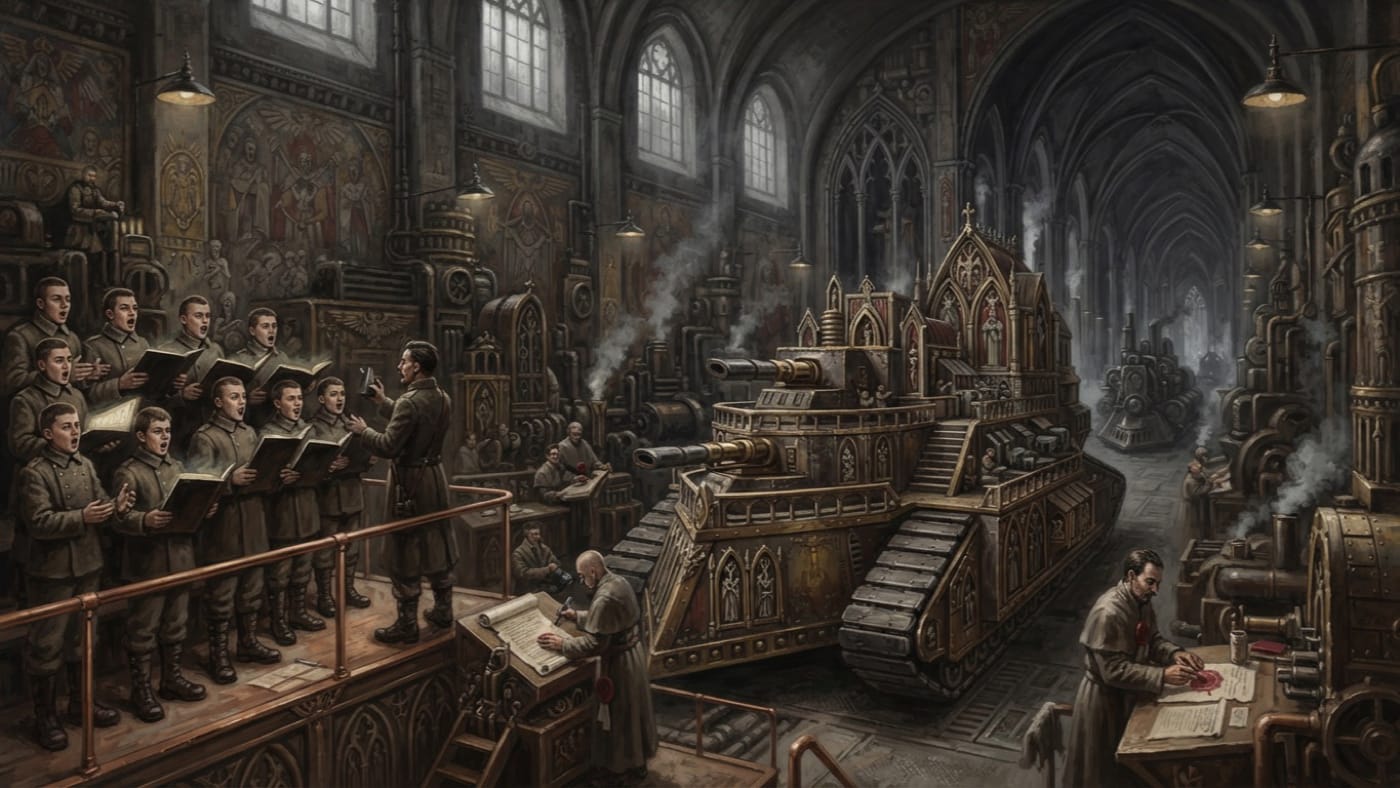
The Processional Arsenal is the Directorate's most public possession and its most crowded one. It is a tracked, diesel-driven landship mounting shrine-artillery. Stepped mortar stations climb its spine. Its battery-chapels are pinned with relic bone. Choirs stand at the rail with cue-slates under their eyes. Its registry names the War Directorate of Orison and Song as primary Bureau and lists War, Engineering, Doctrine, Conscription and Tithes as secondary. Five offices sign the registry. One answers for the cadence.
The best-known exemplar, the Pilgrim's Ladder, belongs to the Pilgrim's Ladder Commission of A.S. 110, which turned the type from experiment into institution. The Tri-Bureau Compact at Essen-of-Hymnsteel dates from the same year. Nothing else in the record links the two, and neither marks the Directorate's founding.
On deck, the Arsenal fires when it is sung. The Cadence Caller strikes the metronome bell, the choir enters, and the Battery Steward signals. The Ordnance Deacon's seal decides when the hymn may become fire. The shell leaves on the psalm-beat. Before the barrel cools, the shot-ledger takes the shot type, the authorising seal, the hymn measure, the choir's condition, the wind and the target. These offices are deck practice aboard the Arsenal, worked by its Shrine-Deck Crew. I will not inflate them into a command chart for the whole Directorate. No such chart has been published, and I have no wish to draw one for the enemy.
In the approved wording, the machine is operationally hungry. It consumes candle wax, chalk paste, throat oil, metronome clappers and clerical patience. Tithes invoices the hunger. Conscription replaces the Choir Runners who die because the bell would not wait for their ankles.
Its margin for error is narrow. Verse, fuse-time, elevation and choir interval must agree, and drifting by half a measure can drop shells into the ship's own holds. At Prague Gate in A.S. 147, a shrine-platform caught inside a Silence Dome lost its hymn-vox. The cue-slates contradicted one another, and the mortars fired out of phase into lower holds where pilgrims were holding relic-candles. Purity called it sabotage. Engineering called it hymn-jam. Doctrine printed both explanations in separate columns and went to lunch.
#On the Approved Military Voice
Every War hymn begins in someone else's drawer. The Hymnal Directorate reads it from the Plate. Two Cantor-Scribes confirm the intervals. A rubbing then passes down into distribution sheets, choir slips and barracks cards, each carrying its seal. Only after all that does the War Directorate put the hymn into a throat that will be spent.
The War Plates hold the ugliest repertoire in the Cloister. They carry stimulant hymns for the fog at Bastion-Shipka, where Syrion presses out of the marsh and Orison layers wakefulness over the air until operators bleed from the nose. They carry coded cadences against Morwen's mimicry, which Orison says it keys to saint-dust signatures that a copy cannot easily imitate. The dust and the keying are Broadcast's craft, whatever the hymn is for. They carry counter-orisons against Velkara's perfumed invitations, built on obligation hammered into melody. They also carry rupture chants for the Bureau's own throat-machines. How each class works stays sealed, and I leave it sealed.
Every claim of efficacy is Orison's own. The dedicated files on the enemy do not describe a reliable acoustic defence. They describe countermeasures that work partly, sometimes, and at a cost. Morwen has turned Choir notes back into their own chambers. Syrion's fog recedes and then returns. A hymn that held for one afternoon proves only that afternoon.
The military voice also depends on metal it does not make. At Essen, bell-cannon throats are said to take their obedient memory from calibration sheets descended from the same Plates. A quarter-tone error in a parish sours a priest. A quarter-tone error in Essen may kill a gun crew on the Sagittal Line months later, and the War Directorate will meet that error far from the pour hall. The Mirror Choir claims the approved frequencies are false and slips discords into sequences until sabotage looks like fatigue. I do not settle that claim here. A weapon built on fidelity is wounded by every rumour about fidelity, and rumours are cheap.
#On Joint Operations and Failed Sound
The Wrath-Sloth Convergence Code shows the Directorate at its proper size: necessary, loud and outnumbered. When the Slumber-Hulk emerged from the Shipka fog in A.S. 194, the bells sounded Convergence. Choirs mounted the marsh-facing platforms with wake-hymns that were short, ugly and rising. Gunners loaded Saint Aegidius. Captain Varik unsealed Scour readiness and withheld ignition. Engineers ran to the pumps and culverts. Hourglass clerks doubled their instruments. For six hours guns and hymns struck together. Then the Hulk turned parallel to the reed road, and the Scour stayed unlit.
Orison's voice held the air. It did not hold the guns, the pitch, the clocks or the pumps. Since the circulars of A.S. 195, the Code has been in the joint custody of War, Bells, Orison, Hourglass, Engineering, Purity and Doctrine. An early digest of the Code carries the heading War Directorate, but the heading does not say whose War Directorate. It does not make this branch the Code's author, and it does not make it commander of every man on the wall. The Code's own historians say no single Bureau invented it, and on this point I believe them.
The Vales of Stagnance show the other side of the ledger. A Processional Arsenal there flooded Syrion's fog with hymn-drones. The lull lifted and the soldiers woke. Every listener aged by months in a single afternoon: beardless boys came out whiskered, and dark hair came out salted grey. The record I hold gives no date for the deployment, so I leave it undated. The Synod declared the exchange acceptable. The record shows the result and does not explain the mechanism, and I will not explain it either. An effect nobody understands cannot be repeated safely, and it will be repeated regardless.
#On the Present Return
As of this compilation in A.S. 201, the War Directorate remains sanctioned and busy. The Sunken Choir is licensed for Line deployment under Instrument 44-K, renewed each quarter, with Mercy's objections noted and non-suspensive. Processional Arsenals remain few and costly. They are jealously scheduled for fog fronts, river crossings, morale ruptures and any assault that needs a church advancing on treads. The Chorus Absolvers remain on the books, with no garrison named. Conscription reports that supply is sufficient. The same attestation once said that boys remained plentiful.
Calibration pressure comes from Essen. Interference comes from the Mirror Choir and the Silence Domes. The strain on Broadcast's saint-dust reservoirs reaches War as well, since War draws on them without owning them.
The record does not give the Directorate's founding year, its founder, the name of its present head or a complete roster of its departments. None of that is needed to see what it does. It takes the Plate from Hymnal, the signal from Broadcast, the hull from Engineering, the child from Conscription and the invoice from Tithes, and it returns a military effect with Orison's seal stamped on the result.