
#On the Three Outer Pressures
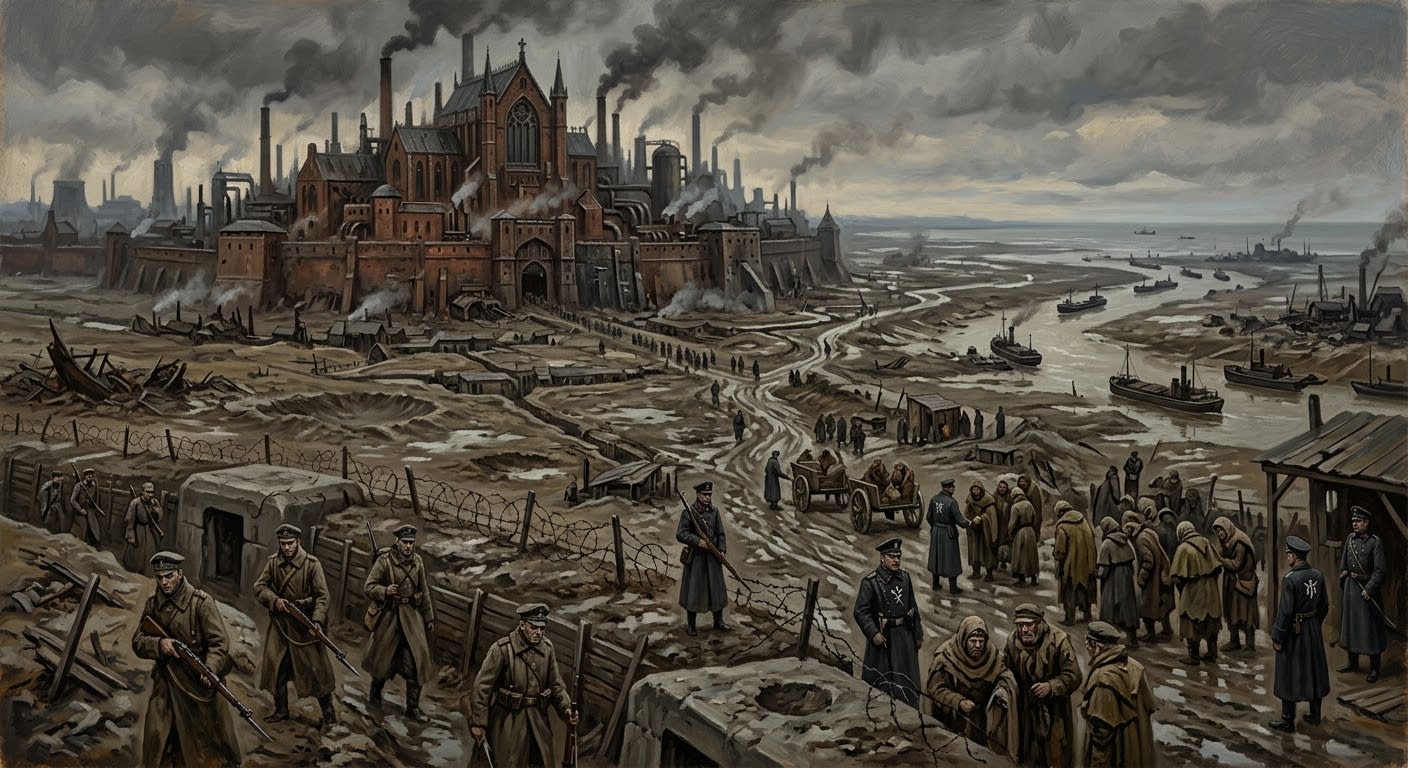
Zones 5 through 7 are the Synod’s outer grammar of danger: the strip that refuses citizenship, the territories that Hell has occupied without receiving lawful title, and the southern sea-rim where commerce, pilgrimage, contraband, and military necessity kneel together while each insists it is standing. They do not form a tidy sequence of worsening distance. Tidy sequences are what schoolmasters draw when nobody in the room has been eaten.
Zone Five is No-Man’s-Land, east of the Sagittal Line and west of the Charnel Lands, a disputed receipt wet with mud, salt, and missing-person extracts. Zone Six is the Charnel Lands, the demonic aggregate eastward: old provinces, ruined cities, pressure domains, and Sin-General custody over things that once had mayoral seals. Zone Seven (Unregistered) is the Southern Coast and sea-rim, the Aegean, Adriatic, Mediterranean (Unregistered), Black Sea approaches, coastal bastions, pilgrim roads, quarantine harbours, chain towers, and those profitable shorelines where the Enemy need not cross a wall if a clerk will clear the cargo.
The three zones are joined by exchange. Zone Five receives shells and returns warnings. Zone Six exports horror, shards, plague, hunger, counterfeit memory, and the occasional person whose return requires more courage to refuse than to welcome. Zone Seven receives ships, pilgrims, salt fish, icons, grain, fever, contraband, and lenses polished from substances Purity has publicly shattered. War calls this theatre management. Doctrine calls it supervised exposure. Tithes calls it opportunity and should be watched near purses.
#On Zone Five, the Receipt Between Stone and Appetite
Zone Five begins where the Line’s authority must leave the gate under rope. It is neither fully Synodal nor fully lost, a condition offensive to every Bureau and useful enough to deserve its own category. Its ground includes shell bowls east of Bastion-Przemyśl, Brest approaches, Danubian flats, Shipka fog-planks, the Knife-Mile, broken villages, old roads, abandoned farms, listening wire, bone reefs, and the little plank paths on which young officers discover that courage has poor traction.
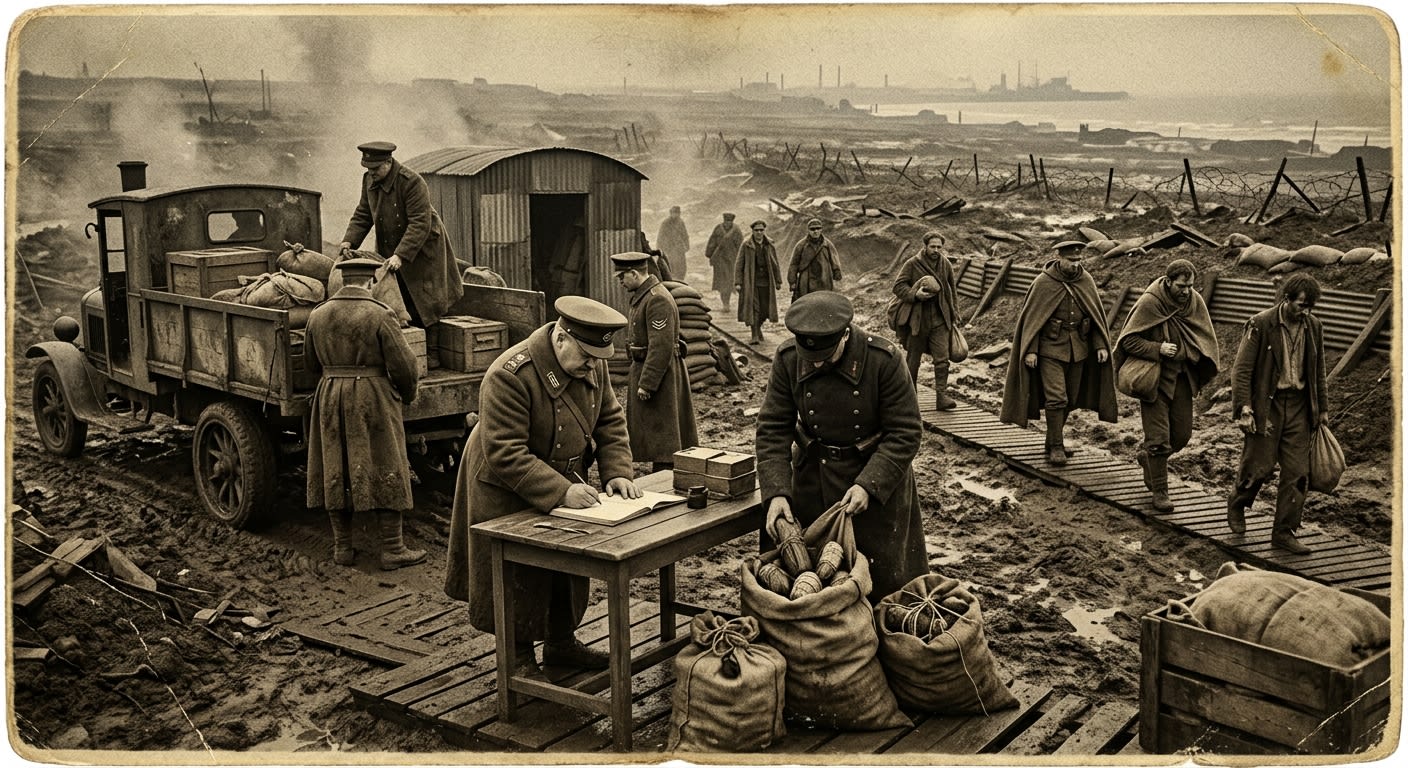
The zone was born after the A.S. 45 Sundering, hardened through the Great Retreat, and took its present doctrine after A.S. 65, when westward flight became refusal and refusal required an eastern margin on which to spend men in smaller, deniable quantities. Zone Five is where advances are tested, patrols vanish, bells lie, shadows pull, and mud exercises local government.
Older primers described Zone Five as unadministered ground.
Corrected. Ground shelled by War, salted by Engineering, prayed over by Orison, indexed by Records, searched by Purity, and billed by Tithes is administered. It is simply administered without desks, chairs, or mercy.
Flesh-Mud remains its most honest magistrate. Prayer-Jam remains its favourite legal confusion. Shadow Noon remains its elegant insult to straight lines and training slates. The field rules are plain: salt first, plank second, rope always; trust old sergeants over young captains; distrust bells that sound too much like home; sit down when your shadow walks away before you do.
Zone Five matters because it absorbs contact before contact reaches the Line. Patrols there identify pressure. Sappers there deny easy approaches. Litany-Engineers there test devices whose names later become either doctrine or memorial inscriptions. Scavenger families, relic pickers, guide children, unauthorized widows, returned villagers, and stubborn little households cling to the edges because policy has never defeated poverty’s talent for remaining inconveniently alive.
#On Zone Six, Where Geography Refuses the Audit
Zone Six is the Charnel Lands, the demonic territories east of Zone Five: Ukraine, Moldavia, Wallachia, eastern Romania, eastern Balkans, Thrace in its worse conditions, old Russian approaches, and the provinces whose names still exist in exile songs though the roads no longer honour them. The Registry calls it Zone Six. Soldiers call it the East when tired. Doctrine calls it Charnel because bodies, ruin, judgement, and geography have been forced into one word and told to behave.
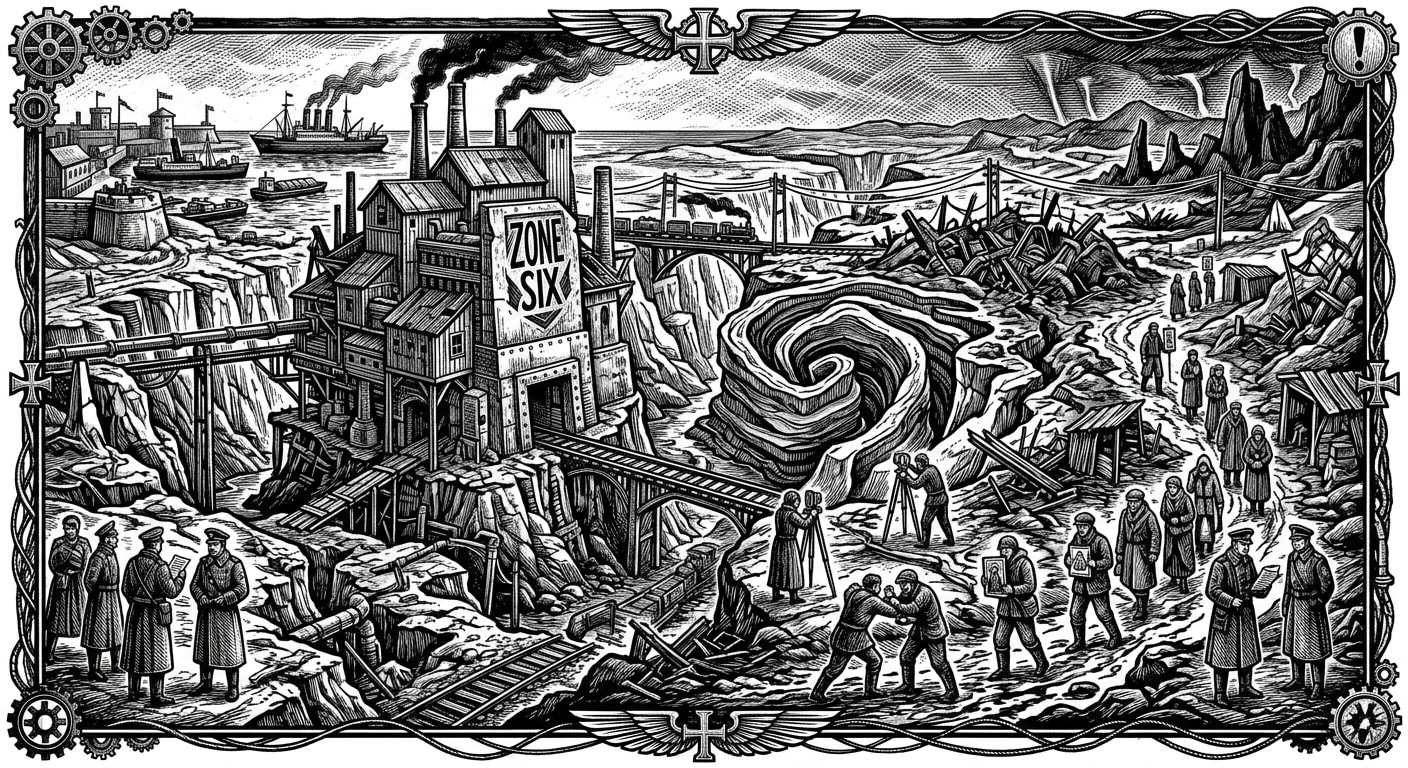
It is not empty. Empty would be merciful. Zone Six contains cities that continue too much, churches stripped before the Sundering and then occupied by worse liturgies, markets where stalls face inward, roads that return maps without men, and agricultural districts whose hunger has learned to count. The A.S. 73 cartographic expedition proved, by returning badly, that ordinary measurement fails beyond certain lines. Its folios gave roads measured in miles on one page and confessional intervals on the next. Records authenticated enough of the nonsense to make it dangerous.
Sin-General pressure replaces old provinces. Kargath makes hunger administrative across drowned Hungarian interiors and the Blightmarsh. Maldrake burns the southern roads and Thracian furnace-plains into campaign appetite. Syrion pools delay in valleys and passes until clocks blush and sentries sit down. Velmora gilds border weakness. Atheron lifts pride into towers near the Carpathian approaches. Morwen teaches wells, faces, and rivers to envy themselves. Velkara needs no province. Perfume is a borderless empire.
Zone Six is also a source. That is the obscenity no sermon enjoys. From it come reports, refugees, infection, relic fragments, forged saints, enemy rumours, glass, and tactical truths too useful to condemn at first contact. The Synod refuses to cede it. The Synod cannot inhabit it. Between these two sentences live committees, patrol cemeteries, and the entire literature of heroic postponement.
#On Zone Seven, the Sea-Rim That Smiles at Inspection
Zone Seven is the Southern Coast: Aegean, Adriatic, Mediterranean, the southern supply lanes and pilgrim routes, Saffron Bastion near Ragusa, Thessaloniki and its harbour chains, coastal quarantine districts, maritime tolls, pilgrim sheds, rope markets, smuggler seams, Greek and Anatolian approaches, and the sea-road by which the lower Line is fed while pretending water has no politics. It is not a rear zone, though it may sit west or south of the main demonic mass. It is a rim: wet, profitable, permeable, and full of men who can make a sealed crate sound pious.
Here the Synod’s southern logistics enter the world as smell. Salt fish, lamp oil, grain, wet rope, mule sweat, tar, fever vinegar, coffin timber, incense, diesel film, and pilgrim breath travel together. Marseille, Genoa, Venice, Thessaloniki, the Pilgrim’s Coast, Saffron, Varna, and the Bosphorus approaches move goods toward the Southern Theater. Every port is a throat. Every throat swallows and lies.
Harbour catechisms describe Zone Seven as auxiliary sea-support territory.
Amended. Auxiliary implies a lesser organ. Remove the southern ports and the lower Line starves, loses powder, loses pilgrims to disorder, loses quarantine discipline, and begins eating its own timetables.
The Pilgrim’s Coast proves the zone’s governing condition. A shore becomes landing, supply seam, sanctuary route, garrison market, smuggler road, fishwife court, and Settlement embarrassment before anyone in Strasbourg has finished colouring the map. Thessaloniki proves another part: chains, towers, quarantine fences, maskwright lanes, Drowned Row, under-quay movement, and the hard fact that a port can be loyal, indispensable, compromised, and still more useful than any clean inland office.
Zone Seven lives under two fears: the open water and the opened manifest. The Black Sea remains an attack lane. The southern coasts receive pilgrims in quantities that test Mercy, Tithes, Records, and patience. Quarantine crescents sort bodies before bodies sort themselves into plague. Smugglers use saint-bone crates, fish barrels, pilgrim hems, coffin seals, and the ancient maritime principle that no customs clerk opens the worst-smelling thing twice.
#On Demon Glass as the Outer-Zone Trade Made Visible
Demon glass is the material confession of Zones 5 through 7. It is harvested beyond patrol confidence, carried through contested margins, polished in ports, denied by Purity, purchased by War, invoked by workshops, and mourned by widows who pay too much to see faces that may not be dead enough. If one requires a single object to explain the outer zones, choose the warm shard wrapped in oiled cloth under a saint-bone manifest and carried by a man who has already decided which lie he will tell at the quay.
The Demon-Glass Scavenger works where Zone Five leans into Zone Six and Zone Six cuts back: Wrath slag-plains, Lust’s mirrored courts, Wound-sites, ruined corridors, fused battlefield crust, places the Bureau classifies as no-recovery while the harvest continues nightly. Scavengers bring tongs, bone-masks, waxed wraps, lead boxes, bad debts, and worse judgement. They lose men at rates high enough to deserve a memorial and inconvenient enough to remain estimates.
BUREAU OF SHADOWS OUTER-ZONE ABSTRACT, A.S. 199 Scavenger cells: forty to sixty across Zones 5–7. Annual yield: 2,400–3,100 shards. Personnel loss: 18–22 percent. Material confiscation: 8–12 percent. Differential: █████████████████████████ Filed without recommendation.
The Demon-Glass Polisher belongs chiefly to Zone Seven’s ports: Maskwright Lanes in Thessaloniki, under-quay workshops, Marseille back rooms, Varna’s cautionary markets, and the hidden benches where Saint Varda’s ugly little maxim is muttered before the lead warms. Lead first, vision second. The craft does not exist officially, which is why it has hierarchies, factions, patronage, rates, quiet-boxes, cold-wash recipes, silence tests, and Bureau-Friends who know which confiscation crate will be returned under a different label.
Saint Varda of the Lead Hands is the cultic proof that official absence cannot prevent occupational need. No canonisation file. No authorised feast. No clean relic. Yet the Polishers use her: hands wrapped grey, shard mounted before gaze, whisper caged before vision sells itself as revelation. Purity hates her because she turns raw catastrophe into regulated sin. War tolerates her because regulated sin can be fitted into a soldier’s mask. Doctrine records her here because I am generous to useful impossibilities.
#On the Bureaus That Pretend Contact Can Be Filed Clean
Zones 5 through 7 require every Bureau to expose its favourite hypocrisy. War needs passage through mud, knowledge from enemies, ships through infected harbours, lenses from contraband, and roads whose legality depends on which convoy arrived alive. Purity needs seizures theatrical enough to frighten markets and porous enough not to blind the army. Records needs names for men who return from places that have returned fewer names than shadows. Settlement needs maps for towns grown around forts, piers, and quarantine sheds. Tithes needs the revenue of vice without the doctrinal burden of admitting vice has become infrastructure.
Doctrine, modestly, needs language that can bless the arrangement without appearing to sweat.
The official order remains simple on paper: Zone Five is contested, Zone Six is hostile, Zone Seven is controlled by harbour, chain, quarantine, inspection, and permit. In practice the three zones trade continuously. A shard pulled from a Lust court crosses a Zone Five night route, enters a Zone Seven fish barrel, becomes a mounted optic, and returns to the Line on a soldier’s face. A refugee flees a Charnel village, sleeps in a No-Man’s-Land grave ring, boards a pilgrim vessel under a dead cousin’s permit, and is counted in a quarantine shed as a sanitation question rather than an eschatological one. A rumour born in Zone Six reaches a Thessaloniki dock before the patrol that heard it is declared lost.
This is why the outer zones cannot be understood as distance alone. They are circulation under threat. Mud, mouth, water. Patrol, shard, harbour. Rope, lead, seal.
#On the Present Condition
As of A.S. 201, Zone Five remains active, contested, essential, and unreclaimed; Zone Six remains demonic, unstable, unceded, and useful in the limited way a wound is useful to a surgeon with ambition; Zone Seven remains held, busy, infected by commerce, and indispensable to the southern Line. The outer zones are not the Synod’s edge. They are its test: whether Order can touch the unclean without becoming merely another appetite with stamps.
It can. It must. It does, badly, which is still preferable to beautifully failing.
The Line holds because Zone Five absorbs impact, Zone Six is named rather than surrendered, and Zone Seven keeps the lower spear fed through water that would sell its own baptismal certificate for a calmer tide. If the reader finds this arrangement impure, the reader has understood it. If the reader finds it impossible, the reader has never purchased grain during a siege.