

#On the Hall and the Row Around It
The Hall comes first and the district second. Readers from the provinces confuse the two, and Marrowgate's own clerks don't help. Notary Row is the district. It lies between the White Ward blocks and the seal registries and holds the surgeon-notaries, the record offices and the tribunal rooms. The Notary Row Tribunal Hall is one building in that district. It is the seat of the Civic Triage Tribunal and the room where Marrowgate's beds are sentenced.
The dates on the survey stamp need a word of care. The Tribunal was constituted in A.S. 83, eleven years after the river-market town was converted into an inland medical port and five years after the Sanitation Chapter laid its first cordon. That is the founding date of a court. It is not the date of the building. No document I am cleared to read says when the Hall was raised, who paid for its rafters, or whether the Tribunal sat there in its first year or moved in once the docket outgrew a borrowed room. I set down A.S. 201 because that is the year I stood in it. The building is older than my visit, and I can certify nothing more about its age than that.
#On the Intake Bell and the Air of the Hall
The benches fill by the intake bell. Stretchers come up from the Wagon Quays on the same bell, though no record I trust says that every petitioner walks one prescribed road from the quay to the Hall door. Some are carried. Some are sent. Some come from the Suture Slums with a work prescription in hand and a debt review on the docket. The building receives all of them the same way. It seats them.
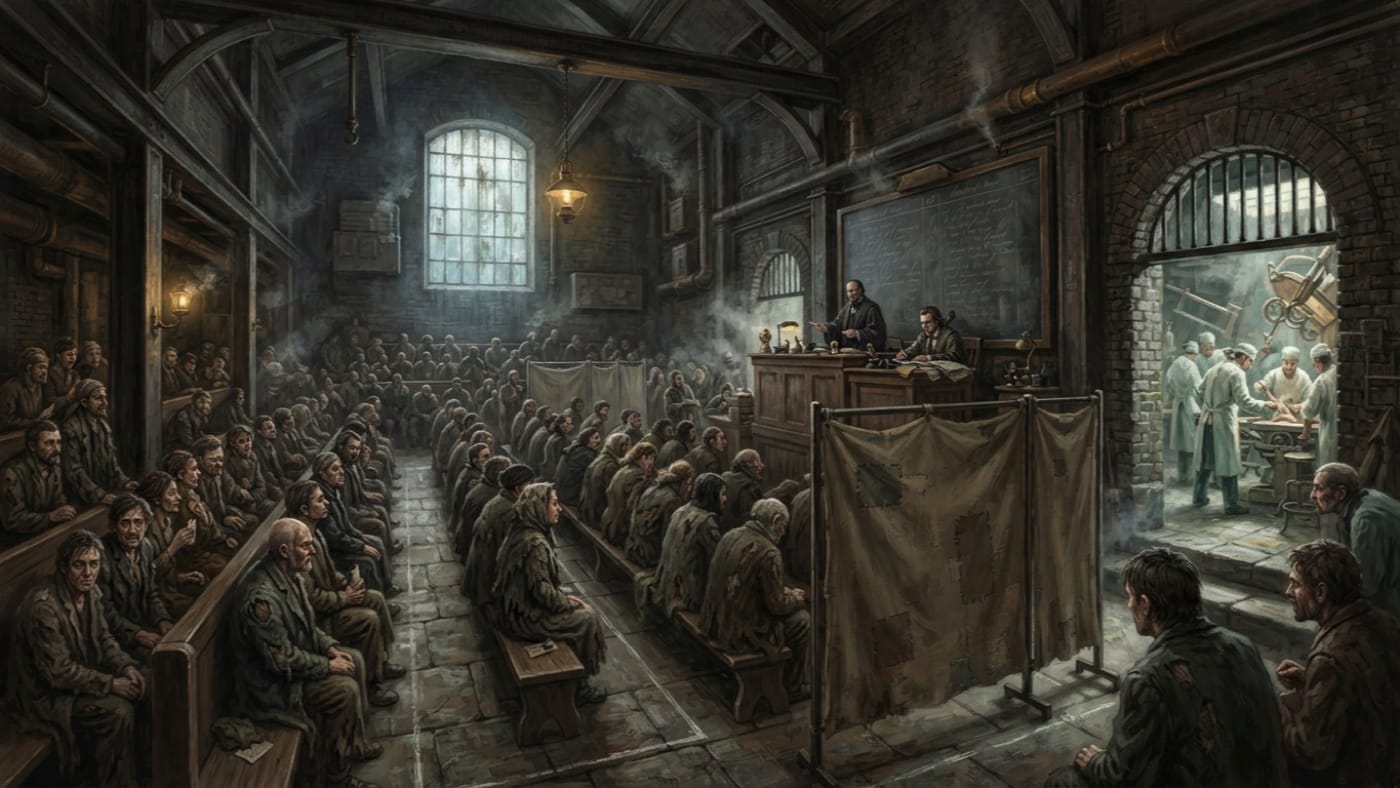
The Tribunal's published account names the hearing room the Hall of Wax Heat. The name describes a smell, and the account lists the rest of it: wax heat, ink, vinegar smoke, damp wool, scorched brass, and the sweet rot of men who have learned to sit upright while leaking through their bandages. Visitors take the wax for the clerks' sealing pots. That is part of it. Notary Row as a whole smells of ink, wax and antiseptic, and the Hall takes the Row's air and adds the petitioners. Wool dries slowly on a crowded bench. Brass scorches when it is kept close to a brazier for the sake of the seals. The rot needs no explanation.
My earlier survey of Marrowgate listed among the Hall's features "a secret backroom where outcomes are sold."
Corrected. That line recorded an allegation and wrote it down as if it were a floor plan. No room has been located, measured or entered in any record I can certify. The allegation stands as an allegation. The furniture is withdrawn.
#On the Chalk Lines
The Hall's first ruling is made by the floor. Chalk lines divide the benches. In the published account, clean-zone petitioners sit nearest the clerks. Grey cases sit beneath the north window, where the draught keeps their fever in view. Black-zone appeals sit behind a screen that spares the court the sight of them and does nothing at all about the smell.
That is what the account describes, and I will not draw more of it than it does. I have no complete zoning map of the Hall and I refuse to sketch one. Nobody has shown me whether the lines are redrawn at each bell, by whose hand, or whether any bench is set aside for cases the three colours cannot hold. The tags are tied in the White Ward by Mercy Ward-Sisters, and the Hall seats by the tag. The building does not diagnose. It has a talent for receiving a diagnosis and turning it into a seat.
The screen deserves its own entry. The Tribunal account reports that it is repaired weekly. The district survey says it is patched more often than it is cleaned. Both can be true. A screen that stands between a court and its dying appellants takes a beating of its own, from elbows and stretcher poles and the occasional fist. I have seen no ledger for its repair and give no cost for it.
#On What the Benches Can Smell, Hear and Read
The Hall is placed so that the petitioner is near three kinds of relief and can reach none of them. Broth can be smelled from the corridor. Saws can be heard from the operating galleries. The allocation boards can be read from the benches, with their bed windows chalked up and wiped away. I do not know the exact distance from the benches to the galleries, and I will not invent a window that looks into one. The sound alone is enough. Surgery and hearings run at the same hours, so a man may hear a saw at work while the court is still deciding whether his own limb will be authorised for one.
These are three separate stages, and the Hall keeps them separate with great skill.
The board shows a bed window: a grant of time within which a patient may be admitted, examined, treated, cut, isolated or reclassified. Windows are posted at midday, and they change whenever the count changes. A petitioner can watch his window vanish without being moved an inch. The board promises nothing beyond what the chalk says, and the sponge sits within reach.
The saw belongs to the Sealhands. The Tribunal authorises a cut. A licensed surgeon-notary performs it and notarises it at the same sitting, and the registry revises the file. Chief Sealhand Orin heads the guild whose rings make the cut lawful. He has no seat on the bench and gets no orders from it. Inside the Hall a Sealhand's word arrives as a surgical recommendation, delivered with a ring on the operating hand. A ruling of Cut sends the patient toward that hand. It cannot make the hand move.
The broth belongs to the ward and its ledger. A bed brings broth, linen and the right to suffer inside authorised walls. The corridor brings only the smell.
#On the Hearing
Magistrate-Physic Toma presides. Clerk Vessa sits below him and records each ruling in the form that will survive appeal. The proceedings are short because the line is long. A Ward-Sister presents the tag. A Sealhand presents a surgical recommendation. A Sanitation inspector presents a cordon objection. The Tribunal account adds that a family member may speak if solvent, connected, loud under the right patronage, or already doomed. I give that as the account's description of who gets heard. I have found no printed rule of the Hall that says so, and a printed rule would be redundant.
The rulings come by category: Treat, Hold, Cut, Transfer, Labour, Hospice, Lime and Review. Several of them send the body out of the building altogether, to the Hospices of Departure, to labour, or to the Lime Yards. Review keeps it on the bench. Among the Hall's dispositions, Review is the one carried out inside the Hall, and it is carried out in the most literal way, by keeping the man where he sits while his wound goes on without a docket number.
#On the Line Beyond the Door
The Hall's authority ends at its threshold. The A.S. 92 Joint Mandate, revised in A.S. 187, gives allocation, hearings and medical debt to the Tribunal and gates, cordons and crossings to the Sanitation Chapter. A ruling issued in the Hall is valid in every room of Marrowgate. Whether the patient can reach the room is a matter for the white line.
Petitioners therefore leave the Hall holding a window for a bed they may not be allowed to approach. Both offices act within their powers when this happens. The Suture Slums survey records the opposite case as well: a labourer with a scheduled hearing stopped at a white line for want of a fresh receipt, his hearing passing without him, his case sent to Review in his absence. The Hall heard the empty bench and ruled on it.
The Tribunal account reports that when Sanitation declares an outbreak, the Tribunal's authority shrinks to the walls of its own Hall. That makes the building the Tribunal's last fortress and also its cell. Prefect Salvius has no need to enter the Hall to empty it. He only has to close the street outside.
#On the Present Condition
As of this survey the Hall is sitting, and it is overfull. The Tribunal account records the A.S. 201 pressures: benches filled past their lines, bed windows withdrawn before they can be posted, Review intervals growing longer. The Hall has not recovered its composure since the clean paper plague of A.S. 199, when certificates issued in good order turned out to describe sick bodies as clean. The account also reports that on the fourth night of that crisis the Marrowwind corrected the Tribunal's dockets, and that the corrections went into the record in a hand no living clerk admitted to. I report this as the account reports it. I do not explain it, and I would distrust anyone in the Hall who offers to.
Since the counterfeit seal ring surfaced in the Suture Slums, every brass seal that enters the Hall is examined twice. Rings cross the threshold under suspicion now, and the clerks have learned to look at a surgeon's hand before they look at his face.
A rumour persists, carried by ward staff, that Clerk Vessa keeps a second board behind the public allocation wall, marked with the patients who should have been saved under any decent arrangement of the world. I have not seen it. I have not seen behind the wall. The rumour is recorded here because it concerns the Hall's architecture, and the wall remains standing in every account, whatever is chalked on its far side.
The benches will fill at the next intake bell. The board will be chalked at midday. The saws will be audible from the galleries, and the broth will smell exactly as good as it did yesterday.