

I've finished reading the sources and am now writing the dossier.
#On His Station
This dossier is a present compilation. It was assembled in A.S. 201, 1911 CE by the common reckoning, from the public record of the Civic Triage Tribunal and from accounts already filed in this Codex. The year dates the compilation. It is not the year of the subject's birth, appointment, first hearing or any inspection, and the archive gives none of those.
Magistrate-Physic Toma presides over the Tribunal in Notary Row Tribunal Hall, Marrowgate. The Row lies between the White Ward blocks and the seal registries. A wounded man is carried past the court before he reaches the archive, and the archive takes him only after the court has decided what he is. Toma does the deciding. His office has a narrow brief. He allocates beds and treatment windows, hears salvage and surgical authorisation cases, and issues labour and Mercy dispositions. The Tribunal's public phrase for this is justice in allocation. It is a phrase for the board outside, written in chalk, and the board is wiped at midday.
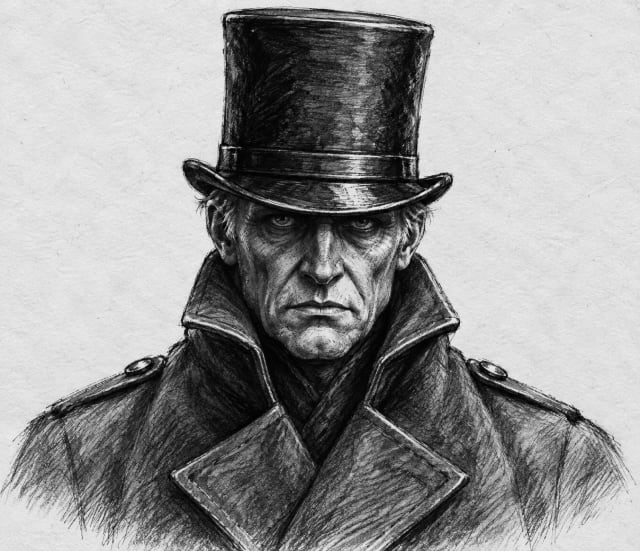
The record keeps nothing more about him. It gives no age, parish, family, schooling or earlier post, and no description of his face. Marrowgate's own register characterises him in two words, cold arithmetic, and I have found no better.
The Tribunal survey states that Toma presides "with the cold arithmetic for which Marrowgate has mistaken wisdom since A.S. 83."
Clarified. A.S. 83 is the year the Tribunal was constituted. The sentence describes the city's taste in arithmetic. It does not show that Toma held the bench in A.S. 83, or held it at any point before this compilation. No accession year for him has been certified.
#On the Arithmetic of a Hearing
The proceedings are short because the queue is long. A Ward-Sister presents a tag. A Sealhand presents a surgical recommendation. A Sanitation inspector may lodge an objection. A relative may speak if solvent, well connected or loud under the right patronage. Then Toma rules, and he rules by category: Treat, Hold, Cut, Transfer, Labour, Hospice, Lime, Review.
Each word is a sentence in the older sense. Treat grants a bed window, meaning time, linen, broth, examination and the right to suffer inside authorised walls. Hold sends the case under the north window, where the draught keeps the fever visible. Labour puts a body to work. Lime finishes the matter. Review is the gentlest word on the list and frequently the cruellest. A reviewed patient keeps his bench and his docket number while the wound goes on at its own pace, and no clerk has yet found a way to make putrefaction wait for the review interval.
The filed accounts agree on his method. He hears a cough and works out the risk to the ward. He looks at an amputation and works out what it will leave behind in law. He treats grief as evidentiary noise unless it is properly witnessed. My Bureau has already filed its view that this is method rather than cruelty, since cruelty requires appetite. I see no reason to amend it. A cruel magistrate can at least be bored, bribed or flattered out of a ruling. Arithmetic cannot.
The work prescription shows his arithmetic most clearly. A patient owes for broth, linen, a draught, a fitting, a bed extension or an appeal stamp. The Tribunal turns that debt into rehabilitative service in the ward laundries, at the kilns or behind the carts. The Prosthetics Guild fits a man's arm cheaply and adjusts it dearly. Missed payments become debt, and the debt comes back before Toma to be converted into labour. A ruling of his can therefore set the shape of a man's every week: which line he may cross, which ration chit he may draw, which name he answers to at muster.
One filed account has him denying a bed because the petitioner's papers arrived five minutes late, and extending a captain's prosthetic maintenance because, in that account's words, the family tithe had healed better than the wound. The Notary Row survey timed a late arrival from the Sanitation post at four minutes and fifty seconds. I do not claim the two clocks measured the same delay. I record that the Row keeps at least two clocks, and that the bench uses its own.
#On Clerk Vessa
Clerk Vessa sits at the lower desk. The partnership is the most important fact in this dossier, and the Hall puts it in one line: Toma issues rulings, and Vessa writes them into a form that survives appeal.
A spoken ruling is only a word. A disposition becomes binding in the sentence written around it: which window, how many hours, which debt source, which labour recommendation, which review interval. The Tribunal's mercy form leaves that last line to "Tribunal convenience." Toma decides. Vessa decides how much of that decision reaches the ward intact. Appellants on the Row are said to know before they pay for the stamp that her windows hold, which tells you more about the pair than any portrait of either.
The arrangement also divides the blame. Petitioners fear the man who speaks. Appellants fear the clerk, who has already written. My Bureau has called Toma the colder officer and Vessa the more dangerous one. The two judgments fit together like the halves of a seal. He supplies the figure and she supplies a form that will hold up in court.
Ward staff say Vessa keeps a second board behind the public allocation wall, listing patients who should have been saved under any decent arrangement of the world. Nobody in the record has seen it. Its existence, contents and purpose are unconfirmed, and nothing filed suggests that Toma knows of it, permits it or would read it. I mention it only because the rumour is told about the clerk. No one has ever told a matching rumour about the magistrate.
#On the Limits of the Bench
Toma's office has edges, and a presiding magistrate is best measured at his edges.
He authorises a Cut. He does not perform it, and he does not make it lawful. The Sealhands cut and notarise under their brass rings, and the registry then revises the file. Chief Sealhand Orin heads that order. He sets his recommendation on the bench beside the Ward-Sister's tag. He neither commands Toma nor answers to him, and Toma has no authority over the rings.
The Tribunal abstract lists "surgical notarization" within the Tribunal's mandate.
Corrected. Under the A.S. 92 Joint Mandate, as revised in A.S. 187, surgical notarisation is reserved to licensed Sealhands. The Tribunal authorises. The ring makes the cut lawful. The magistrate's word reaches as far as the Gallery door.
He grants a bed. He cannot deliver the patient to it. Gates, cordons and crossings belong to the Sanitation Chapter and to Prefect Salvius. If the Prefect closes a corridor, a valid Tribunal window stays chalked on the board until it runs out, while the man it names lies three yards past a white line. Ward ministry and broth belong to the Bureau of Mercy. Toma's bench has no authority over medicine generally, over all of Marrowgate's surgeons, or over quarantine. It holds the allocation and nothing beyond it.
Its institutional ambitions are larger. The Tribunal wants quarantine review moved into its Hall. The Marrowgate sources describe its private plan to get there through a staged legal scandal over some cordon abuse witnessed well enough that Strasbourg would have to act. Salvius is reported to be preparing a "necessary" lockdown that would forestall it. Both remain ambitions, and nothing has been transferred. No surviving order shows Toma directing the scandal, and I will not supply one. Anyone who watches the Hall can see that the petition would come from the presiding bench and be drafted at the lower desk. That is an observation about the furniture.
#On a Compromised Record
The present compilation finds the bench under three pressures, and none of them can be ruled away.
The first is the clean paper plague of A.S. 199. Healthy-looking certificates moved from the White Ward through the Row's registries to the Wagon Quays and beyond. Some carried counterfeit seals. Others carried genuine seals pressed onto false findings, which is worse. Tribunal records were among those later corrected. The audit found systemic fraud in health certification and named no organiser. No surviving finding ties the Sealhands to it, and none assigns it to Toma. What it established about his court is narrower: a bench that rules on paper had been ruling on paper that lied.
The second is the counterfeit ring. A forged Sealhand ring surfaced in the Suture Slums, and licensed surgeons refused to operate for a week, until the Tribunal had certified their own rings. Seven patients died. The Tribunal classified the deaths as administrative. The families called them murder until Vessa corrected the record. The archive does not say who ordered the refusal, what the correction said, or what part the presiding magistrate played in either. I leave those blanks as I found them. The certification that ended the week was the Tribunal's, and the week lasted until it came.
The third is the Marrowwind. Its first uncontested event came in A.S. 194. By A.S. 199 its corrections had reached the Tribunal's own files: cleared names reappeared under fever columns, and bed ledgers marked vacant bled ink through the page. Each correction reopens a ruling the Hall considered closed. A debt calculated on a false clearance now rests on a finding that has been struck out, and the appeal comes back to the bench. The Bureau of Records admits a correction only on the corroboration of a living witness. My own Bureau of Doctrine holds that the dead are filing amendments. That is Doctrine's reading. The mechanism is unproved, and no registry on the Row has stamped it.
#On the Present Compilation
As of A.S. 201, Toma presides. The benches fill by intake bell. The black screen is patched more often than it is cleaned. Bed windows vanish before posting, work prescriptions lengthen, and the Lime Yards blow white dust across the clean line on the days the wind is in the east. Vessa writes beneath him. Orin's recommendations lie on the bench, and Salvius's lines run outside the door.
The record gives his office, his method and his clerk, and nothing else. I have added nothing to it. The docket is longer than it was this morning.