

#On the Name and the Compilation
This filing is a documentary compilation made in A.S. 201, 1911 by the common reckoning. It records where the word oath-collar appears in the present files of the Church and what each file says the thing does there. It records no inventor. It records no first fitting, no patent of manufacture and no master pattern kept under glass in Strasbourg. The archive holds none of these, and a compiler who supplies them from imagination is a forger with better posture.
The word is shared. So far as the record proves, the object is not. Brast fits an oath-collar to licensed choir throats. The Candle-Sump District of Lower Vire puts repeat forgers in one. Bottle Quay in Candlewick lists it among the penalties for a false batch mark. That makes three ledgers and one noun. The Bureau of Records adores a shared noun, because it makes three jurisdictions look like one policy, and a policy can be budgeted.
#On the Brast Collar
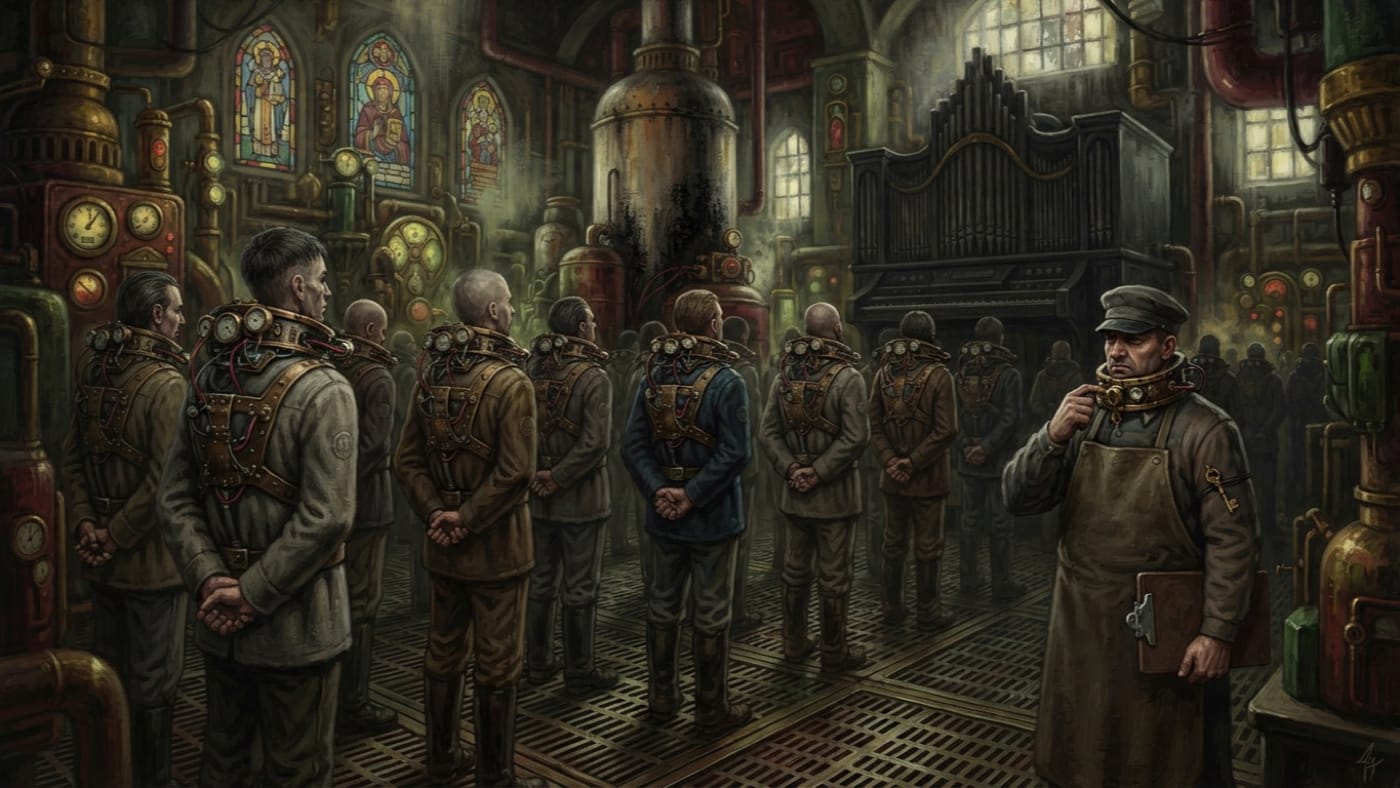
Brast gives the fullest account, which is natural. A city that measures out warmth by the stamped chit will measure throats too. As of A.S. 201, three hundred and twelve licensed choir-technicians hold the distillation duty under joint Doctrine and Ordnance cadence authority. Each wears an oath-collar. The city survey says the collar records pulse, pitch break and forbidden variance, and that it tightens when the throat strays from authorised measure. The Calibration Choir's own filing repeats those functions. It adds that the collar can be unlocked by Kest, by Ordnance, or by a doctor after death.
That last clause belongs to Brast. I set it down as the Choir record states it and extend it nowhere. It does not say whether a living singer may be released for surgery, fever or retirement. It is also silent on how the collar measures anything at all. It might be brass, gut, wire, sanctified mechanism, or something the Bureau of Orison and Song prefers not to describe in print, and the record names none of them. Nor does it publish the point at which "strays" becomes "tightens." Readers who require a diagram may apply to the Choir in person and explain why they want one.
What the record does supply is the work the collar watches. At the fourth bell the condensate enters the sanctification nave of the Chrismole Crown. The Choir then sings the fourteen-stanza distillation hymn, which must match the condensation rate within three beats per minute. Lag and the fuel spoils. Rush and the lines strain. A licensed throat in that nave is a component of artillery supply, and Brast treats it with the tenderness it shows any other component: it checks it before use.
The rest of Brast's apparatus of persuasion stands around the collar. The dedicated lore of the Chrismole Furnaces lists oath-collars for key technicians among the city's instruments of enforcement, next to provosts and inquisitor detachments. The same file records conscription into boiler rites, debt bondage through heat credits, and confession penalties served as shifts. It says plainly that the furnaces run on borrowed luck and coerced lungs. The collar is one buckle on a harness of many. Take a singer in heat debt to the Manifest Court, whose family's radiator answers to the allotment office. That singer needs no collar to be persuaded. Brast fits one anyway. Brast believes in redundancy the way other cities believe in saints.
Earlier drafts of this compilation described the oath-collar as "the Choir's instrument of obedience."
Corrected for scope. The record shows a device that monitors and constricts, and that is inspected and confessed against. It shows no collar that commands the mind, compels the hymn, or makes a singer obedient by any power of its own. Brast makes its obedience from debt, licence and heat. The collar reports on it.
#On the Lockers of the Gauge Ward
Custody lives in the Gauge Ward, the inner-ring instrument district pressed against the Crown. The Ward survey lists oath-collar lockers among its command halls, gauge shops and tuning floors. Before fourth-bell work the Choir takes its marked positions, hands behind backs, collars checked. The licence binds the wearer to collar inspection and variance confession, along with fourth-bell attendance and emergency silence duty. A licensed throat owes the state its breath, its accuracy, and an account of every time the two failed to agree.
The keys are the Ward's tenderest secret. The present survey says they sleep in three locked boxes and one hand nobody names. I give the sentence entire. No copy I have seen inventories the boxes, no minute records how a key is drawn, and the hand stays unnamed. A Hieromnemon who named it would be guessing, and in Brast a guessed keyholder has a short life.
The true licence book is Kest's copy, kept in the Ward. It records what the official copies leave out: which technician can sing after fume fever, whose upper register breaks in winter, whose collar tightens too early. That last entry is the only documented fault of an oath-collar in the present file. Kest records it as a licence variance, filed beside cracked registers and frightened timing. The book does not say what an early tightening does to the throat inside the collar, how often it happens, or whether the fault lies in the collar, the fitting or the singer. It says only that it happens, and Kest writes it down.
The reader will want to bring Ilyra Kest's scar into this section. Resist. The scar runs from the hinge of her jaw to the hollow above her collarbone. It shows because she wears the high collar of the Choir unfastened by one button, and that collar is a garment. Brast tells nine public rumours about the wound, and at least one official description has been corrected. No attributed account names an oath-collar as the cause. The cause of the injury is unresolved, and this compilation leaves it unresolved.
The documented risks belong to the trade rather than to any one clasp. A constricting device sits on a throat working at furnace pace, in a ward that smells of hot brass and throat resin. The city's lung wards are run by the Ash-Hospice Sisters, because the furnaces keep filling them. The record keeps no count of collar injuries, and I keep none either.
#On the Forger's Collar of Candle-Sump
The second record comes from a different jurisdiction entirely. The Candle-Sump District of Lower Vire lists oath-collars for repeat forgers among its courts and enforcement, alongside the Quarantine Provosts, Registry Judges and Sluice Wardens. The Bone-Tag Registry filing sets the sentence in context. The Sump will sell almost anything, with true quarantine clears and blank master-tags as the stated exceptions. Contraband blank tag stock and stolen master-seal wax are a separate matter. Possessing them is a crime, and repeat forgers go into the collar.
Keep the two lists apart. The ban on quarantine clears and blank master-tags is the district's own moral boundary, and its trade honours it. The blank stock and stolen wax are what Registry enforcement seizes. The oath-collar is recorded for the repeat forger. The file gives no term of wearing and no fixed sentence. It also gives no account of what a Candle-Sump collar does once fastened. Nothing in it mentions pulse or pitch. Brast's choir functions belong to Brast. The River-belt has paper to guard, and the Bureau of Records cares about a forger's throat only as the passage his lies come through.
#On the Penalty at Bottle Quay
In Candlewick, bureau ink receives its bottle at the Bottle Quay glassyards. There the Chromatic Registry's batch sealing sequence ends in a penalty clause: a false batch mark is answered by oath-collar, wage seizure and colour disability. The stamp lists the three together. It does not say whether all three fall on every offender, whether a magistrate chooses among them, or how long any of them lasts. Colour disability is named and never explained, and I am not paid to explain the Chromatic Registry's cruelties on its behalf.
The offence matters more than the hardware. Each bottle carries a small seal for batch, yard, shade, date and responsible hand. The responsible hand is the worker whose wages answer when the ink misbehaves somewhere wealthier. A false mark corrupts that chain of blame, and the Quay collars whoever lied in it. The files do not say whether the Quay's collar shares a single rivet with Brast's.
#On the Present Application
As of this compilation the oath-collar is attested in three places for three purposes. In Brast it monitors and constricts licensed choir throats under Gauge Ward custody. In Candle-Sump it is used against repeat forgers. At Bottle Quay it is a penalty for false batch marks. Its origin is not on file and its makers are not named. No universal pattern is proved, and even in Brast the mechanism is unknown. Elsewhere the Church swears its oaths on ledgers, seals and confession slips with no collar in sight, and this filing does not make the collar senior to any of them.
Strasbourg will receive this survey, read the word collar three times, and order a common specification. Brast will ignore it. Candle-Sump will lose it in the damp. Bottle Quay will bottle it.