

#On the Prescribed Observance
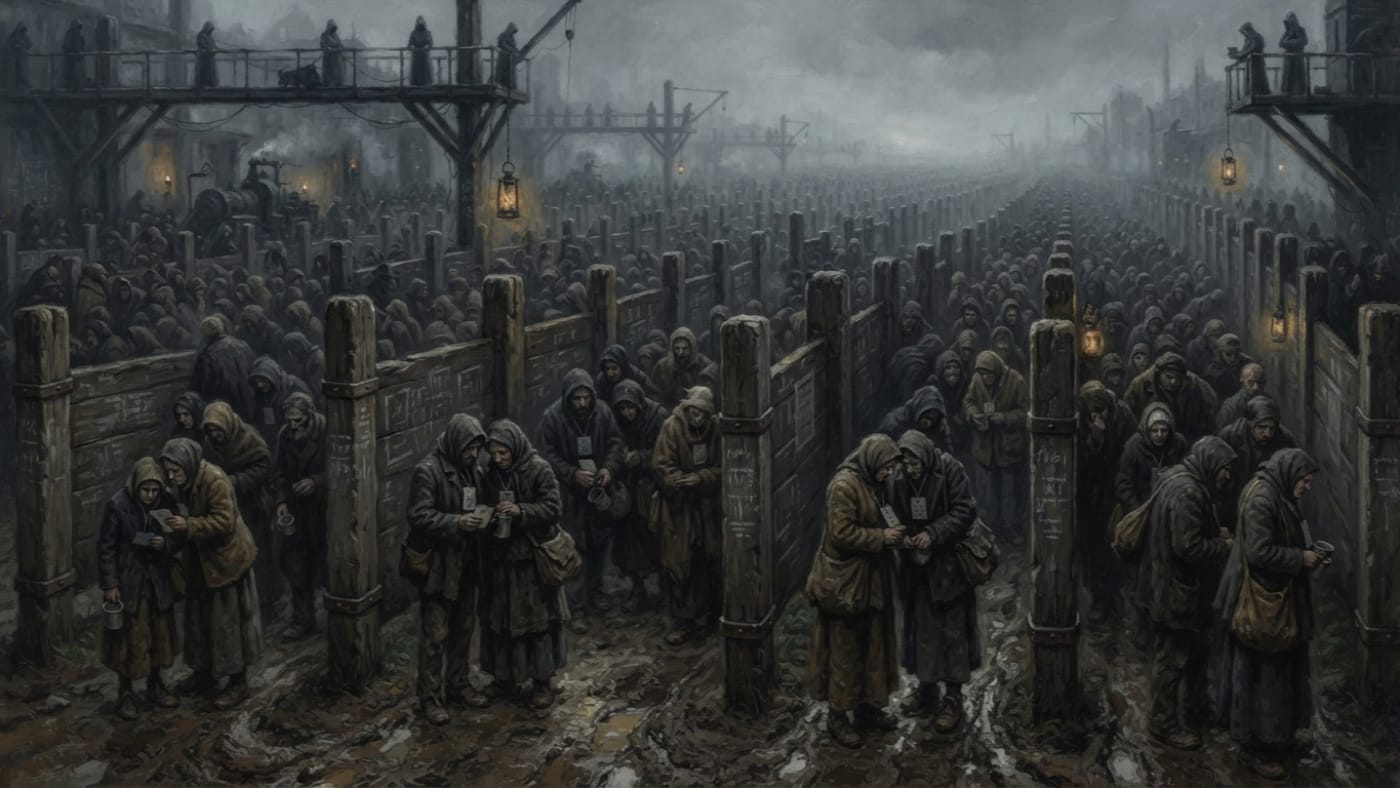
The Queue Prayer is said at fence-posts. That is the entire public instruction, and the Bureau of Rites has seen no reason to add to it. A traveller on the Queue Road reaches a post and repeats the prayer there. Then they shuffle forward with the lane, reach the next post and repeat it again. The posts are wet timber, iron-banded where the barricades meet, splintered at hip height by years of carts and elbows. Some carry chalked numbers and some carry notices. By order of Rites, every one of them also carries a prayer that is written on none of them.
I have searched for the text. The Codex holds no authorized edition, no composer and no date of composition. It sets no number of repetitions and gives no rubric for posture or cadence. What the road has is the practice: mouths moving beside posts in cold air, through tallow smoke and the vinegar reek of stamp ink, while the queue does what queues do.
It stands.
Rites prescribes the prayer as a response to the Minute Drift. This is the disturbance in which bells ring twice, ink dries early and a body leaves the Barricade Maze older than its papers say it is. Rites prescribes and the traveller repeats. The lane advances by the width of one person whenever a clerk lifts a hand. Nobody has suggested that the prayer moves the lane. It is meant to hold something else in place.
#On Prayer, Card, and Witness
Rites does not prescribe the prayer alone. Three measures travel together. The lanes confuse them constantly, and I shall not.
The first is the sanctioned bell-card. This is the stamped paper on which the road records a traveller's bell-marks, and therefore their minutes. It is an object, so it can be lost, soaked, forged or confiscated. When the Drift is at work it can also be wrong. It may carry stamps the window never struck, or leave out hours the traveller swears they stood.
The second is witness pairing. Two people vow to remember the same hour and compare their accounts at the next gate. If they agree, one hour is held by two memories. If they disagree, they have a quarrel and a gate ahead of them, and the gate charges for the delay.
The third is the prayer, the only measure a traveller carries entirely in the mouth. It needs no partner and no stamp. A person stripped of their papers and abandoned by their witness can still say it. That is either its mercy or its convenience, depending on which side of the stamp window you stand.
All three measures answer the same injury. Under the Drift, bodies, memories and papers disagree about how much time has passed. Hunger arrives at the wrong hour. A shadow lies along the gravel at an afternoon angle while the bell insists it is morning. Hair greys between gates. The card keeps the paper's account and the witness keeps memory's. The prayer, repeated post by post, marks the progress of the lane in the one ledger a pauper cannot be charged for: the order of their own speech.
That last sentence is my reading, and I sign it as mine. Rites has issued no explanation of what the prayer is meant to fix.
#On the Bureau's Prescription
The Bureau of Rites standardizes the Church's liturgy and audits compliance with it. Elsewhere its Sub-Priors of Form time genuflections against pocket watches. Its faith in exact observance is total, and within its own jurisdiction that faith is justified. An observance performed exactly is by definition compliant, and compliance is what Rites certifies.
The Queue Prayer fits neatly inside that faith. Rites cannot open the floor of Gate Nine. It cannot lower the Permit Directorate's minute rates or rehang the bells of the Maze in their proper order. It can prescribe an observance at every fence-post. Once it has done so, the Drift is a matter of ritual response, and ritual response belongs to Rites. Jurisdiction established beside a post does not wander off when the post begins to misbehave.
I record that as institutional analysis. I do not record that the prayer was written for that purpose, or that it fails. A prescription can direct attention. Forty-eight thousand registered people moving their lips at the same posts are at least attending to the posts, the lane and the order of things. No report has said whether the Creator, or the Drift, attends to them in return.
I find no rate entered against the prayer in any Directorate ledger I have seen. That makes it rare on the road: an act no clerk has yet bothered to price.
#On What the Reports Establish
The road's countermeasures have produced the usual harvest of paper. Testimony describes the prescribed measures, the prayer among them, as having efficacy that is "statistically non-zero." I have looked for the statistics and none are attached. The phrase reaches me secondhand, from people who would like it believed. I pass it on inside its quotation marks, which are doing more work than any figure.
Two facts stand against it, entered without quotation marks. None of the prescribed measures has been certified as a cure. And the Drift has spread.
The Drift was first classified in A.S. 194, mainly in the Barricade Maze between Gates Three and Five. After the spring rate doubling of A.S. 200 it reached three more places. At Gate Two Bridge Pinch, shadows step onto the planks before their owners do. At the Bell-Mark Gantry, stamps fall irregular from the clerks' hands. In the Shed Wards, bodies age beyond what their records allow. Fence-posts stand in all of these places, and the prayer has been said beside them throughout.
The fence-posts at which the Queue Prayer is said stand within the Drift's localized zone, the Barricade Maze.
Corrected A.S. 201. The Drift has been confirmed at Gate Two Bridge Pinch, the Bell-Mark Gantry and the Shed Wards since A.S. 200. The prescription covers the whole road. So, it turns out, does the zone.
Two offices read the same record and reach two conclusions. Rites keeps its Category Two Localized Temporal-Scribal Disturbance. The Bureau of the Hourglass assesses Class II-Extractive, sub-designation Alpha, and its recommendation for official reclassification is still pending. Both positions are current. The prayer belongs to the first. The word "extractive" belongs to the second. By the account of those who have read them, the sealed reports tie the disturbance to the Apparatus beneath Gate Nine, and they do not name its product or who receives it.
The record will bear three readings, and I refuse all three. The first is that the prayer protects, partly and unmeasurably, in a way the bodies cannot feel. The second is that it protects nothing. The third is that whatever effect it has runs through the Creator, the Great Deceiver or the wheel. The reports establish repetition, spread and a pending recommendation, and nothing more.
#On Songs Below the Fence
In the culverts beneath the road, the Unstruck keep a different practice. Their songs are forbidden. They foul the bell schedules, misalign the stamp windows and cut lane ropes where the Drift runs thickest. Brother Senn preaches among them with clocks wrapped in oilcloth and calls the bell-marks spiritual violence.
A sealed maintenance note links their interference with dampened extraction surges. Someone above the Directorate has read that note. No copy I have seen names the office that approved its recommended posture.
The comparison flatters neither side. Above the fence, a prescribed prayer obeys the lane, the bell and the post. Below it, illegal songs attack the bell and the lane directly. The link in the note belongs to the songs. No source extends it to the prayer. None shows that the two share a method, or that the prayer feeds what the songs disturb. I decline to supply the missing study. It would only join the recommendation in the queue.
#On Present Application
In A.S. 201 the road stands at Amber. The rates stay doubled and the lanes stay full. The prayer is said at the posts of the Barricade Maze, on the approach to the Gantry, along the Shed Wards and on the muddy bank at Gate Two. The people saying it hold bell-cards gone soft with damp and tin cups of broth gone cold. Some have a witness beside them. Some lost theirs at an earlier gate. Their lips move. The clerk on the catwalk above lifts a hand, the lane advances one body's width, and they reach the next post and begin again.
The Gate Nine inquiry is still waiting on its recommendation. Beneath the Hearing Hall, by the sealed account, the wheel keeps its own count.