

#On the Bowl and the Docket
This survey was compiled in A.S. 201 / 1911 CE. It draws on the papers that travel with the material, because the material itself has not been made to testify. The year given is the year of compilation. It marks no founding, no first batch, no inspection and no edition. Any clerk who copies it into a register as the birthday of relic-ash will be reassigned to counting the stuff.
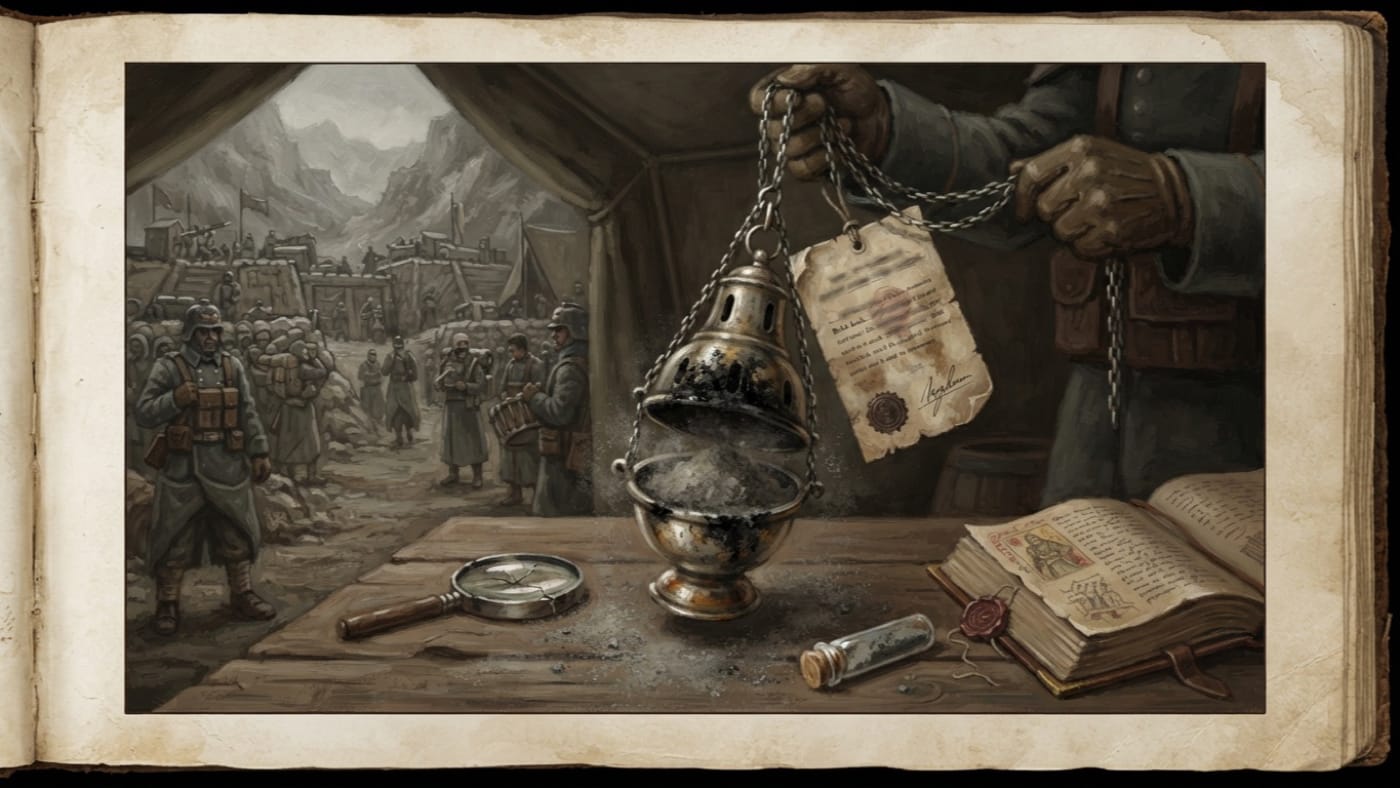
The object is ordinary, and that is what makes it dangerous. It is an iron field thurible, blackened at the vents, its chain rubbed bright where a gloved hand has worked it. In the bowl, or caked against its sides, is a grey particulate whose colour tells the examiner nothing. Tied to the chain, or folded into the chaplain's book, is a docket: a source named, a witness signed, a loading recorded before action. The docket is the reason this article can exist. The particulate is the reason it cannot reach a conclusion.
For the purposes of this survey, relic-ash is a class of field material. It consists of remains identified or claimed as relics, reduced to particulate, and used in thuribles, field wards and military rites. The definition rests on the claim and the use. It says nothing about any given batch. Two thurible charges filed under this heading need share no saint, no preparation, no ingredient and no result. Nothing in the record before me gives a reason to pretend they do.
#On What the Ash Claims to Be
The old Lore Book is confident, as old Lore Books are. It says the Ash Chaplains are named for the ash they carry, and that this ash is scooped from the crumbled femurs and powdered skulls of saints long since canonized. In that telling every thurible smoulders with the dust of the dead. The same page admits that some chaplains cut the ash with common soot, then assures the reader that Providence makes it holy all the same. I have no quarrel with the assurance as devotion. As inventory it is worthless.
The parent article on the Ash Chaplains gives a longer list for what it calls the proper mixture. It names powdered saint-bone, certified funeral charcoal, palm-branch cinder, chapel soot, salt, oil residue, and a grey binding dust whose recipe the Bureau of Relics claims and the Bureau of Orison disputes. I enter that list as the office's own account of a claimed mixture. It is no formula, and no quartermaster should copy it into an order as one. The same article records that quartermasters adulterate the bowl, which tells us more about the ledger than the list does.
What, then, makes ash into relic-ash? A claim, and a paper that carries the claim. The Bureau of Relics requires an Authenticity Writ before a shrine may display a holy remain, and its examiners have erased many a saint's memory with a single word: unverified. The Relic Authenticators build provenance chains from custody ledgers, witness statements, earlier seals and examination under the lamp. In their own idiom, provenance is a spine. Their own trade also knows that a spine can be set crooked, smoothed over with "lost record" language, or bought.
A seal on a field docket therefore establishes what an office was prepared to sign. It names a source, a witness and a moment of loading. It does not reach back along the chain to the bone. Nor does it reach forward into the lung to report what the bone did there.
Every thurible smoulders with the dust of the dead.
Corrected for survey use. Every thurible issued as relic-ash carries a relic claim. Some carry saint-bone. Some carry soot. Several, by the Lore Book's own admission, carry both, and the docket does not always say which.
Adulteration is no proof of universal fraud. A disputed sample is only disputed. Some bowls are cut with soot by thieves. Some are cut by men who ran short before a breach and preferred grey to nothing. Some, so far as the paper shows, carry exactly what their docket says. The survey files all three under one heading because the field does.
#On Its Neighbours in the Grey
Ash looks like ash. That is the whole of the classification problem, and it has embarrassed every Bureau that owns a drawer.
Ordinary corpse ash has its own category. Funeral cinder, the residue of a burned trench and the grey that settles on a field after artillery has made cremation unnecessary all stay outside this class. None of them becomes relic-ash because of where it lies, what colour it is or how anyone feels about it. Where a particular record documents a relic claim, the material enters this survey. Where no record does, it remains the dead, disposed of honourably or otherwise. A chaplain who loads it without a docket is loading something else.
Saint-dust is a traded product, and its trade has a capital. The Saint-Dust Cooperage of Mournwater is a River-belt town whose river the map-clerks still argue over. It ships relic-derived dust as brine slurry in coopered casks, graded in its halls and certified on its White Steps. Its motto is "If it settles, it's true." Its scandal concerns shipments that settled wrong. Mournwater particulate may well reach a chaplain's bowl by some road. Nothing in the record makes it the general origin of relic-ash, though, and an assay of Mournwater slurry proves nothing about a charge loaded in a Sibiu pass-fort.
The Chrismole Furnaces of Brast list a substrate on their receipts. Its contents and supply chain are reserved. This survey has no clearance for either and draws no line from Brast to any thurible. It records only that industrial substrate is a separate, restricted category, and that the Bureaus do not want it confused with field relics. On that point, for once, the Bureaus and I agree.
The Bureau of Alchemical Standards tests relic media along with its other residues, reporting what a material holds, carries, preserves or refuses. The work is real and often useful, but it tests matter. A reagent strip can report calcium, carbon and lime. It cannot report a saint's name. The Bureau's own stamp calls its classifications provisional. No paper presented to this office describes any universal assay that tells sanctified particulate from its imitators.
#On Use in the Field
The documented military use belongs to the Doctrine of Layered Death. Shield-Paladins set the wall and Litany-Engineers set the charges. The Ash Chaplain then climbs to a rearward height, opens the thurible once the Lock has set, and leads the Litany of Stones, while the Processional Band keeps the rhythm behind him. Field regulation ranks the thurible's priorities as lungs, then sight, then morale. The loading is witnessed, the bowl sealed, the source named and the docket signed.
The Alpine Watch drills the same order in its pass-forts, where the third layer raises relic-ash against the mountain wind. That detail deserves more attention than it gets. Ash in a thurible answers to the air before it answers to the chaplain, and on a ridge a charge meant for the rank may end up in the next valley.
Field wards belong to the class as a use and fall outside this survey as a design. Units that hold relic-ash also employ it in protective rites. The papers before me establish no single pattern for such a ward, no approved method of application and no demonstrated result. I record the use and decline to draw the diagram.
The old battle-preachers, whom the Tribune-Chaplains claim as ancestors, left no papers, ash dockets included. Nothing in the record shows that they used relic-ash, or that the Ash Chaplains descend from them. They appear on this page only because civilians keep seating them in the same pew.
#On What the Ash Is Said to Do
Here the ledgers part company, and every one of them is signed.
The Bureau of War lists steadier ranks, fewer routs, better breach survival and fewer cases of voluntary collapse. By the Lore Book's account, soldiers say the ash burns in the lungs like incense and steadies the heart. The Bureau of Medicine lists scarring, cough, fever, eye irritation and a gradual narrowing of the throat. The chaplains cough like old furnaces by thirty and develop a cracked lower register that the inspectors file as vocal degradation. Every one of these claims is attributed to its source. None of them is a dosage, and this office will not supply one.
The War claim deserves a precise reply. A breach holds because wall, charge, ash and rhythm work together: a drilled company breathing on a count it learned in barracks, under a chaplain whose voice the men fear more than the shells. When the formation stands, the ash was present at the time. Presence is not isolation. No record before me separates the work of the particulate from the work of the litany, the drum and the drill. The parent article admits as much: the Bureau has no assay that distinguishes sanctity from successful theatre under artillery conditions.
Claims that the ash fouls hostile song, frightens demons or works by some named supernatural process belong to the people who make them. Doctrine may hold them. I enter them as held.
#On the Present Classification
As of this survey, A.S. 201 / 1911 CE, the class stands as follows. A docket can show that an office named a source, that a witness saw the bowl loaded and that a chaplain signed. A sample sent to Alchemical Standards can show what it is made of, in the terms a reagent understands. Neither can show which saint it came from, whether any saint did, or what the ash did in the lung that the drum and the Lock had not already done.
Relics claims custody of the ash. Records claims the docket. War claims the result. The chaplain claims the cough, which is the only portion nobody contests.