

#On the Station of the Nine
"Mark the casing. The saint is not yours." — rule of the reliquary bench, as recited to the Warden
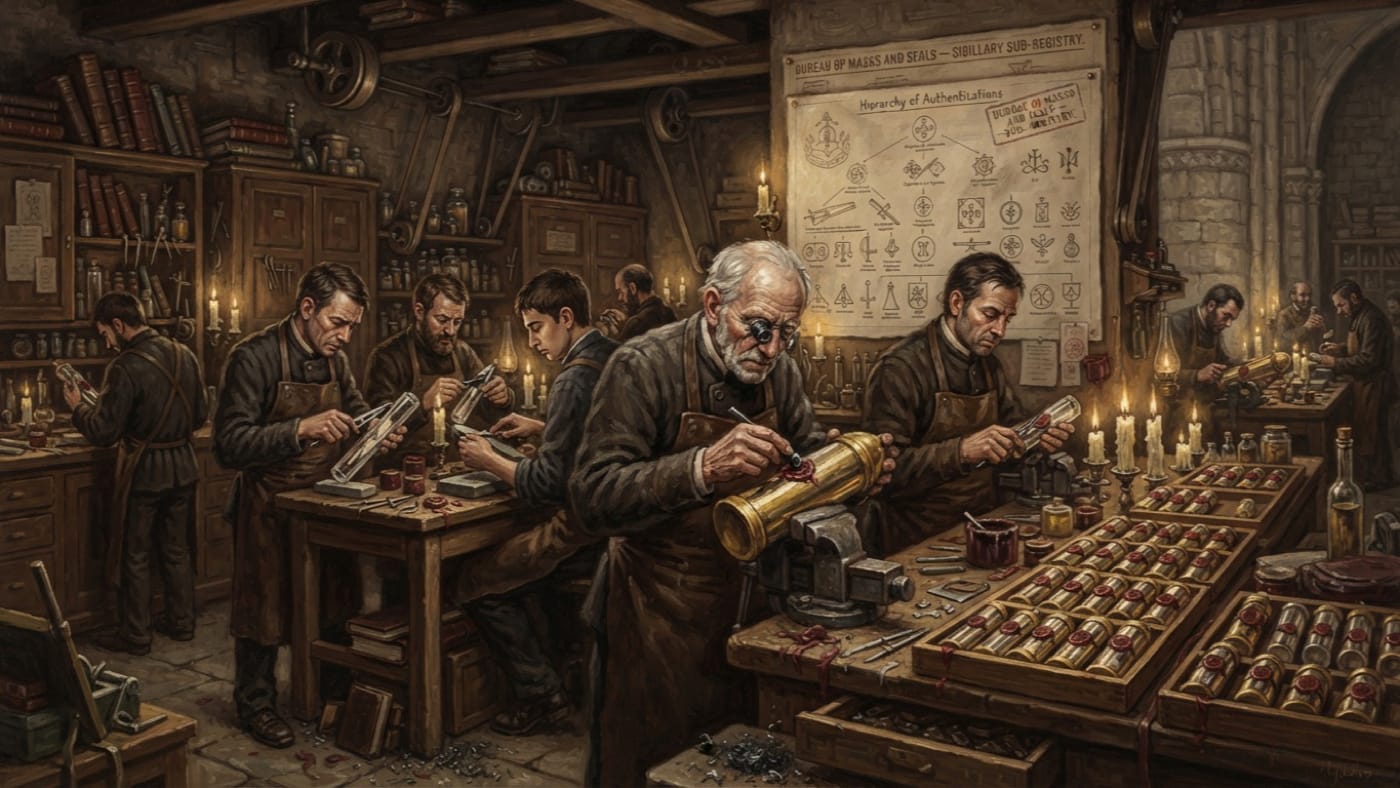
The Bureau of Masks and Seals keeps nine Reliquary Sigillators on its present establishment. They cut the dies that mark reliquary casings, and they apply the reliquary sigil with those dies. The rest of the Sigillary may cut counter-seals for grain chits, mask licences and death warrants. The nine cut for caskets.
Their remit is narrow, and the Bureau guards its narrowness the way a sacristan guards a key. Classification belongs to the Bureau of Relics. The certificate belongs to the Bureau of Records. Sanctity belongs to whoever can prove it before a tribunal. The nine are left with metal and wax, and they answer for every grain of both.
The Bureau calls them a specialist sub-guild. Whether they stand on the rolls of the Guild of the Anvil and Stylet or on some separate register of the Bureau's own, the published record doesn't say, and I won't draw a chart of their allegiance from a single noun. The year their bench was founded is not on file either. I leave it blank, as the Bureau has.
What the nine produce is plain enough. The impression names the relic, gives its classification and ties the casing to a chain of custody written down elsewhere. If the impression can't be read, the casket might as well carry no name at all, and a nameless casket on a chapel shelf is an open invitation to every thief, forger and pious opportunist in the diocese.
#On the Bench and Its Demands
The nine work three levels beneath the eastern cloister of Strasbourg Cathedral, in the Sigillary, by tallow light. Oil lamps are forbidden near the wax stores, so the reliquary bench smells of mutton fat, hot resin and men who have stopped noticing either.
A flat seal is a simple matter. Paper lies still. A reliquary is a dome of gilt, a crystal tube, a casing of bone, a battered field box with a dent where a shell fragment found it. Every one of them curves differently, and the die has to be cut to fit the curve it will strike. A die cut flat bites in the middle and leaves the edge vague. A vague edge is a gift to a forger. So the Sigillator begins with the casing and works backward, taking its geometry with callipers and checking the reference impressions under magnification. The cutting is done to suit the object, and the object doesn't care.
Then comes the wax: beeswax, pine resin and a mineral pigment whose formula is classified. I will say no more about it, and the reader should infer nothing from that. The wax has to hold on metal, on bone casing and on crystal. It has to be soft enough to take the die cleanly. Under that wax, sometimes no thicker than a fingernail of gilt away, lies whatever the Church has declared holy. Crack the crystal and the Sigillator has spoiled a vessel. Scorch the fragment inside and the Sigillator has wounded a saint, and the Bureau of Relics keeps a separate docket for that.
Watch one of them at work. The shoulders don't move. The breath is held for the strike and let out afterward, slowly, the way a sniper breathes. The free hand braces the casket on its padded cradle, and the eye stays on the glass, never on the hand.
#On the Passage of Responsibility
Authenticating a relic takes four Bureaus and five actions. The nine perform one of the five. They are blamed for most of the failures.
The request comes down to the Sigillary's first level with the relic's classification already settled. A Relic Authenticator of the Bureau of Relics has examined the object, traced its provenance and written the verdict. The Sigillator receives that verdict. The Sigillator doesn't reopen it. A die-cutter who second-guessed an Examiner's judgment of provenance would be in breach of jurisdiction long before anyone thought to ask whether the doubt was right.
Next, the tools go to the Bureau of Rites for consecration. Rites blesses gravers, files and dies without being able to tell a sound bevel from a ruined one, and sends them back sanctified. Only then may the work begin.
The Sigillator cuts the die and strikes the casing. Here the material responsibility changes hands. Once the impression has set, it belongs to the inspection.
The Bureau of Relics returns to inspect the finished impression. This is the same Bureau that classified the relic, now doing a second and different job, and it judges whether the mark is sound, legible and true to its die. Last, the Bureau of Records files the authentication certificate, which the impression will answer to for the rest of its service.
Every line on that stamp is a fence. A perfect impression struck on a misjudged bone is still a perfect impression, and its maker is blameless. If the impression is crooked on a true bone, the fault lies with the Sigillator and with no one else. The nine know which half of that arrangement they occupy.
#On Service Beyond the Vault
Most of what the nine strike will never stay in Strasbourg. Reliquaries are sent to parish chapels, bastion shrines and the trench niches of the Sagittal Line. There, rain soaks the wax, mud packs into the edge and enemy fire shakes every casing in its bracket. The Sigillator must allow for all of it at the bench, months before the casket ever reaches its niche.
In the field, checking a seal and examining a relic are two separate acts, and whoever confuses them puts the whole front at risk. The Counter-Relic Examiners of the Bureau of Relics ask both questions: whether the impression is intact and matches its certificate, and whether the thing inside is still what the certificate claims. The wax can answer only the first. If the impression is doubtful, the casket goes back to Strasbourg, where a fresh strike waits for a fresh Relics verdict. A sound impression stays where it is.
Standing Order 88-R (A.S. 182) required that all frontline relics be re-authenticated monthly.
Corrected. The required frequency is weekly. The monthly directive was the original, and it was wrong. The order was revised within the season, after losses the Bureau of Relics does not reproduce. The Warden adds that the order governs Relics examination. It does not send the nine to every bastion each week, and it does not require any sound seal to be struck again.
#On the Cases the Bench Cannot Settle
The procedure is exact. Some objects ignore it.
In Cologne there are seventeen femurs attributed to Saint Aldebrand. Every one bears an authenticated sigil, and according to the Bureau each was struck by a different Sigillator in a different year. The present bench numbers nine, so seventeen hands means the reliquary work has passed through more than one generation of cutters. Every one of those impressions is sound. Each correctly records a determination the Bureau of Relics made, and since the Fourteenth Doctrinal Congress of A.S. 147, the Femur Principle has held that notarized femurs are authentic. The Sigillary's position is that seventeen correct impressions are seventeen correct impressions. The arithmetic of the skeleton lies with Relics.
Vienna is a harder matter. The reliquary associated with the Siege of Vienna of A.S. 95 is bound up with the miracle of Saint Aldebrand ratified in A.S. 104. Since that ratification, the parent record states, its sigil has been reapplied four times. The wax melts. No cause is entered against the die, the wax or the hand. The nine cut again, warm the wax again and strike again, and Relics inspects again, and every time the paperwork is in perfect order. The Bureau offers no explanation, and the Warden has none to offer either.
The last case is from A.S. 194. A relic recovered from the Gilded Chasm arrived at the Sigillary already carrying a sigil in the Bureau's own format, struck in wax of the classified formula. The die-cutters compared it against every register of hands, dies and applications. No known Sigillator had applied it. The file was entered as Pre-Authenticated, Origin Unknown. Archon Casselius of Mainz read it and wrote in the margin: "Do not inquire further."
That one is worst for the nine. Cologne leaves the bench to answer for its arithmetic, and Vienna leaves it to answer for its wax. The Chasm impression is their own work in every respect except authorship, and the order forbids them to find out whose hand made it.
#On the Present Service
As of A.S. 201 the reliquary bench is fully staffed at nine. The tools come back from Rites consecrated and the wax is kept warm. Requests come down from the first level with their verdicts attached, and impressions go up to Relics for inspection. Somewhere along the Line, an Examiner is holding a lamp to a casing one of the nine shaped, and finding the edge readable.
Vienna's next reapplication will be made when it is needed. The Chasm file remains in its drawer.