

I've checked the continuity reference, the voice guides and the parent and sibling articles. Writing the codex prose now.
#On the Mark and Its Authority
"Wax remembers what the clerk forgets." — saying of the Sigillary bench, unattributed
A reliquary sigil is a small stamped impression set into the casing of a reliquary. It names the relic inside. It records the classification the relic has been given. It ties the casing to a chain of custody written down somewhere else. Three things have to be kept apart, and every clerk who mixes them up eventually gets taught the difference. The impression is the wax on the casket. The die is the cut metal that made it. The certificate is the filed paper the impression answers to. You can scrape off the first. The second gets melted down when it retires. The third outlives both, because the Bureau of Records has never thrown anything away.
The Founding Instruments, under whose authority the Bureau of Masks and Seals was set up in A.S. 92, list "reliquary authentication marks" among the instruments reserved to that Bureau and no other. That list is short. The monopoly it creates is complete. This entry describes the sigil as it is kept in service in A.S. 201, the present year of survey. The year the first one was cut is not recorded here. The Bureau has not supplied it, and I don't invent founding dates for my own amusement.
#On the Die and the Wax
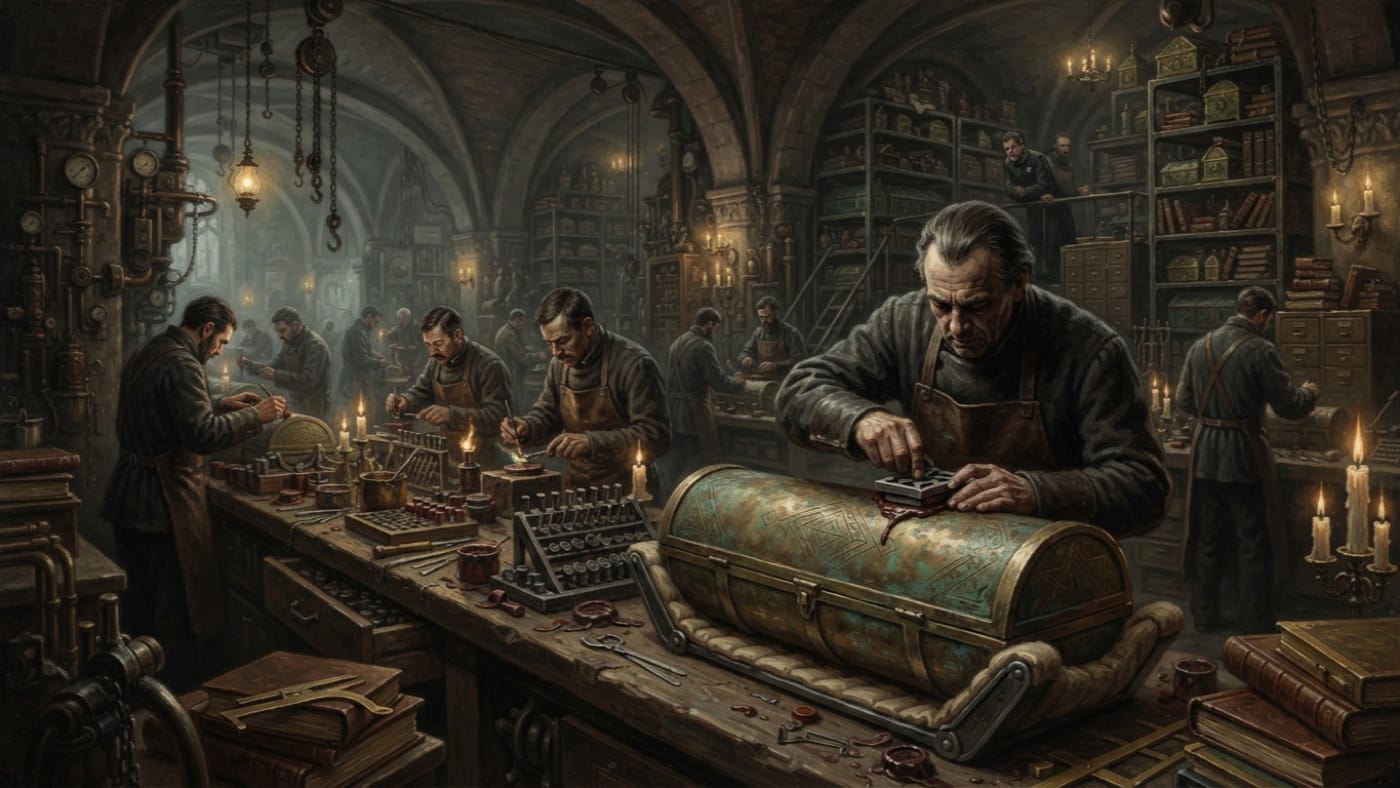
The work happens in the Sigillary, under the eastern cloister of Strasbourg Cathedral, three levels down, by tallow light. Oil lamps are banned near the wax stores. The bench belongs to the Reliquary Sigillators, nine die-cutters who do nothing else. Their colleagues cut counter-seals for grain chits and marriage writs on flat paper, a surface that keeps still and has no saint inside it. The Reliquary Sigillators get no such kindness.
A reliquary is curved. Some are domed caskets, some are crystal tubes, some are bone-cased boxes, and some are field shrines knocked out of plate by a chaplain's armourer the night before an assault. A die cut flat for a curved surface bites hard at the middle and leaves the edges vague, and a vague edge is exactly what a forger hopes to find. So each reliquary die is cut to fit the shape of the casing it will mark. The Sigillator works from the casing, and the casing never comes to the Sigillator's convenience.
Then comes the wax. Sigillary wax is beeswax, pine resin and a mineral pigment. The working formula is classified, and nothing in this entry should be read as a hint about it. The wax has to grip gilt metal, bone casing and crystal. It needs enough heat to take the die cleanly and seat itself, and that heat must never reach the contents. A cracked crystal is a disgrace. A scorched fragment of a saint is a tribunal. The Sigillator presses a raised design into a soft substance against a hard curved surface, a hand's breadth from something the Church has declared holy, and goes on breathing.
The finished impression must stay readable in two places. One is the cathedral vault, which is dry, cool and patrolled. The other is the trench niche of the Sagittal Line, where rain, mud, rifle shock and bombardment are just the weather. In the vault an impression slowly blurs from being handled. On the Line it can lose its crisp edge in one wet season. A blurred edge cannot be read, and an impression that cannot be read certifies nothing. The die-cutters know this better than anyone, which explains their manners.
#On the Four Bureaus Required
The parent record puts the procedure in one sentence, and I can't improve on it: four Bureaus to stamp a bone.
First, the Bureau of Relics classifies. In practice that means a Relic Authenticator, a gloved Examiner who rebuilds the relic's provenance, weighs it, smells it, listens to it, tests its response, writes the verdict and notarizes it. The word "classification" carries two meanings here, and the Bureau of Relics would like them never confused. First, Second and Third Class describe what kind of holding the object is. Ward-safe, Votive, Contaminant and Fraud, the grades of the revised taxonomy of A.S. 165, describe what the Bureau has decided may be done with it. One is a shelf. The other is an order. Whether a particular impression shows either term in readable form, or only sends the inspector to the certificate that does, is a detail the Bureau of Masks and Seals does not publish.
Second, the Bureau of Rites consecrates the Sigillators' tools before use. Rites can't read a die's geometry, and it blesses the die regardless. The arrangement has lasted for generations.
Third, the Sigillary cuts the die and applies the sigil.
Fourth, the Bureau of Relics comes back to inspect the finished impression. The Bureau of Records then files the authentication certificate, for an object it will almost certainly never see.
The last line of that stamp is the whole policy. The Examiner answers for the judgment. The Sigillator answers for the wax. A flawless impression proves that someone with authority made a determination and that an authorized hand recorded it. It does not prove the determination was any good. The Examiner says the casing must not be faulted. The Sigillator says the judgment is not her department. Both are correct. Both have been sealed as correct.
#On Custody and Field Service
The impression is the visible end of a paper trail. Behind it are the Examiner's verdict, the registry entry, the provenance chain and the filed certificate, and since the Reliquary Schisms the Bureau of Records has shared custody of every provenance chain. A relic's sigil, then, is the one part of its record that travels with it.
And travel it does. On the Line, reliquary niches are cut into the walls of trench and ravelin, and custodians in armoured waggons move the relics on rotation. Each move is a chance for substitution. Since A.S. 180 the Bureau of Purity has confirmed incidents of counterfeit relics, blessed by agents of Velmora, reaching frontline chaplains. A counterfeit casket with a passable impression on it is the forger's ideal, because a tired man checks the wax before he checks the bone.
That is why there are two inspections. Checking the seal means asking whether the impression is intact, whether it was struck by a registered die, and whether it matches the certificate. Examining the relic means asking whether the thing inside is still what the certificate says it is. Counter-Relic Examiners carry reagents and candles for the second question. A perfect seal answers only the first.
Standing Order 88-R (A.S. 182), issued against Velmoran counterfeit penetration, required that all frontline relics be re-authenticated monthly.
Corrected. Monthly was the original directive, and it was wrong. The required frequency is weekly. Three chaplains and one prayer-company learned the difference in terms the Bureau of Relics does not reproduce, and the order was revised within the season. Weekly re-authentication does not mean weekly re-sealing. A sound impression stays where it is. A doubtful one goes back to Strasbourg.
#On Impressions That Refuse Their Explanation
In Cologne there are seventeen femurs of Saint Aldebrand. Every one carries a valid reliquary sigil, and according to the Bureau's own account each was applied by a different Sigillator in a different year. The Sigillary currently has nine Sigillators, so seventeen signatures cover more than one generation of the bench. No two of the seventeen impressions are copies of each other, and none of them is a forgery. Each one correctly records an authenticated determination. Anatomy gives Aldebrand two femurs at most. The Bureau of Relics settled this at the Fourteenth Doctrinal Congress of A.S. 147 with the Femur Principle: all femurs are authentic if notarized. The Sigillary's view is that the wax is sound and the arithmetic belongs to someone else. Each casing is struck with the same certainty. The certainty does not add up.
Vienna is worse, because there the wax itself won't cooperate. The Reliquary of the Siege of Vienna has been connected since A.S. 95 to the defence of the city. The Church ratified the associated miracle in A.S. 104, and since then, by the Bureau's count, the sigil on it has been reapplied four times. The wax melts. That is the whole record. Nobody has identified an outside heat. The casing has not been reported hot. No die was found at fault. The Sigillators cut again, seat the wax again, and file again. The Bureau has issued no theory and I don't have one to sell.
The Bureau of Masks and Seals' own account adds a case going the other way. It reports that fragments held in the Third Ossuary bear sigils applied in A.S. 92 that have not degraded at all. The Bureau of Engineering calls that stability "metallurgically implausible." Masks and Seals calls it "adequate." Access to the Ossuary is restricted to Hierarch's Seal or above, so the report can be recorded but not checked by anyone writing this entry. It is recorded.
The last case is A.S. 194. A relic recovered from the Gilded Chasm, the territory of the Covetous Serpent, reached the Sigillary already wearing a reliquary sigil. The impression followed the Bureau's own format. The wax matched the classified formula. The die-cutters checked the registers of every Sigillator, every die and every application, and found no hand that could have struck it. They filed it under Pre-Authenticated, Origin Unknown. Archon Casselius of Mainz read the file and added one note in the margin: "Do not inquire further."
The Bureau has not inquired further. Neither will this entry. Who cut that die, and where they got the formula, are questions this Codex leaves unasked by order.
#On the Present Entry
As of A.S. 201 the bench under the eastern cloister is staffed, its tools are consecrated, and its wax is warm. Nine Sigillators cut dies to curved casings. Relics classifies and then inspects. Records files the certificates. On the Line, a seal that doesn't match its certificate sends the casket back to Strasbourg, and the bone inside goes to the Examiner's candle.
Cologne's seventeen femurs remain authenticated. Vienna's wax will be applied a fifth time when it is needed. The Ossuary report stays where its classification keeps it, and the Chasm recovery stays in its drawer.