
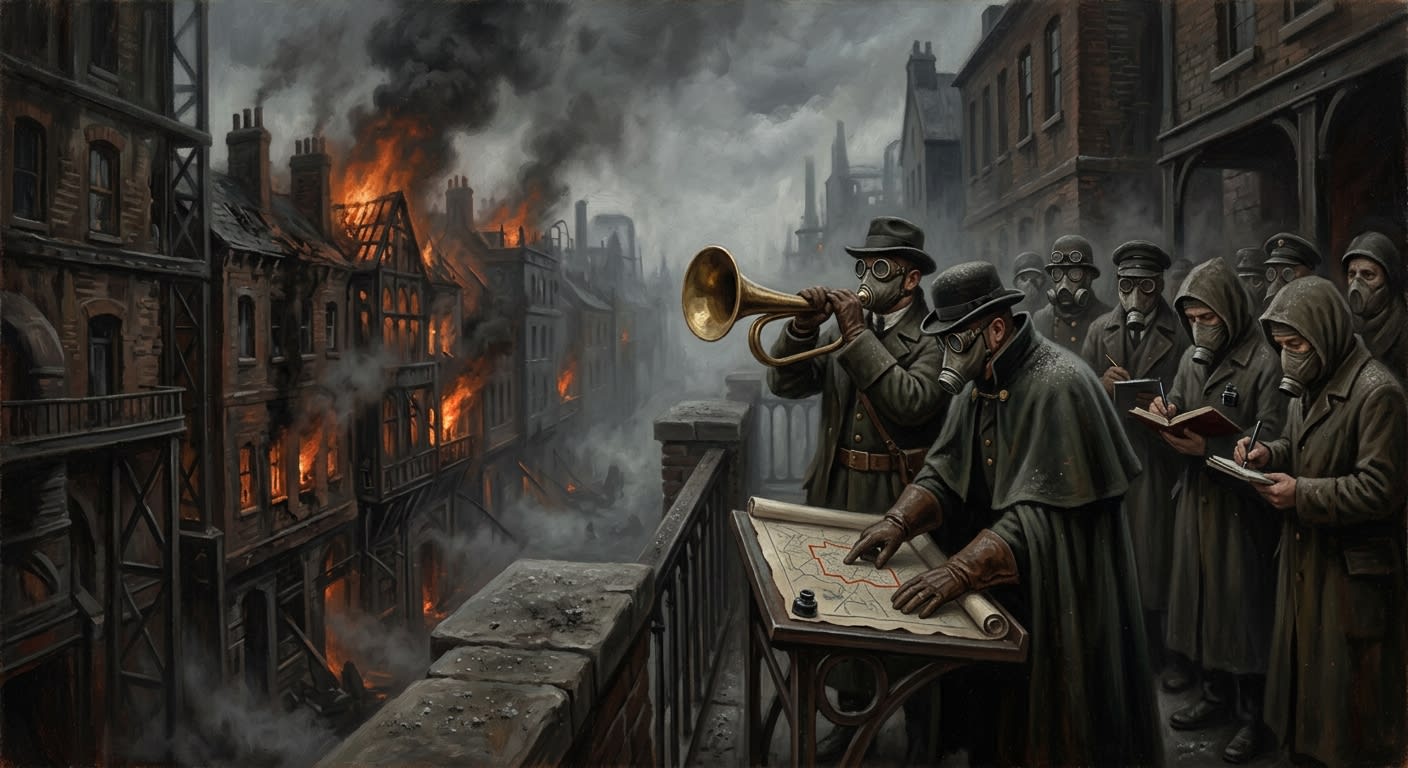
#On the Permission to Burn
The Scour is the Synod's most honest sacrament, which is why so many clerks insist upon calling it a protocol.
A quarter condemned by Purity, a settlement named by Doctrine, a rail district judged too sleepy, too hungry, too musical, too generous with its cellar grain, too intimate with fog, coin, dream, mirror, or error — such a place may be cleansed by prison, corrected by tithe, repaired by sermon, starved by schedule, or made instructive by ordinary public death. These are the mild tools, the parish tools, the tools by which civilisation conducts its daily shaving of the soul.
The Scour is reserved for those occasions when the razor discovers bone.
In official language, the Scour is a ritualised fire-purge of a condemned habitation unit: alley, ward, hamlet, barracks-block, market strip, trench spur, marsh quarter, or, in extremity, an entire town whose moral inventory has ceased to justify its roofline. In field language it is simpler. The Scour is the Synod telling a place that it has failed to remain worth the trouble of naming.
Its patron instrument is the Order of Ash, whose motto, Better ash than apostasy, has been mistaken by the sentimental for cruelty and by the clever for metaphor. It is neither. It is a purchasing schedule. Apostasy spreads, feeds, breeds, argues, hides in rafters, hides in lullabies, hides beneath the kneading-board and behind the confession screen. Ash keeps no children. Ash writes no pamphlets. Ash does not marry into better families.
The first Ashmen used pitch, lamp-oil, roof-thatch, and borrowed weather. Modern Scour crews use clarified accelerant, resin-wadding, bell-timed ignition cord, siphon sprayers, culvert fuses, under-street lines, and firebreak maps copied in red ink by clerks trained never to ask whether a map is mercy or confession. The distinction is filed elsewhere.
The citizen will ask, because the citizen has been permitted too much bread, what sin merits such treatment. The answer is mercifully broad. Rationalist sympathies have merited it. Sloth-contagion has merited it. Hidden books, hidden bodies, hidden songs, hidden grain, counterfeit relics, mirror-fog, improper lullabies, household saints weeping sideways, children speaking in unregistered dialects, entire streets answering a bell one beat late — all have, at one time or another, approached the Scour ledger. Some entered it. Some escaped by intercession, bribery, counter-signature, or the providential arrival of a worse district.
This elasticity troubles weak minds. It comforts mine. A law that cannot stretch cannot strangle.
#On the Horns Before the Fire
Before the Scour falls, the catechism horns sound seven long blasts and one short in the quarter to be burned.
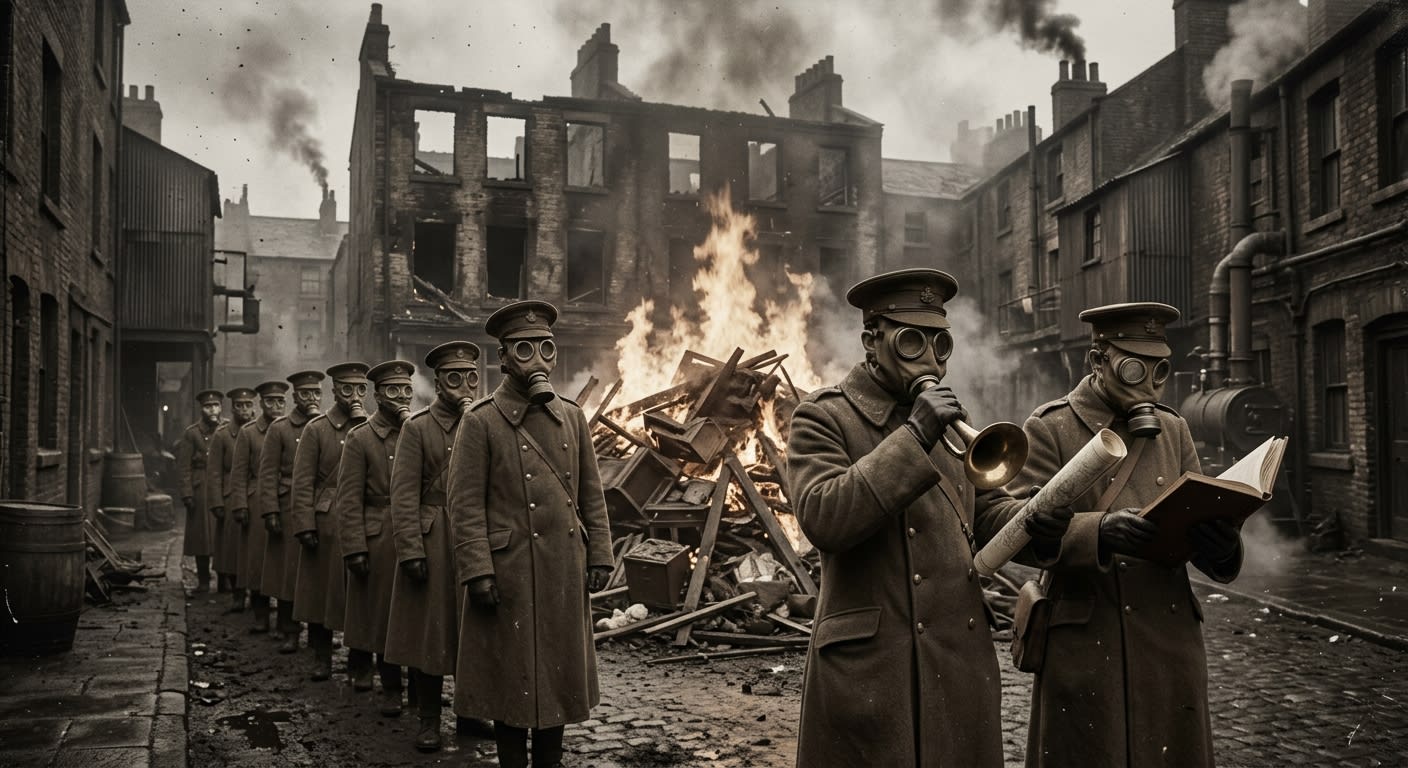
The sequence is never improvised. The first blast names the perimeter; the second seals the exits; the third suspends petition; the fourth announces Ash jurisdiction; the fifth absolves neighbouring wards from rescue-duty; the sixth summons witnesses; the seventh commends the condemned to such mercy as remains after paperwork. The short blast at the end is for children, animals, and idiots, three categories which overlap in the Ledger more often than tender households admit.
At Bastion-Shipka, where Syrion's fog has the indecency to interfere with clocks, horn discipline has acquired doctrinal grandeur. Horn-codes there have arrived out of order, sounding end-of-shift before mid-watch, Scour pre-signals without hand on rope or breath in brass. The Hourglass calls this a time-bleed. The fire crews call it a bad omen and check their valves twice. I prefer the crews' scholarship; it has soot under the nails.
Once the horns begin, every household in the condemned zone must remain indoors unless marked for extraction by white cord, orange wrist-tie, or direct order from a licensed Ash officer. Those who run are vectors. Those who hide are vectors. Those who attempt rescue from outside the line are vectors volunteering for instructional proximity. Firebreak teams move first, dragging wet canvas across alleys, breaking rooflines, smashing windows to force a clean draw. Bell crews establish timing. Records clerks count exits, re-count exits, and reduce the number by doctrinal expectation, since a crowd under judgment always contains more guilt than bodies.
The condemned hear the horns and begin their private theologies. Some pray. Some curse. Some bargain with the household saint. Some push furniture against doors, as though the Ashmen have not studied furniture. In several districts of Metz, mothers once chalked infants' names on window shutters in the belief that legibility might spare them. A useful instinct, tragically misapplied. Legibility saves documents. Flesh must be attached to the correct document, at the correct office, before the correct blast.
Earlier civil primers described the horn sequence as an evacuation warning.
This phrasing is withdrawn. Evacuation implies the preservation of inhabitants as primary object. The Scour horn announces separation: salvageable labour, contaminated matter, clerical witnesses, sacred fire, and the blessed outside who must learn without touching.
The eighth sound, that little final bark of brass, is often remembered most vividly by survivors beyond the line. Seven long blasts can be mistaken, in fear, for ordinary alarm. The short blast cannot. It has the tone of a stamp coming down.
#On the Geometry of Expiation
The Order of Ash thinks in triangles, corridors, wind-sheets, roof-pitches, wells, cellar mouths, stairwells, animal pens, chapel aisles, and the regrettable habit of human beings to gather where air remains. Fire, unmanaged, is weather. Fire under Ash discipline is canon law with appetite.
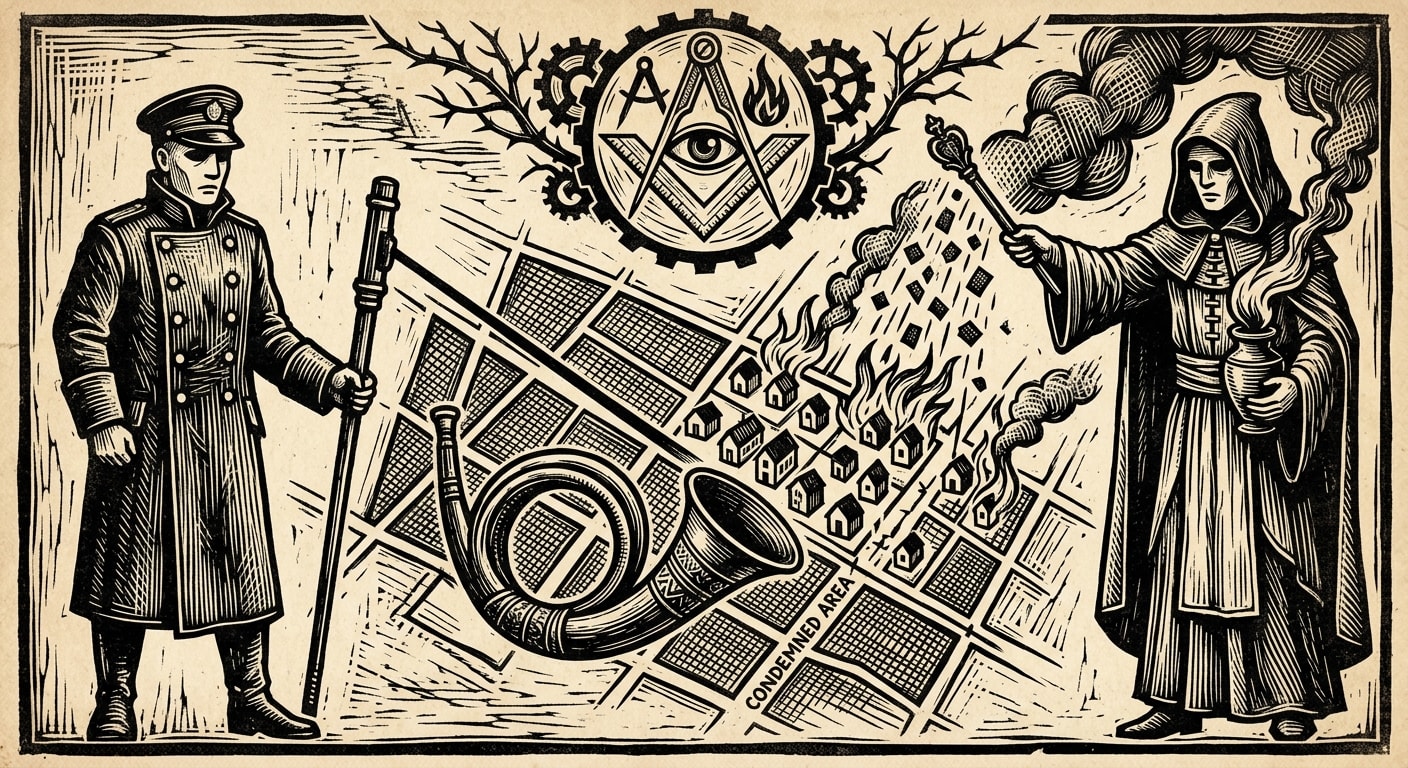
The crude picture of Scour imagines a torch applied to thatch. The true Scour begins weeks earlier, sometimes months, when a suspected quarter is surveyed under another name. A tithe assessor counts cellar stores with unusual attention to oil. A Records scribe corrects street names. A Street-Vicar remarks which families refuse door-prayer. A gasket mechanic inspects pressure lines and finds, by happy coincidence, that two back alleys would make excellent draft-channels if opened from beneath. The Ashmen receive these reports bound in grey cord. They do not smile. Smiling wastes moisture.
Scour maps divide a condemned zone into five classes. The Mouth is where air is admitted. The Throat is where flame is drawn. The Belly is where heat is meant to linger. The Rib is the preserved boundary. The Ash-Pan is what remains for Records, Tithes, and the municipal rat catchers. The names offend certain delicate theologians, who object that such anatomy resembles Gluttony doctrine. Those theologians are welcome to stand in the Belly and propose alternatives.
In old village purges the Ashmen burned from the perimeter inward, teaching the condemned to watch their world contract. In urban Scour the sequence varies. A market district may be burned from its stalls outward, so that trade dies first and households understand the hierarchy of their sins. A barracks block may be fired from the sleeping rooms downward, to prevent armed men from descending through smoke with heroism in their eyes. A suspected Lantern mercy nest may be burned chapel-first, so that the sermon loses its pulpit before the congregation loses its lungs.
Wells are capped. Cellars are smoked. Roofs are opened to encourage a vertical confession. Streets are wetted when they must remain passable and salted when Doctrine wishes the ground itself to remember. At Metz the Order of Ash once salted the earth beneath forty houses because a single proscribed pamphlet had been hidden in their rafters. Later audits found three more pamphlets in the district and vindicated the salt retroactively. The Bureau cherishes such moments. Nothing perfumes policy like delayed proof.
The rite's beauty lies in its refusal to indulge chaos. Each sprayer moves by bell. Each fuse answers a horn. Each witness stands inside a chalked rank. The condemned may flail, plead, break shutters, lift infants toward the smoke, recite old prayers, invent new prayers, or confess to crimes of admirable imagination. Their improvisation only flatters the Order's discipline. Against the wild vocabulary of fear, Ash replies in procedure.
#On Shipka, Where the Match Waits
Shipka is the finest lesson in unused Scour, and therefore the finest lesson in Scour. Any fool can burn what has been condemned. Only an institution of proper cruelty can make a population live for decades above sealed accelerant and call the arrangement protection.
Shipka sits at the southern Line, at the marsh-gate below the Balkan heights, facing the Languid Dreamer and his fogs of delayed intention. Its rail quarter, the Vertebrae, keeps supply moving toward Constantinople. Its pumps hold back water. Its bells hold back sleep. Its Scour stores hold, in red-sealed drums, the possibility that one wrong outbreak, one confirmed stillness field, one platoon found smiling in their beds at noon, may convert streets into sacrament.
Captain Varik's company drills there in oil-slicked canvas and mica masks, with ignition-lances polished like altar candlesticks and sealed orders naming streets no decent officer says aloud in taverns. Firebreak diagrams sit in War's files under practical labels; Doctrine's copies call the same channels sanctified purgation. The rail workers know the pipes beneath their homes. They do not know all of them. Ignorance has uses. It lets a man sleep above his own cremation route.
Twice the Scour nearly fell. During the Reed-Road Sleepfire, marsh flame and sleep-contagion flowered together in the stilt hamlets: households standing in burning clothes, hair alight, bodies swaying gently, no one fleeing because Sloth had made flight seem vulgar. The Order of Ash demanded the quadrant. Engineer-captains, those soot-minded heretics of utility whom Providence occasionally employs, opened pumps and sluices, flooded the reed road, cut telegraph access, and broke the fire with water and demolition. Dozens died. The main quarter lived. War praised initiative. Purity smelled softness.
Later came the Slumber-Hulk in fog, a chained enormity dragging itself through marsh-water toward Scour radius while the bastion stood masked, soaked, armed, and ready to murder itself clean. Choirs and artillery turned the thing aside. Fuses were lit and snuffed in the same hour. Ladder-crew graffiti preserved in disciplinary annex gives the people's verdict: Better to sweat six hours than burn six streets.
Doctrine's verdict is tidier: readiness to burn stiffens lesser virtues. The pumps work harder because the fire exists. Logs are signed more carefully because one contaminated stamp may summon the horns. Taverns quiet when Scour crews pass. Children learn the difference between drill-smoke and real smoke earlier than they learn the difference between mercy and threat, which is appropriate, since the latter distinction has not been ratified.
Popular Shipka pamphlets have styled the bastion's unspent Scour as “proof of Synodal restraint.”
Corrected: Shipka proves that a drawn knife need not cut in order to govern the meal. Restraint is a word for men without sealed fuel caches.
#On Those Who Stand Outside the Line
No Scour is complete without witnesses. A private burning is accident, arson, or embarrassment. A witnessed burning is government.
The witness-lines are arranged with the tenderness of a tax schedule. Children of neighbouring wards stand forward, if the smoke blows away from them; if the smoke blows toward them, old men are substituted, being already acquainted with coughing. Guild officers stand by trade, widows by ration class, soldiers by unit, clerks by Bureau, priests by seniority and capacity to sing through fumes. Bell adepts keep the hymn steady. Records clerks note who looks away. Tithes calculates material loss and spiritual recovery in parallel columns, the only known instance in which Tithes admits recovery as a category without charging interest.
The condemned zone burns. The outside learns.
There are screams at first. The Bureau of Orison and Song has approved certain covering hymns, though field crews dispute the choice. A brisk hymn keeps witnesses upright. A slow hymn encourages sympathy. Sympathy near a Scour is the first ash on the sleeve of rebellion. In old Mainz practice, a cantor will sometimes pause after the roofline fails, allowing the crack of beams and the inward breath of flame to instruct unaided. This is controversial among softer choirs. They prefer to sing. Choirs always prefer to sing. One day the Bureau will discover a choir that prefers silence and immediately burn it for suspicious self-knowledge.
At ███████, during a Scour authorised under Seal Vermilion, the witness-line began repeating the condemned quarter's final prayer before the flames reached the chapel. The prayer is not reproduced. Every witness was later examined for smoke-inhalation, doctrinal drift, and shared vocabulary. Forty-two were cleared. The rest were filed under heat-related complications.
After the fire, Ashmen enter with relic shovels and iron rakes. They search for icons, bones, books, teeth, seal-rings, melted coins, and anything that has survived in a pattern too deliberate to be natural. Children's slates are prized when the lesson has baked into them. Door lintels are useful if names remain legible. Wells are inspected for inverted reflections. Brick by brick, ash by ash, the place is converted from habitation into evidence.
The dead are counted according to recoverability. Those reduced beyond personal identification are counted by household. Those reduced beyond household are counted by street. Those beyond street are counted as doctrinal yield. There is no waste in a competent Scour. Even smoke travels upward in useful form, reminding Heaven that the Synod remains busy.
The orphans, if any have been extracted, go to the registrars. Salvageable tools go to War. Coin goes to Tithes after heat-adjustment. Charred land goes to Settlement, unless Purity claims it for a caution-field, or Doctrine claims it for a shrine, or Records claims that no such street existed. The Bureaus quarrel over ash with the appetite of gulls over a corpse. This is healthy. Shared ownership breeds laxity; disputed ownership breeds paperwork; paperwork breeds Order.
#On Abuse, Failure, and Other Productive Embarrassments
The Scour has failed. Let no rival Bureau think the admission wounds me. Failure, properly archived, becomes a manual.
Rain has refused to burn. Wind has turned at the wrong bell. Condemned wells have boiled upward through capped stones and spread steam-confession over witness-lines. A parish in the Ardennes once burned so cleanly that no ash remained, provoking three years of argument between Ash, Records, and Doctrine over whether perfect consumption indicated divine approval, demonic theft, or clerical miscount. Records won, as Records often does, by producing a form for absence and charging the others for copies.
The Order of Ash keeps, in private reliquary, a jar of rain that refused flame. I have not seen it. I have seen the men who have seen it, which is nearly as instructive and less likely to glass the hands. The jar is their shame and their teacher. They study it. They get better.
Abuse is more delicate, because abuse presumes a proper use from which zeal has strayed, and no Order enjoys admitting that zeal owns legs. Unauthorized Scour has occurred: a captain burning a granary district to hide ration fraud; a prior demanding Ash against a debtor hamlet; a frightened Warden firing a fogged alley before contamination was confirmed. Each was punished according to paperwork. Justice is never blind. Blindness would interfere with reading.
The rival Orders sneer, of course. Custodians complain that Ash leaves witnesses. The Shroud prefers an empty bed to a blackened street. Lictors grumble that fire denies the flesh its full usefulness as text. Erasure Notaries call Scour vulgar because smoke cannot be indexed alphabetically. The Ashmen accept these criticisms with admirable calm, then ask which Order will stand in the infected quarter when the lullaby starts humming through the nursery walls. Silence usually follows. Silence, for once, is honest.
#On the Present Application
As of A.S. 201 the Scour remains authorised across the Sagittal Line and its supporting corridors under layered seal of Purity, War, Doctrine, and, when property values require sanctification, Tithes. Brest keeps river-fire stores in brass-rib vaults. Przemyśl threads ignition lines through wire-yards whose maps are too ugly for public catechism. Irongate has prepared chimney-drafts that could turn whole tunnel lungs into furnaces, though the Gasket Choir objects to any plan that interrupts structural song. Constantinople maintains more Scour charts than any living clerk can reconcile, which is sensible for a city facing both Kargath and Maldrake and therefore living between hunger and fire like a sausage between two bishops.
Shipka remains the exemplar of waiting flame. Its Scour stores are sealed. Its pumps breathe. Its fire crews drill until pitch enters their dreams. Captain Varik chews bitter bark instead of tobacco and copies old battle reports by hand, a habit I approve for its moral ugliness. A man who may one day burn his own quarter should keep his penmanship tidy.
The Scour's enemies call it atrocity. Its defenders call it mercy. Both parties flatter themselves by imagining the Bureau cares which noun survives. The Scour is a decision placed beyond argument by heat. It is the correction no marginal hand can soften, the audit no debtor can bribe, the sermon delivered after the congregation has lost voting rights.
When the horns sound seven long and one short, the quarter receives its final kindness: certainty.