

#On the Cadence at the Breach
The phrase reaches the Ledger through a mud report. During the Knife Mile Catastrophe of A.S. 137, a company of Shield Paladins "entered under Saint Ardent brace cadence and locked where the map promised firm ground." Records kept the sentence because it named the company's drill. A casualty paragraph that names a drill can then blame the ground.
The cadence is the working rhythm of the Saint Ardent variant of the Lock Formation. It sets the order of call and answer, exhale and push, rim-touch and reply, so that forty men in smoke go on behaving as one wall after their eyes and ears have stopped being useful. No complete score survives under the title, and the Ledger has no record that one was ever written. What does survive is a handful of drill components, cut into iron and printed on cards. Together they tell a man when to brace and how to find out whether the man beside him is still bracing.
The drill has outlasted its namesake in the files. Saint Ardent of the Lower Works is disputed by Hagiography and by War, and claimed as kin by a widow in Essen. The Ledger has no birth, death or feast for him, and nobody has found the Lower Works. The cadence needs nothing from him beyond a name a sergeant can say once in a breach. The rims do the rest.
#On Stone, Creed, and Brace
The spoken frame is four lines on the drill card. Call: Stone. Answer: Creed. Command: Brace. Countersign: None shall pass. The call and the answer tell the file that its men are awake and are its own. The command sets the push. The countersign is spoken from inside the iron, and the wider manual warns that a parasite may one day speak it in a host's voice, so a Lock learns to listen for the wrong mouth as well. These are drill words. Nobody has entered them as the saint's, and a recruit who asks whether they were his dying words is handed a shield and pointed at the man who will teach him to hold it.
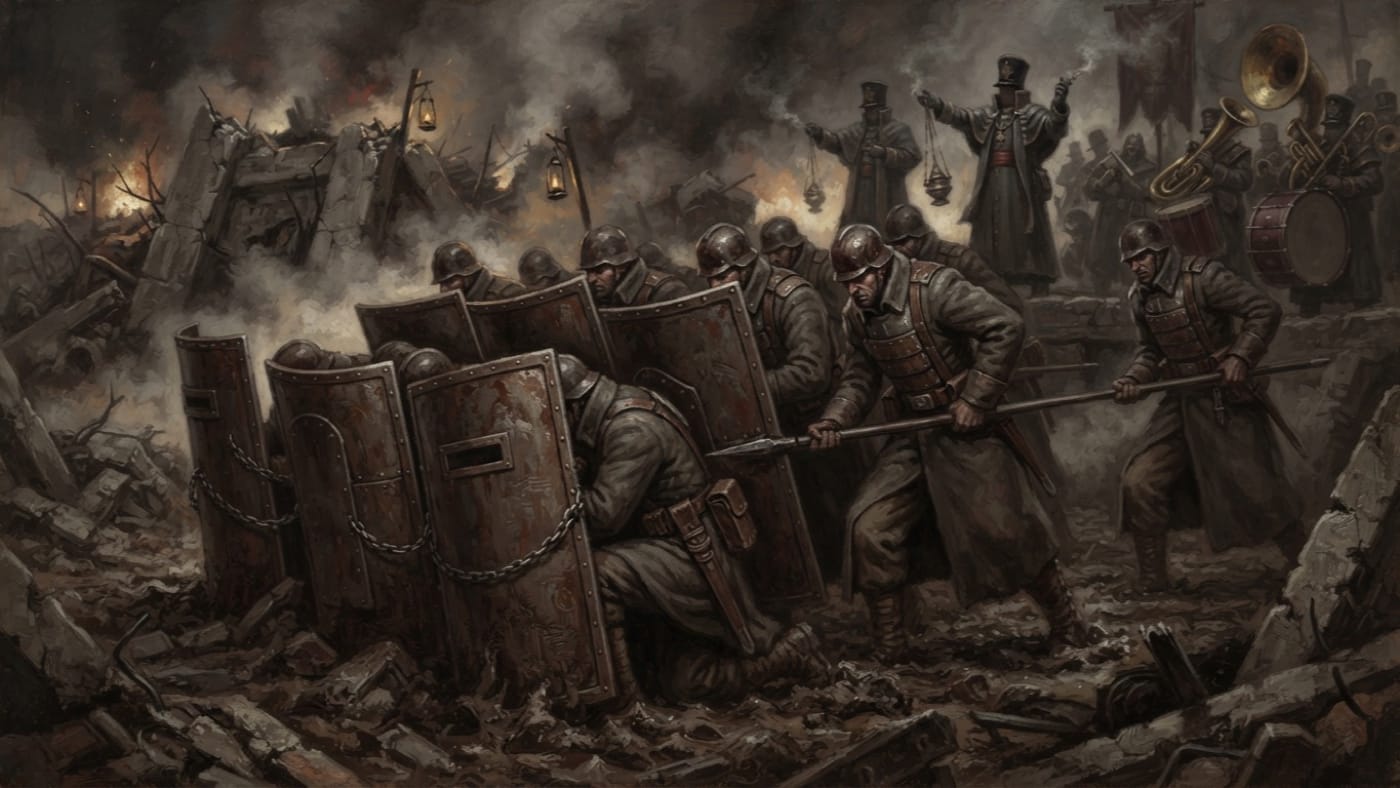
Under the frame runs the breath. The first rank drops into whatever the breach has become and interlocks its tower-shields, edges chained, iron overlapping until the enemy faces one plate. The second rank overlaps above and behind, braces forward into those shields, and chants Credo Lapidem on each exhale. The chant is kept low and pushed down through jaw and collar, because artillery eats the air and a shout lifts the ribs out of the brace. The push rides the out-breath. Forty men who breathe out together push together. The third rank sets hooks and shoulder poles into the kneeling backs ahead, or holds in reserve to drag fallen shields back into the wall. The accounts differ in their emphasis, and a breach will rearrange the duties anyway.
One formula has to be kept apart from all of this. Paladin drill also recites "First shield holds the world; second shield holds the soul; third shield holds the Creed entire." The Lore Book calls that cadence older than the Synod. Tradition says so about itself, and I enter it as tradition's claim. The formula is no stanza of Credo Lapidem. It is no verse of the call and answer, and it is not Ardent's. It also does not split the body of the Lock into three exclusive anatomies, whatever a parade-ground poet might wish.
When speech fails, the cadence goes into the hands. Chant markers cut into the rims let a blinded Paladin read his alignment through a glove. Pressure passes along the left edge from bearer to bearer: press, hold, release; press, hold, release; press, hold until answered. Nothing fixes how long the last hold lasts, and the manual issues no pressure alphabet. The seal does one thing. It tells a man inside the Lock that the iron beside him is still held. It carries no orders to the rear, and it has never claimed to.
#On the Count Behind the Shields
The cadence is useful to the men behind the Lock, and most of them never touch a rim. In the sealed breach choreography the Litany-Engineers work immediately behind the shields, reciting Counter-Sorcery Verses Twelve through Nineteen while they drive charges into breach-side earth. On the Chaplain's command they detonate in sequence with the shield-lock count. If the brace drifts, the count drifts, and a charge fired two beats early lands on friends.
The Ash Chaplains stand on the rearward rise, where at least seven men in ten must be able to see and hear them. They swing relic-ash thuribles and lead the Litany of Stones to hold Paladins and Engineers to one tempo. The Processional Band splits the labour three ways. Percussion follows the Paladin brace-step. Pipes follow the demolition sequence. Horns are kept back for the Creed Volley, which calls in the Radiant Fusiliers if any are on hand.
Each office has its own text or signal. The Engineer has verses, the Chaplain a litany, the band its instruments. The second rank has two words and a shoulder. All of it hangs from the Doctrine of Layered Death, whose current field copy counts five layers: wall, charge, ash, rhythm, dividend. The cadence keeps the first layer standing long enough for the other four to be worth paying for.
#On the Cadence in the Mire
The Knife Mile lies in No Man's Land facing the Ravelin of Vigilance at Bastion-Constantinople, the southern anchor of the Line. In A.S. 137 its parapets had been cut down to stakes by seven nights of raids. War ordered a stabilising push before Third Peal. Rain came before dawn. The trench walls ran into ribs of slurry, and the first sappers went down to the knee, then the belt, then the shoulder.
The company entered under the cadence and did what the cadence teaches. The first rank dropped. The second overlapped and braced. Exhale, push. The trouble was physical, and no faith on the line could have mended it. A brace pushes against ground, and the map had promised ground. The ground at Knife Mile was Flesh-Mud, and a first rank that kneels correctly into Flesh-Mud has knelt into something with an appetite. The manuals call this the swallowed knee. The push had nowhere to go except down, and the later ranks, still pushing, pressed the men in front of them lower.
What followed was improvised. The Paladins drove their tower-shields into the muck flatwise, edgewise and crosswise. They hooked rims under rims and ran straps through elbows that were already sinking. Iron and trapped men became a causeway. The Fusiliers crossed on it and fired from the far lip until the breach closed. Whole companies died waist-deep with their arms still through the shield loops. The survivors remembered the backs under their boots. Bureau annals entered the action as logistical stabilisation. Within three months it had become the Penance March of Extraordinary Zeal.
The Ledger does not say whether the second rank was still breathing the creed when it lay down. I will not supply the breath.
Public teaching sheets describe the Mud Lock as a planned tactical adaptation of the Lock Formation.
Corrected for officer copies. Nobody planned the Mud Lock. Trapped men built it, men trained well enough that even their drowning stayed in formation. The cadence took the company into the mire. Nothing in the cadence provided for laying the company down in it. Doctrine supplied the intention afterward.
#On the Answer Still Required
The cadence fails in ways the failure ledger names. Broken chant comes first: one lost exhale means one missed brace, and one missed brace opens a seam. A gap follows, a half-inch with a blade already in it. Tilt comes with fatigue, when the upper rim leans back and shows a throat. The swallowed knee belongs to the mire. The Pale Chanters attack the cadence itself. They work below hearing, in helmets and marrow, and they leave a man unwilling to lift his shield. The current field copy answers with jawbone chant and rim pressure. Doctrine holds that a chant carried in bone is harder to steal than one carried in air, and that the Creator attends to a wall that keeps its creed. War holds that the wall which keeps time holds longer. Both rulings are on file. Neither rules out losing.
Rim pressure has limits, and the limits are plain. It reaches the next glove and the one after that. It does not reach the rear-rank officer, the Engineer's fuse or the band. It cannot make mud into ground. A Lock sealed by touch knows it is still a Lock. It may know nothing else.
As of A.S. 201, Lock drill is taught at all seven bastion sectors of the Sagittal Line, and the Saint Ardent variant carries the cadence into each of them. At Constantinople, whose forward works still face the Knife Mile, recruits learn Stone and Brace a short walk from the ground that showed what the words cannot do. The third rank learns the recovery order with the rest: shield first, then bearer.