

#On the Variant at the Breach
The Saint Ardent variant is the standard form of the Lock Formation as drilled by the Shield Paladins. It is the wall that the Doctrine of Layered Death names as its first layer. Its job is to receive the breach. When a breach opens, the variant takes the blow, slows what comes through, and sells the minutes to the men behind it. The drill card promises nothing beyond that. It does not mention victory, and the phrase "safely contained" has been corrected out of the training recensions.
What sets the variant apart from a plain Lock is what it provides for the hour when the Lock goes blind and deaf. Smoke takes sight. Bells fall out of agreement with one another. The breach closes to arm's length, and a trumpet sounded at arm's length wastes a trumpeter. The variant's answer is to move command into iron and gloves.
By Paladin custom every Lock carries a saint's dedication. This one carries the name of Saint Ardent of the Lower Works. Hagiography and War both dispute that he existed, and a widow in Essen claims him as her grandfather. Essen is where the widow lives. That is the whole of the Ledger's geography on the matter.
#On the Ranks and Their Duties
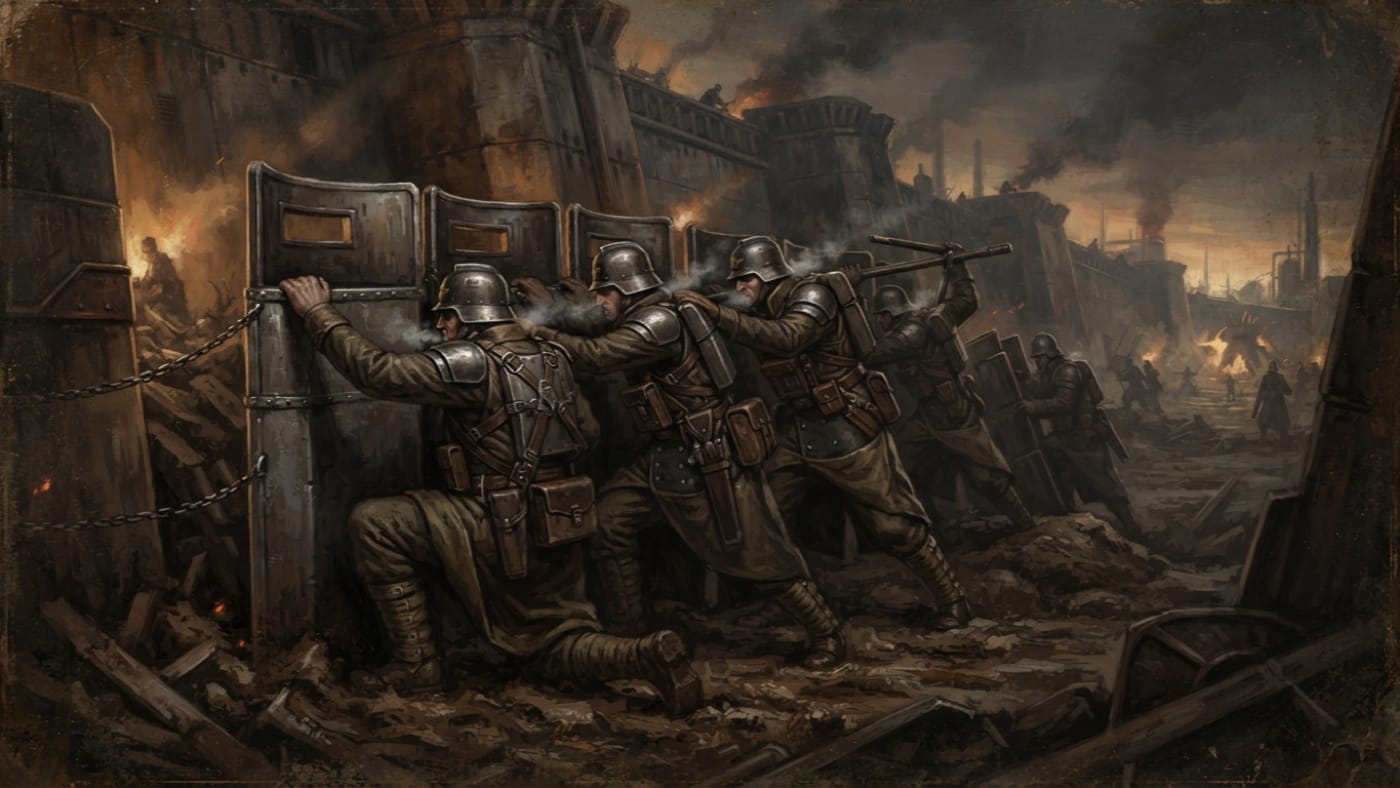
First rank drops. The left knee goes into the floor of the breach, whatever that floor has become, and the tower-shield goes down with it. Rims interlock and edges are chained, as in every Lock, until the enemy faces a single plate of iron with men folded behind it. After this the first rank sees very little, and nobody expects it to.
Second rank overlaps. Its shields ride above and behind the first and close the upper seam, where a kneeling man's helmet would otherwise invite comment. This rank braces forward into the iron below, so the first rank is held up from behind by shoulders as well as by its own knees. It also carries the formation's breath, of which more below.
The works decide the third rank's duty. In a narrow cut it sets shield-hooks and shoulder poles into the kneeling backs ahead and becomes the formation's spine. In a wide breach it may stand as a further wall. Where space allows, it holds in reserve to recover what the front loses. The older accounts stress recovery, and the field manual lets the ground decide. Both are correct, which suits a doctrine very well.
A fourth rank appears when enough living men remain to justify one. It pushes, waits, extracts casualties and recovers shields. Having one improves the variant. Lacking one does not abolish it.
The recovery order is printed plainly: shield first, then bearer, unless the bearer prevents recovery. The shield is the wall. A bearer who is down is a casualty, and a casualty can be carried away later or built upon now. Paladins are trained to fall forward into the Lock so that building upon them is the easier choice.
#On the Left Rim
This is what makes the variant distinct. Chant and alignment markers are cut into the shield rims: shallow grooves placed where a gloved thumb falls when the shield sits correctly against its neighbour. A blinded Paladin runs his fingers along the edge and learns three things. He learns whether his iron is level, whether it meets the next shield at the right height, and whether the seam has opened by the half-inch that kills formations. He reads the grooves through leather, mud and whatever has dried on the glove since morning.
The left edge carries the signals. Pressure passes from bearer to bearer along that side, palm to rim to rim to palm. A file of men who can no longer see one another can still feel one another holding. When speech has failed entirely, the emergency seal goes down the line by touch: press, hold, release; press, hold, release; press, hold until answered. The last hold has no set length. It lasts until an answer comes back through the iron and the neighbour proves he is present, or until it becomes plain that no answer is coming.
While voices still work, the spoken frame runs above the hands. Call: Stone. Answer: Creed. Command: Brace. Countersign: None shall pass. These are drill words, issued on cards, and nobody has ever entered them as the saint's own. Meanwhile the second rank chants Credo Lapidem on each exhale. The chant stays low and is carried through jaw and collar, so the breath goes into the brace and not out into the noise. The timing that binds call, breath and push belongs to the Saint Ardent brace cadence and is filed there.
The manual issues no pressure alphabet. Now and then a junior officer invents one. The first breach in which he tries to send a sentence through a dying man's forearm corrects him. The seal says one thing only: the iron beside you is still held.
#On the Work Behind the Wall
The variant exists for the men behind it. Litany-Engineers work just behind the Lock, planting charges in the earth beside the breach while they recite Counter-Sorcery Verses Twelve through Nineteen. Ash Chaplains on the rear elevation lead the Litany of Stones to keep Paladins and Engineers to one tempo, and the Processional Band keys drum to brace and pipe to detonation. Every minute the Lock holds is a minute in which a fuse can be measured.
Three texts sound in that space, and enthusiastic choirmasters must not confuse them. Credo Lapidem is the second rank's breath. First shield holds the world; second shield holds the soul; third shield holds the Creed entire is an older Paladin drill formula, which tradition dates before the Synod on nobody's authority but its own. The Litany of Stones is the Chaplains' chant for keeping time. Each has its own owner and purpose, and no hymnal joins them.
A perfectly held Lock does not mean the Engineer's charge fires on the beat. Rim pressure reaches the next glove. It does not reach the fuse.
#On What the Variant Cannot Hold
War's failure ledger names five categories: gap, tilt, swallowed knee, broken chant and backward corpse. The rim markers deal with gap and tilt, as far as fingers can find a half-inch while a forge-beast leans on the far side. Broken chant belongs to the Pale Chanters. They attack the cadence and the willingness under it, so that a man's arm stays strong while his intention to lift it wanders off. The current field copy answers with jawbone chant and rim pressure. These are countermeasures. Nobody has certified them as immunity, and I decline to certify them here.
The Wormhost is worse, because it comes from inside the file. The training addendum tells Paladins not to answer if a parasite repeats the countersign in its host's voice. Correct words prove nothing about who speaks them. A hand on the left rim confirms that something is holding the shield. It cannot say what.
Public teaching sheets present the Mud Lock as a planned adaptation of the Saint Ardent variant, prepared for liquefied ground.
Corrected for officer copies. Men who were already sinking improvised the Mud Lock. Doctrine found the plan afterward, in the wreckage, and filed it under foresight.
The case of record is the Knife Mile, in No Man's Land facing the Ravelin of Vigilance at Bastion-Constantinople, in A.S. 137 / 1847 CE. A company of Paladins went in under the Saint Ardent brace cadence. That proves the variant was in use by that year and proves nothing about when it began. The ground was Flesh-Mud. The first rank dropped correctly and kept going down. The second rank braced correctly and pressed the first rank deeper. Every provision of the variant assumes something firm beneath the knee, and there was nothing firm. The Paladins then drove their shields into the mire and built a causeway of iron and men. The Radiant Fusiliers crossed it and fired the breach shut. Whole companies died waist-deep with their arms still in the straps.
#On Present Service
The A.S. 201 / 1911 CE drill survey records the Saint Ardent variant as the standard Lock taught in all seven bastion sectors of the Sagittal Line, from Königsberg to Constantinople. It is adjusted for ridge, gate, marsh and fog, and excused by none of them. The survey records present use only. It records no founding, no ratification and no inventor. The Ledger will not supply any of these just because a recruit asked politely.
Recruits learn the rim grooves before they learn their field names. They practise the seal blindfolded, a hand on the left edge, until an unanswered hold feels like what it is. They learn the recovery order with the rest: shield first.