

#On the Western Quarter
"A seal can feed you, or hang you." — Candlewick proverb, repeated in every quarter of the city and most sincerely in this one.
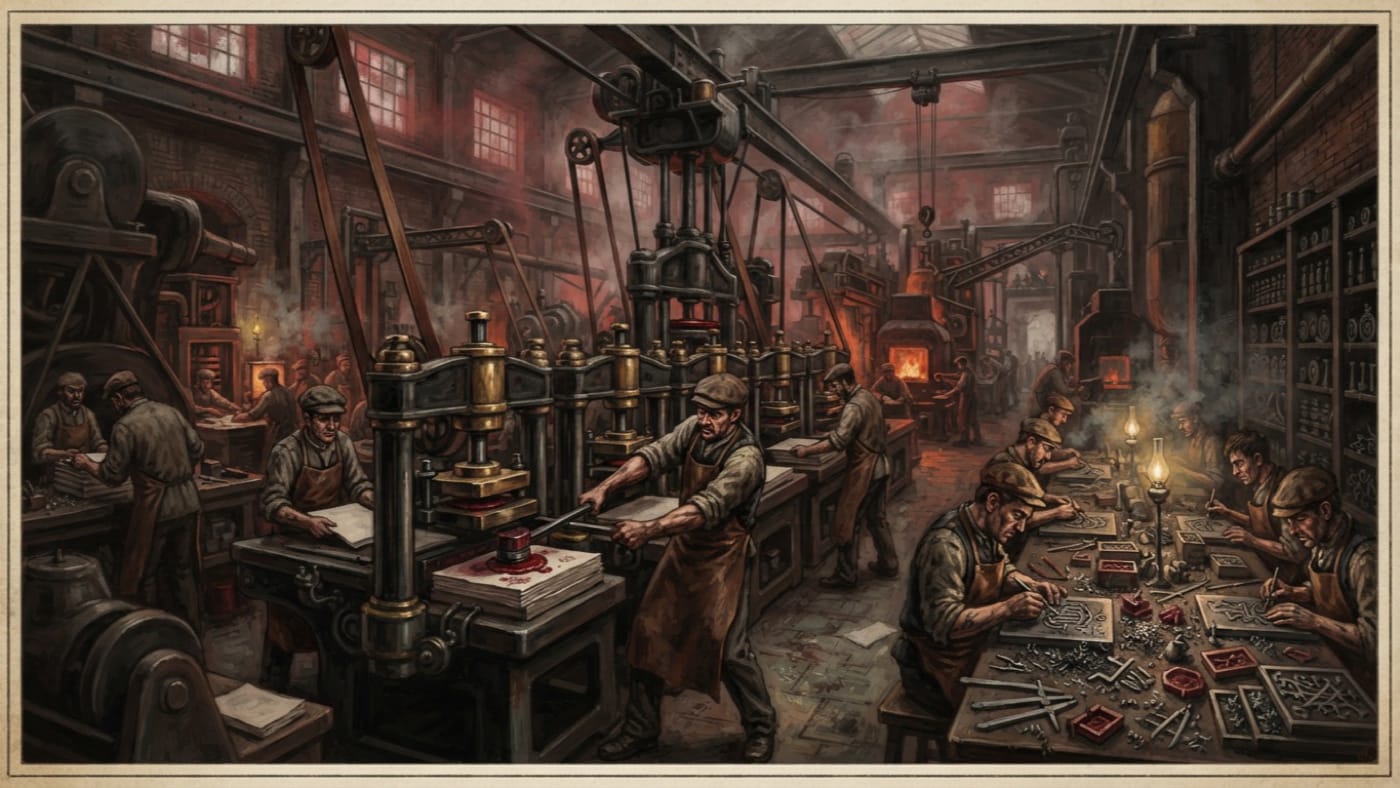
The Sealworks occupy the western quarter of the Candlewick Palatinate. You smell the place before you see it: tallow and iron heat, which settles into wool for a week and into apprentices for good. Elsewhere in the city the air belongs to vinegar mordant, glass-soot, camphor and wet algae. Here it belongs to the furnace and the die. Vatmarsh Row fixes the ink so that words endure. The Lantern Mile makes the candles to read them by. The Chromatic Registry decides which colours may exist at all. The Sealworks strike the mark that turns all that preparation into an act of state.
Stamp foundries. Wax presses. Benches where men cut dies whose authority they will never be permitted to use.
The Records Annex has shown me no separate founding instrument for the quarter, and I decline to forge one. Its work is bound up with the city's own chronology. In A.S. 92 the Bureau of Records installed its annex in Candlewick, two years after the Concordat of Strasbourg gave the Synod its formal constitution. Around A.S. 98 came the Great Fire, and after it the wax quotas that outlived its ashes. Then came the First Continental Levy of A.S. 110, when every conscription order, transit pass and ration permit in the Heartlands demanded the same mark in the same place. Whatever the western quarter was before the Levy, the Levy taught it to hammer in step.
#On the Making of an Impression
Everything begins as cargo. Tallow, beeswax, metals for dies and coal come in by barge through the Seal Locks, the River-belt's wettest customs house, and every barrel is counted before anyone believes in it. House Wickwarden controls the city's wax supply. I do not claim that the House owns every foundry in the quarter. I claim only that no foundry here can strike a seal without Wickwarden's wax, and that the Houses of the Compact have never needed to own what they can starve.
The sequence is short enough to recite and hard enough to bankrupt the careless. The die is cut. The wax is heated. The impression is struck. Between those three verbs lie years of apprenticeship, a great deal of coal, and the legal certainty that one wrong stroke on the die makes a whole batch inadmissible.
The die-cutter works the metal into the face of an office, and that face must match a standard he did not write and may not alter. The wax must take a colour the Chromatic Registry has defined and sealed in phial and vault, a colour no House or master may improve upon. The press then brings die and wax together under hammer and weight. What comes away is small, warm, slightly greasy and lawful. It leaves the quarter as registered wax and seal kits, bound for bastion offices and bureau counters across the Heartlands, and none of it leaves without Registry approval.
New dies do not enter service as mere metal. They receive the Seal Blessing: the die is anointed, names are read over it, and the wax is ceremonially baptised. I give no text of the rite, because I hold no authorised copy and the Bureau of Doctrine prefers its liturgy performed rather than paraphrased by a Warden with opinions.
The struck wax keeps something of its making. The Registry's examiners read old seals for the heat patterns left at the moment of impression. The method is slow and fallible, and it does not reconstruct the life of a document. It is still enough to make a counterfeiter sweat at his furnace, and not from the coal.
#On Those Who Work the Presses
Three trades keep the quarter alive. The seal die-cutters are the aristocrats of the floor: master craftsmen under guild protection, whose hands the Houses insure more carefully than their faces. The wax press operators feed and strike the presses and breathe whatever the presses exhale. Then there are the apprentices, bound by contracts the Compact calls training and any honest canonist would call servitude with a curriculum.
All of them work under quota. Debt is enforced through House quotas, and the penalty for default is something Candlewick has refined into an art. The defaulter loses guild protection and is reclassified as unlicensed labour, and with that classification go mask rations, shade tokens and access to the infirmary. The masks matter. "Smell" is a gentle word for the tallow smoke and iron heat that enter the lungs. A press operator without a mask ration is spending his breath at a rate the Lungward Sisters can calculate and will not subsidise.
The press cadence governs more than the quarter. Candlewick arranges its working day by the noise from the west, the way a bastion arranges prayer by its bell-tower, and the city treats the hammering as liturgy. I do not quarrel with the classification. A sound that tells a hundred and ninety thousand people when to work, when to queue and when to fear deserves at least a minor office in the Breviary.
That is the quarter's whole moral arithmetic, and it needs no ornament. The marks made in the Sealworks authorise rationing, passage, identity and military paperwork across the Heartlands. The people who make them depend on authorised papers as much as any widow in a Registry queue. The Palatinate holds that the seal is the soul. I record that the Palatinate says so. I do not certify that any wax contains a soul. I certify only that in Candlewick a man without the right impression is treated as though he had lost his.
#On Authorized Marks
Visitors confuse the institutions, and the Bureau does not forgive confusion, so I set them in order. House Wickwarden supplies the wax. House Vatmarsh, from Vatmarsh Row, controls the mordant salts and fixing agents on which the permanence of ink depends; that chemistry is done elsewhere in the city. The Chromatic Registry defines the sanctioned shades and grants or withholds approval. The Seal Provosts enforce colour-law with raids, seizures, informants and, now and then, evidence they supplied themselves. The Charter Court of Impressions tries shade-treason. Five authorities, five appetites. Each believes the Sealworks exist to serve it, and each is partly right.
Over all of them hangs the red line. An unauthorised blank seal die is among the gravest offences in the Palatinate. That does not make every unfinished die in a lawful foundry a crime. The offence is the unlicensed blank: a face without an office, an authority without an owner, waiting for whoever pays.
The Black Canal pays. Its traffic includes counterfeit seals alongside outlaw pigments and rewritten identities, and its brokers do not pretend the work is easy. A seal fit to pass inspection takes a die-cutter's training, a furnace, wax of registered grade, access to the standard being imitated, and the nerve to face the Charter Court. Forgery is a craft. It is simply practised in the wrong parish.
The Syndicate has lately done worse. The parent entry records a counterfeit bureau shade that three separate auditors certified as genuine before they were told where it came from. That is a threat to authentication, which is the one thing the Sealworks exist to perform. It is not yet a collapse, and no report before me shows the shade in general circulation across the Heartlands. The masters of the western quarter know that their craft is worth exactly the difference between their mark and a thief's.
#On the Present Condition
Candlewick in A.S. 201 stands at Operational Amber. The Fading Winter, which began in A.S. 199, has not ended: documents across the River-belt lose their text while seals, signatures and shades remain intact. Hungry Ink, the Palatinate's older affliction, consumes or rewrites the words on a page and leaves the genuine seal in place. Since A.S. 143 a correlation between outbreaks and atmospheric ash has been on record. A correlation is not a mechanism, and no office has established one. No office has proven that the two afflictions are a single process either, whatever the frightened say in the Registry queues.
Earlier assessments described the Fading Winter as "a contained incident."
Withdrawn. The parent entry superseded that assessment, and this one follows it. The Fading Winter is ongoing.
Consider what this does to a quarter whose whole product is authentication. A seal certifies that a document came from the proper office in the proper form. It has never certified that the words above it would stay where the clerk put them. Before the Winter, nobody needed that distinction. Now a valid impression can sit beneath a blank page, or beneath a sentence its issuing officer never wrote, and it is no less genuine for that. The mark holds. The meaning leaves. Every inspector trained to trust the wax is now asked to distrust what the wax protects.
The countermeasures are crude and well known: salt-stopping, wax overcoats over vulnerable documents, and burning affected pages, which is unlawful when the page was a charter. The Sealworks did not invent these remedies, hold no exclusive contract to apply them, and have cured nothing. The city's pressures reach them through their supply. Wickwarden's shortages arrive as idle presses. Vatmarsh's hoarding of mordant salts arrives as documents not worth sealing. Registry restrictions arrive as standards that change faster than a die can be cut.
And yet the presses hammer. The Synod has met a crisis of unreliable paper the way it meets every crisis, by demanding more paper, more revalidation and more marks to certify the marks. Seals from the western quarter are less trusted than they were in A.S. 198. They are also in greater demand, and that is the more dangerous of the two conditions.
Sigillum manet. What it seals is no longer the quarter's concern.