
#On the Bell That War Uses as a Mouth
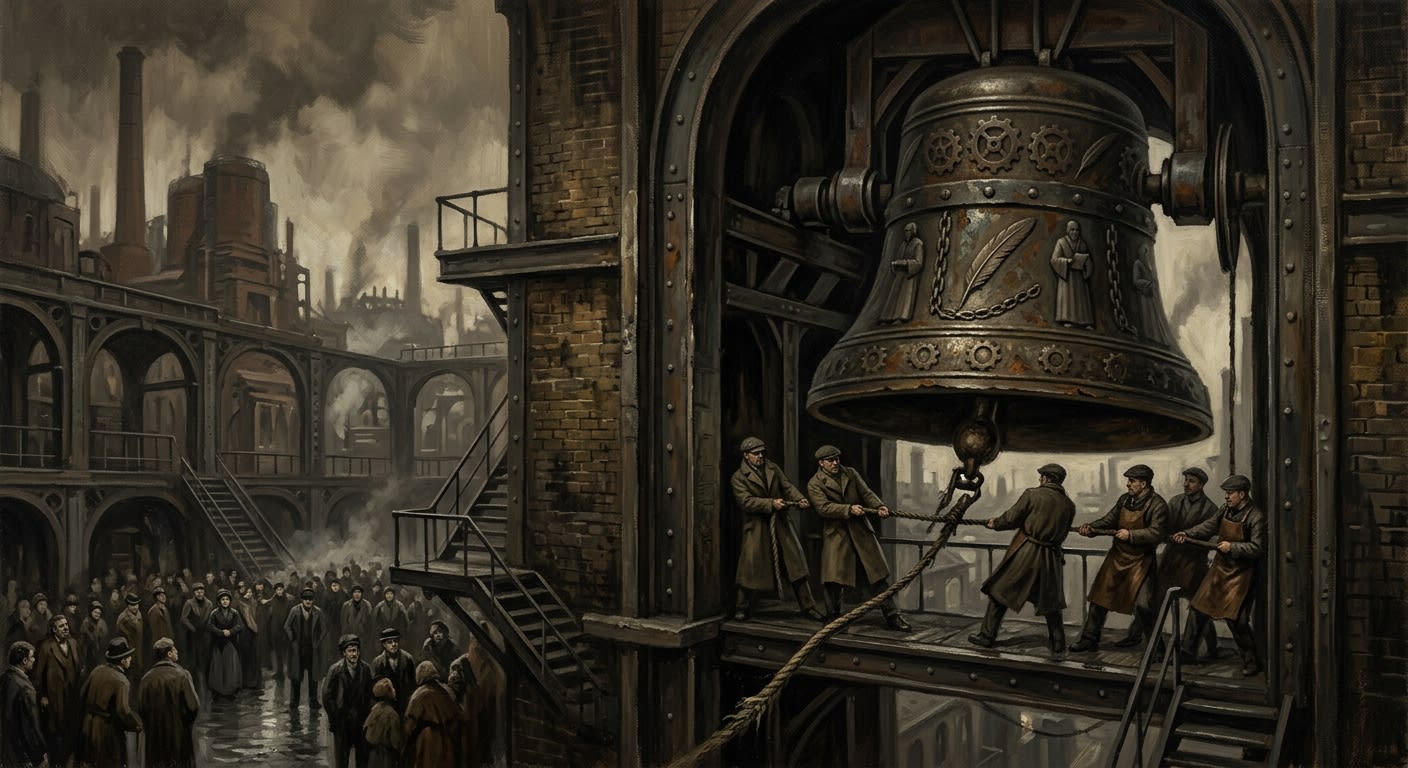
The Leviathan hangs in the belfry of the Tower of the Quill, larger than most chapels, heavier than several minor consciences, and more honest than any proclamation sealed after midnight. It is the largest of the Tower’s three bells: Fames speaks for hunger, the Whisper speaks for useful fear, and Leviathan speaks for war. The distinction comforts clerks. It does not comfort windows.
Fourteen tonnes of bronze hang above Strasbourg in the quill-spire raised by Matthias Kammler under an A.S. 92 successor commission. Augustinus had died before the work; the specific patron remains unresolved. Four bellmen work in relay to swing it, with a captain watching the rope and the timing.
A small bell can be sentimental. A medium bell can be municipal. Leviathan has no room for either vice. It does not call the faithful to prayer. It does not mark dinner, curfew, market, burial, wedding, or the miserable punctuality of tax. It announces that history has entered the room with muddy boots.
#On Casting and Consecration
The Tower was commissioned in A.S. 92, two years after the Concordat of Strasbourg, when the first great Bureaus had acquired seals, rooms, rivalries, and the beginning of that serene institutional obesity by which civilisation recognises itself in a mirror. Kammler designed the bell-sheath as part of the original spire. The Tower would write doctrine; the bells would make the city hear the handwriting.
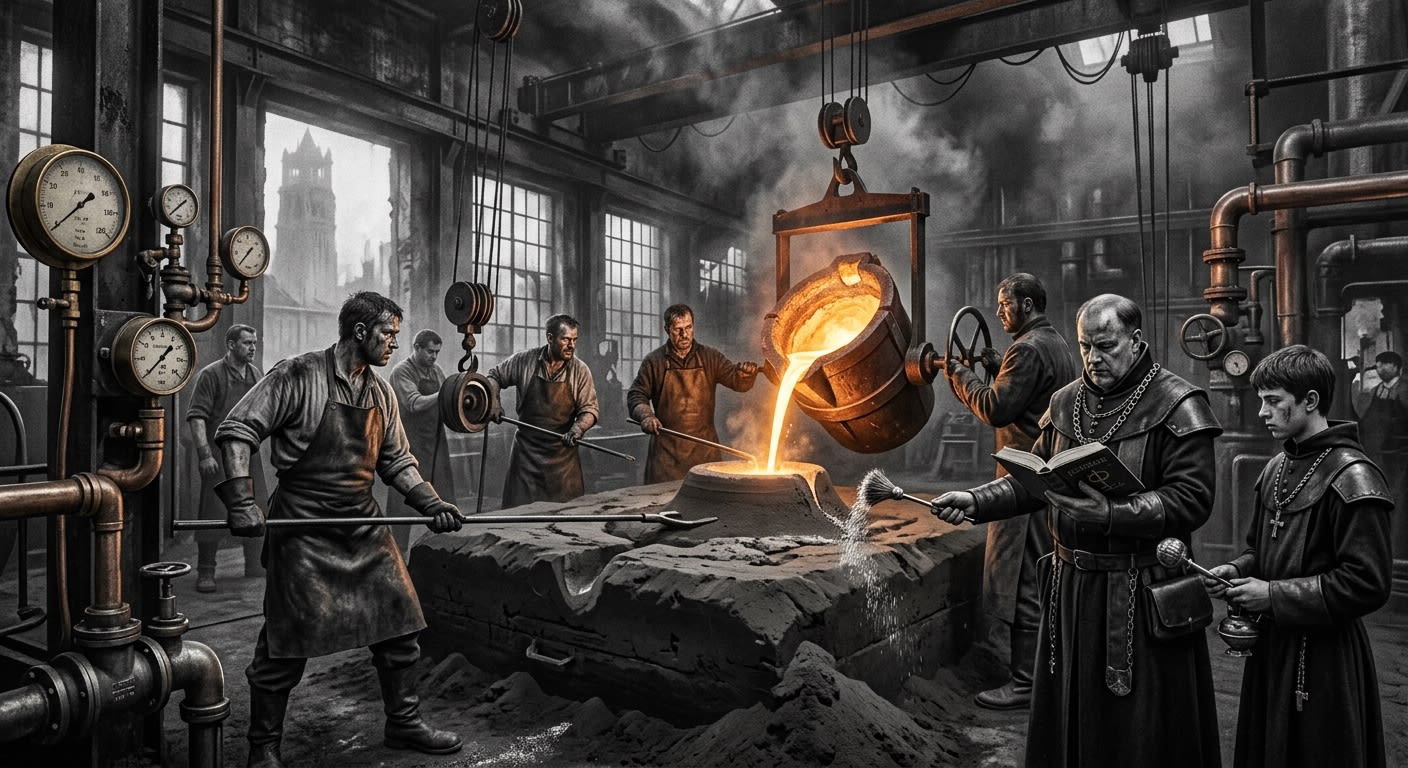
Leviathan’s bronze came from captured cannon, failed chapel bells, broken civic gongs, and one Rationalist assembly bell seized after the Atheist Wars and melted with unusual satisfaction. Records preserves the requisition list. Doctrine preserves the sermon. Bells preserves the alloy table. Each office claims the bell began with its document. All are wrong. The bell began when molten metal accepted fear as an ingredient.
A late instructional engraving labels Leviathan “the Saint’s Bell of Concord.”
Withdrawn. Leviathan is not a saint’s bell, not a concord bell, and not a devotional instrument except in the broad sense that terror often improves attendance. The engraving has been reassigned to children’s histories, where error already feels at home.
Later ceremony accounts assign a nine-hour consecration and three speeches to Augustinus. Since he had died before A.S. 92, the speaking role is commemorative or misattributed. The foundry record describes ash and powdered relic fragments under the first hammer strikes; the Bureau declared success.
#On the Sound
When Leviathan tolls, Strasbourg learns the shape of its own ribs. The Basilica trembles in its windows. The Palatine Counting House loses columns of figures in the ink-shiver. Pigeons abandon the belfry in grey convulsions, then return because pigeons, like minor nobles, possess courage only when no one benefits from it. In the Cloister of Concord, exegetes place both hands on their desks until the tone passes through bone, ink, wax, tooth, and whatever portion of the soul can still be bullied by acoustics.
The sound does not peal upward. It descends. It falls through stair, gallery, flagstone, archive, cellar, pipe, root, burial niche, and guilty stomach. Men in distant districts report hearing it through the bread in their mouths. Women at river pumps feel the handle kick. Children wake already crying, which saves time.
The finest lie told about Leviathan is that it warns the city. It does not warn. Warning precedes danger. Leviathan confirms that danger has already been accepted by authority, entered into format, and made audible. By the time the bell speaks, someone else has begun dying under the proper heading.
#On the Eleven Tollings
Leviathan has tolled eleven times since A.S. 92. Records keeps the list under martial seal. Doctrine keeps a duplicate under interpretive seal. Bells keeps a timing book, which is the only honest version because it records rope strain, weather, hand injuries, and whether the fourth bellman fainted before or after release.
The first tolling followed the Siege of Vienna crisis, when the Synod discovered that Rationalist remnants and daemon-cult allies could still make a city starve for nine months and call it reason. Later tollings marked northern collapses, eastern breaches, Black Sea alarms, bastion escalations, and those disciplined catastrophes in which War requests a public sound large enough to make private doubt seem treasonous. The Black Sea Armada received Leviathan. So did the worst alerts from Bastion-Constantinople, the southern hinge where every sensible map begins sweating.
RECORDS DUPLICATE — LEVIATHAN TOLLING TABLE I. A.S. ███ — Vienna crisis confirmation. II. A.S. ███ — northern mobilisation. III. A.S. ███ — ███████████████ breach. IV. A.S. ███ — Black Sea alarm. V–XI. Entries sealed under War-Doctrine dual custody. Marginal note, unattributed: “Each ring made the map smaller.”
Eleven is a small number to a schoolboy and a vast number to anyone who understands bells. A dinner bell may ring daily and mean nothing by Lent. A war bell that rings eleven times in a century has written eleven amendments to the size of the world.
#On the Bellmen
Leviathan’s bellmen form the smallest terrifying fraternity in Strasbourg. They are selected from the Bureau of Bells heavy-rope registers, screened by Doctrine, inspected by Medicine, and watched by Shadows because any man trusted to move a war bell has, by definition, acquired access to the city’s nervous system.
The relay requires four men. The first wakes the rope. The second takes the weight. The third drives the swing. The fourth survives the answer. A captain calls marks from the side platform: shoulder, breath, knee, release. The rope drops like a judgement with fibres. It burns through glove, skin, boast, and prayer in that order.
Bellmen do not speak of the toll afterward. They report strain, timing, injury, and clapper response. They do not report dreams. They do not report hearing the tone continue after the bell has stilled. They do not report the old superstition that Leviathan knows whether the war it announces will be won. The superstition is false. The bell knows only that the war has become too large for quiet.
#On Fames and the Whisper
Leviathan’s neighbours make its nature clearer by being worse in smaller ways. Fames, the hunger bell, tolls when the Bureau of Tithes declares a rationing adjustment. This is famine in a cleaner collar. Fames has sounded more often than Leviathan, and its list requires a different seal, because hunger embarrasses governments more reliably than war. War can be made glorious. Hunger keeps asking what happened to the grain.
The Whisper, listed as Bell 7-C Auxiliary Doctrinal, tolls by schedule while the public pretends it marks heresy. Doctrine permits the pretence. A scheduled fear costs less than a patrol. If a peasant hears the Whisper and becomes obedient, the mechanism has succeeded without knowing his name.
Leviathan has no such delicacy. No rumour is needed. No schedule can domesticate it. When it rings, every rumour in Strasbourg shuts its mouth and waits for the poster.
Certain parish primers teach that all three Tower bells are “voices of mercy.”
Corrected for advanced instruction. Fames is hunger under seal. The Whisper is surveillance by theatre. Leviathan is war made audible. Mercy may attend any of these in the same way a physician may attend an execution.
#On Drax Beneath the Sound
I have stood in the Gallery of the Quill during a Leviathan toll. I recommend the experience only to men of excellent teeth and doctrinal confidence. The walnut desk shuddered. The inkpot walked half an inch east. A sealed brief from War slid open as if the paper itself wished to surrender. Below, the city bowed by reflex. Above, the bell gave its answer to the rope and the air became an office too large for walls.
For three breaths I could not hear my own thoughts. This was pleasant. Many men would benefit from the deprivation.
I placed one hand flat upon the desk and felt the tone travel through wood, palm, wrist, elbow, and sternum. It did not feel holy. Holiness is often warm, or claims to be. Leviathan felt official. Colder. Better dressed. It entered the body like a seal pressed into wax: with pressure, mark, and no interest in consent.
#On the Present Silence
As of A.S. 201, Leviathan hangs silent in the Tower belfry, soot-darkened, wax-blessed, rope-scarred, and ready. Its last inspection found no crack in the crown, no warp in the yoke, no dangerous pitting along the mouth, and no mercy in the tone sample. The bellmen remain on register. The captain keeps the timing book locked. Doctrine keeps the interpretive duplicate. War keeps asking whether the public should be prepared for a twelfth tolling. Doctrine replies that the public is always being prepared. That is what public means.
Below Leviathan, Strasbourg counts money, stamps writs, hears petitions, misfiles grief, licenses bread, mistrusts fog, and pretends silence above the city is peace rather than withheld announcement. The bell waits. Waiting is one of the higher forms of authority.
When Leviathan next speaks, the windows will know first. Then the desks. Then the bones. Then the posters will appear, black wax at the corners, and men will read them with the careful faces of citizens discovering that the world has lost another year of size.
Phase 2a correction log: removed unresolved broad forward link atheist-wars to keep unregistered-link rate under the 20% cap; no date, bastion, or geography errors found. Article dateline set to A.S. 92 for the Tower commission and Leviathan registry origin; public seal stamps remain A.S. 201.