
#On the Ark That Fell Slowly
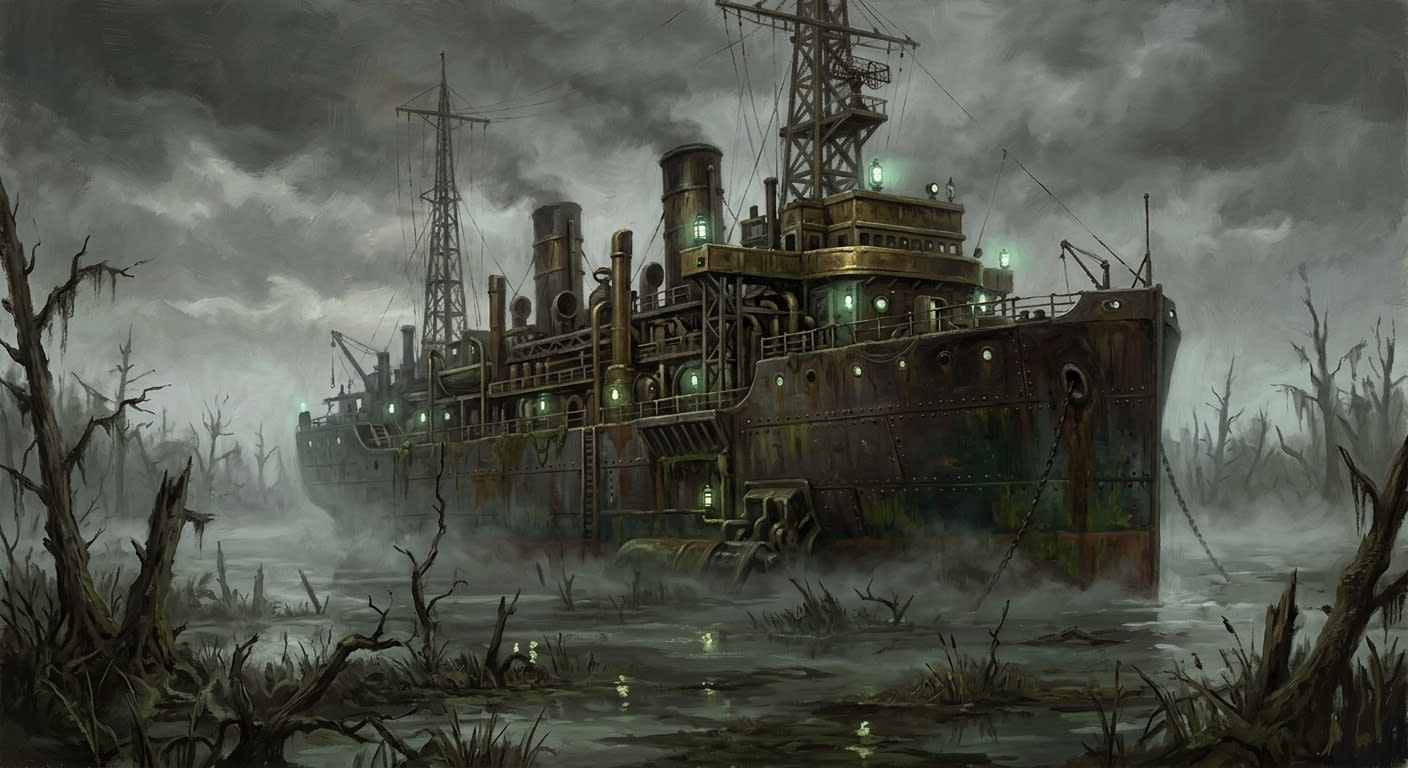
The Vigil Ark Sanctissima Vox remains on the active roster of the Bureau of Bells. This is no clerical error. Errors can be corrected. The Sanctissima Vox lies seventeen miles inside the Blightmarsh, embedded in grey mud since A.S. 147, its relic-lanterns still glowing beneath the surface, its hull canted like a drowned chapel asking for absolution from below. The roster says active. The lanterns agree.
A prudent Bureau does not contradict illuminated evidence.
The Ark was dispatched four years after the Year of Ash Rain, when Maldrake’s Thracian fires had darkened the Constantinopolitan sky for eleven days and every southern ration office had begun using the phrase “temporary austerity” with the loose sincerity of a pickpocket in vestments. The Bureau of Bells proposed a correction in sound. The Blightmarsh swallowed hymns; the Ark would feed it larger hymns. The Marsh returned prayers as silence; the Ark would answer with amplified doctrine, brazen horns, consecrated lantern-light, and the full arrogance of the western air.
#On the Broadcast Mission
The Sanctissima Vox crossed the Marsh boundary at dawn. Its mission papers used the language of experiment: project hymnal frequencies, measure acoustic absorption, observe hostile response, withdraw before dusk. These phrases comfort those who sign documents west of the Line. At altitude, above a nation of chewed soil, experiment becomes prayer with instruments attached.
The Ark carried four Sermon-horns, six relic-lanterns, a gondola chapel, two hymn engineers, one chaplain, one captain, one signals choir, and enough sanctified arrogance to lift a cathedral. The sermon selected for broadcast was the Seventh Antiphon Against Appetite (Unregistered), revised after the Famine Pit hearings and approved for use against Kargath-adjacent phenomena by three Bureaus and one exhausted censor.
By midday the signal degraded. Not failed. Degraded. The distinction mattered enough for three inquiries and one resignation. Listeners at the western receiving post heard syllables thicken, vowels fatten, consonants arrive wet. The Ark’s captain reported that the horns remained functional and that the lanterns burned with “unusual eagerness,” a phrase later removed from the public abstract on the grounds that equipment should not possess appetite in official prose.
By evening, the relic-lanterns had aged centuries in minutes. Wax ran like broth. Wicks powdered. Brass halos blackened with verdigris. The Ark began to descend.
It fell slowly.
Initial dispatches described the loss as a crash.
Corrected. A crash is sudden, merciful, and compatible with engineering. The Sanctissima Vox settled into the Marsh as if the air had tired of carrying it and the mud had been waiting with paperwork prepared.
#On the Three Survivors
Three of forty-one crew were recovered by a patrol that violated standing orders to reach them. The patrol commander was reprimanded, decorated, reprimanded again after the decoration caused questions, and finally transferred to supply administration, where courage can do less damage.
The survivors agreed on the descent. They disagreed on the sound. One called it thunder. One called it a scream. The third refused both words and wrote, on his deposition slate, “hungry.” He then attempted to bite the slate. The Bureau of Medicine classified the episode as exposure shock. The Bureau of Doctrine accepted the classification because the alternative required a meeting.
Survivor deposition, Vox/3: Question: “What did the sermon become?” Answer: “It found the mouth.” Question: “Whose mouth?” Answer: ███████████████████████████ Audio clerk note: witness chewing throughout interview; no food present.
The chaplain did not survive. His hand was recovered, still clenched around a bell-rope fragment. The fragment rang once during cataloguing at Bastion-Constantinople. Three clerks heard it. Two recorded the note as C-sharp. The third recorded the note as “please.” The third clerk was sent to the Paper Mines of Ulm, where metaphor is corrected by labour.
#On the Wreck Beneath the Mud
Reconnaissance flights in A.S. 168, A.S. 183, and A.S. 197 report the same finding: the wreck remains visible beneath the grey surface. Its lanterns are still lit. The mud around the hull is darker than the surrounding Marsh, and shapes avoid it. This last point appears only in the sealed addenda, as the Bureau of War dislikes admitting that even Blightmarsh things make tactical decisions.
The Ark has not been recovered. Recovery plans have been drafted, costed, blessed, revised, shelved, retrieved, denied, and rediscovered under unrelated headings. The chief obstacles are distance, exposure, unstable ground, lantern activity, hostile sub-surface motion, and the minor inconvenience that no sane commander will send men seventeen miles into Kargath’s mud to retrieve a vessel whose lights have been on for fifty-four years.
The Sanctissima Vox is not silent. Instruments flown above the wreck record a low harmonic at irregular intervals. The frequency corresponds to no approved hymn, though three retired cantors independently wept upon hearing the wax-cylinder copy. One said it resembled a congregation singing with its mouths full. One said it resembled a sermon heard from underwater. One said nothing and asked to confess.
#On Its Use in Doctrine
The loss of the Sanctissima Vox gave birth to the modern Vigil Ark restrictions: no Blightmarsh overflight, no experimental hymnal projection beyond the boundary, no relic-lantern exposure past dusk, no sermon whose final antiphon names hunger more than seven times. The Bureau calls these rules prudent. The crews call them Vox-laws. The Saint Barachiel flies because the Sanctissima Vox fell.
A Bureau of War lecture once described the Vox mission as “unsuccessful.”
Amended. The mission produced doctrine, restrictions, three survivors, a glowing wreck, and fifty-four years of argument. By Bureau standards, this is a rich yield. Success would have been quieter.
I have heard junior officers ask why the Ark remains on the active roster. The answer is plain enough for military minds, which is to say it has been printed twice and ignored. A vessel whose lights still burn, whose harmonic still registers, whose hull still occupies contested ground, and whose status still compels inter-Bureau expenditure has not ceased acting upon the world. Death is a theological category. Activity is an administrative one.