
#On the City Beneath the City That Was Eaten
Skopje fell within hours on the first day of the Sundering. The public catechism says this cleanly because public catechisms are written by men who have never had to inventory teeth after a Sin-General has dined. The older reports are less tidy. Buildings vanished inward. Livestock, garrisons, parish rolls, market stalls, babies in swaddling, iron gates, wheelbarrows, bridge stones, a Rationalist artillery park, and three separate arguments about who commanded the southern road were consumed into the impossible appetite of Kargath the Maw. The city did not burn. Burning leaves ash. Skopje was bitten.
What survived went down.
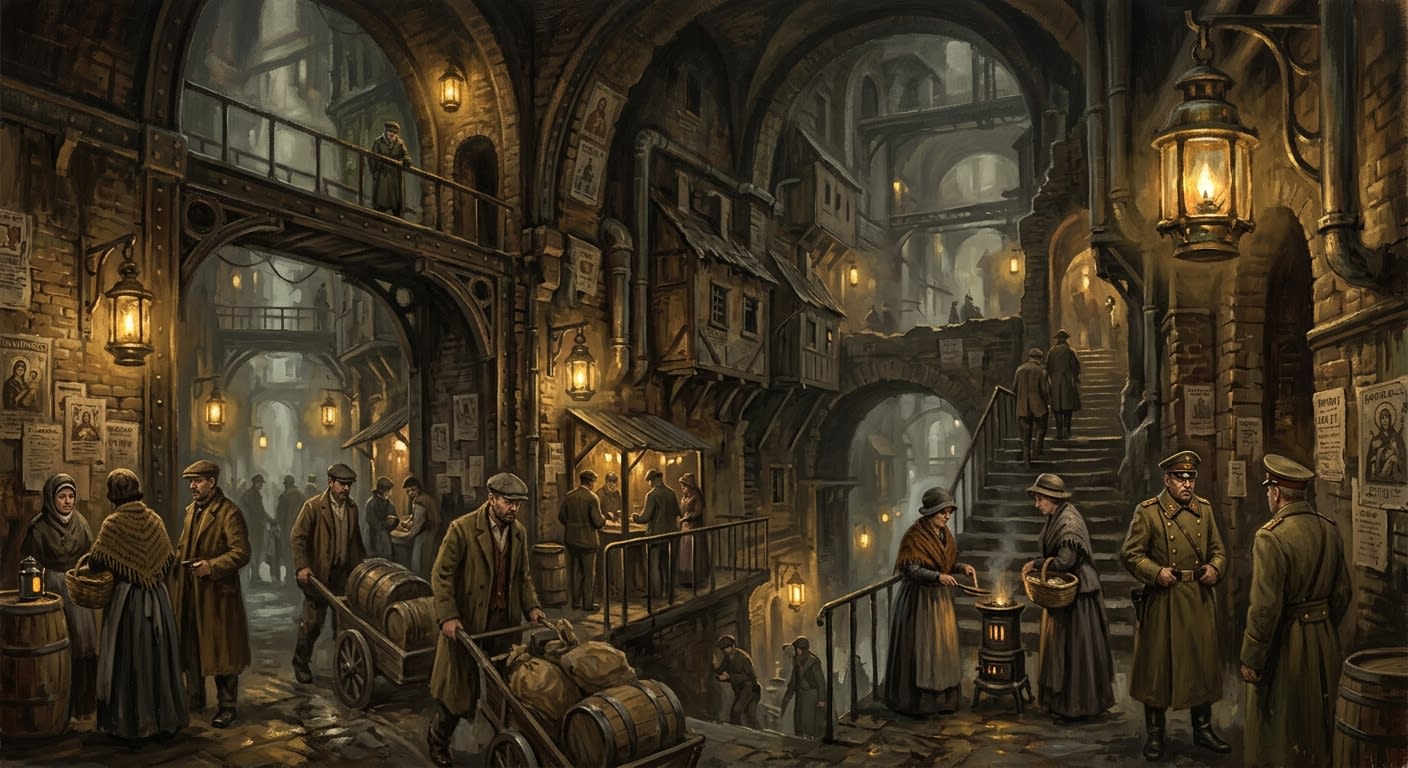
The Lantern Warrens are the tunnel-labyrinth beneath those ruins: old cellars opened into cisterns, Ottoman drains cut through Rationalist foundations, church crypts broken into smuggler galleries, bell pits collapsed sideways into refugee holes, and black-diesel crawls dug by men who mistook survival for a building trade. On maps they are a contested ruin. In practice they are a city written in negative space, inhabited by tallow traders, forged-paper brokers, fuel carriers, ash families, fugitives, hymn-sick children, and saints too unofficial to receive theft-proof reliquaries.
The Warrens matter because roads still pass near the ruin, because contraband finds tunnels the way water finds cracks, and because the southern theatre has always required places where official convoys may become unofficial cargo without suffering the embarrassment of transformation in daylight. From Thessaloniki the road takes two to four days, depending on patrol schedules, bribery quality, and whether the fog has decided geography should be instructional.
#On the Lanterns
The Warrens are named for their lamps, and the lamps are why sensible men avoid naming them too loudly. Black-diesel lamps in Skopje hum when lit. Not always. Not predictably. Not in the same passage twice unless some fool has decided to study them. The hum begins low, barely more than a pressure tremor inside the glass, then climbs into a hymn no licensed chorister has composed and no Bureau of Bells clerk has admitted recognising. Acoustic analysis places several modes before the Bell Codex by at least a century. That is the polite finding. The impolite finding is that some tones appear older than the Synod’s right to explain them.
A lamp will sit ordinary for three nights: smoke, heat, black soot on the chimney, a wick trimmed by a child with a knife too large for her hand. On the fourth it may begin with a note like a throat clearing behind stone. The tunnel grows still. Men lower cups. Mothers cover children’s ears. The flame trembles blue at its root, and the hymn arrives in fragments: a Kyrie reversed, a funeral response without priest, a ration-line chant from no ration-line recorded, a chord that makes sealed debts itch under the skin.
The Pipe-Runners call the condition “Skopje weather.” It is a useful phrase because it makes horror sound local, temporary, and wet. When a pipe in Constantinople hums like the Warrens, the runner says Skopje weather and bleeds the line. When a grandmother’s lamp at Brest gives one pre-Codex bar before curfew, the Lamp-Mercer says Skopje weather and breaks the wick. When a Bell-Tapper hears the same tone in a bellway-adjacent pipe, he says nothing at all, because his invoices improve when other people lack vocabulary.
Earlier Purity pamphlets described the Skopje lamp-hymns as “local superstition arising from inferior fuel, poor ventilation, and Balkan temperament.”
Corrected. The phenomenon has been recorded by Bureau of Bells instruments, three confiscated Pipe-Runner slates, and one Fume-Inspector who later denied his own handwriting with heroic stupidity.
#On Purges by Fire
The Warrens have been purged by fire four times. The phrase is accurate in the way a guillotine is accurate: one cannot fault the edge, only the policy.
The first purge came after the A.S. 171 harmonic classification, when an entire lamp-array under the old north market produced a Category Four tone that made every dog in the ruin lie down facing east. The Bureau of Bells could not date it. The Bureau of Purity could not tolerate it. Fire crews descended with oil, ash, hooks, and printed absolutions. They burned three corridors, sixteen stalls, two chapels, one paper forge, and a nursery whose families had been paying protection to the wrong office.
By spring the lamps returned.
The second purge took the tallow quarter. The third took the lower cistern and failed when water burned on top. The fourth reached the Chapel of the Uncounted Toll, where a bell without clapper had been hanging from a rusted beam since before the Warrens acquired their name. The crews reported successful destruction. The bell was listed as melted, removed, and doctrinally neutralised. Six weeks later, smugglers swore it rang once under no hand when a convoy of forged papers passed beneath it.
PURGE REPORT — SKOPJE, FOURTH ACTION Corridor Twelve cleared. Lamp stock seized. Unlicensed bell removed. Children recovered: ██ Children singing after recovery: ██ Mode identified by Bells observer: ███████████████████ Observer reassigned before countersignature.
Fire does not cleanse a tunnel-labyrinth. It negotiates with it. Flames run where air permits. Smoke chooses higher law. Families retreat through holes no survey marked, wait until the boots fade, then return with salvaged wicks and worse prayers. After purges, the Warrens are reoccupied more than rebuilt, which is faster and harder to invoice.
#On Trade and Forgery
The Warrens live by things that must not be inspected: tallow cut with marrow-fat, black diesel thinned for lamps, forged passage papers, counterfeit bell exemptions, relic splinters that are mostly chair legs, ration stamps, route lists, debt cancellations, old seals, new lies, and silence purchased by the hour. The trade in forged papers is especially fine. Skopje forgers have had a century and a half to study the documents of armies, Bureaus, smugglers, pilgrims, dead garrisons, and desperate families. They produce work so good the Bureau of Records occasionally confiscates it for training and then misplaces the originals.
Mutual heresy accusations function as local etiquette. The tallow men call the fuel carriers smoke-cultists. The fuel carriers call the paper forgers name-thieves. The paper forgers call the lamp families hymn-whores. The lamp families call everyone else loud. At any formal inquiry, each faction denounces the others with tears, witnesses, and convincing dates. By the next bell they are trading again, because hatred is a luxury and the Warrens prefer commodities with better shelf life.
There are authorities, though the Warrens dislike the word. Route-mothers control stair mouths. Wick-priests maintain lamp shrines no doctrine has blessed. Paper uncles arbitrate names. Tallow captains own the grease vats. Pipe-Runners own the warmth. Above them, sometimes, sits whichever armed company currently controls the ruin-mouth and believes control extends downward. This belief rarely survives first descent.
#On What the Hymns Want
The Bureau prefers causes. Causes permit forms. The Warrens provide correlations, which irritate clerks and enrich exorcists. The lamps hum more often after bell-adjacent fuel passes through the southern lines. They hum near old debt marks tied to Velmora’s marrow contracts. They hum when forged papers bearing dead names are burned for heat. They hum before certain fogs, after certain funerals, and during the week when spring thaw releases vapours from the deeper cisterns. They hum when children born belowground first speak a word from aboveground language. They hum when nobody is watching, then stop before witnesses arrive, like experienced officials.
The residents have rules. Do not harmonise. Do not write the notes. Do not sell a singing lamp to a stranger unless the stranger has already cheated you. Do not answer if the flame sings your childhood name. If the lamp-hymn matches a bell from the surface ruins, extinguish every light and wait for the rats to move first. If the rats sing, abandon the corridor.
The Bureau of Bells maintains that no recognised hymn structure can predate formal Bell Codex ratification and still possess lawful acoustic authority.
Clarification. The Bureau means no such hymn structure can be permitted to predate the Codex. Existence and permission are separate departments.
The most dangerous theory is also the simplest: Skopje remembers being eaten and sings through whatever burns. This theory is sentimental, unverifiable, doctrinally untidy, and popular among people who sleep under streets with bite marks in the stone. I record it because error, when shared by enough survivors, becomes evidence with poor shoes.
#On Present Condition
As of A.S. 201, the Lantern Warrens remain contested ruins, contraband artery, acoustic nuisance, black-market parish, and embarrassment with stairs. No Bureau controls them. Several Bureaus profit from them. The distinction is the spine of Synodal governance.
Skopje’s surface belongs to patrols, weather, bones, and whatever Kargath’s first meal failed to finish. Beneath, the lamps still burn. Some nights they burn quietly, and business proceeds: papers stamped, tallow poured, routes sold, fuel bled, children shushed, knives hidden when inspectors pass. Other nights the first lamp hums and the whole warren lowers its head as though a bishop has entered with a warrant.
Then the hymn rises, old as an unpaid debt.