
#On the Cohort Chained to a Sleeping War
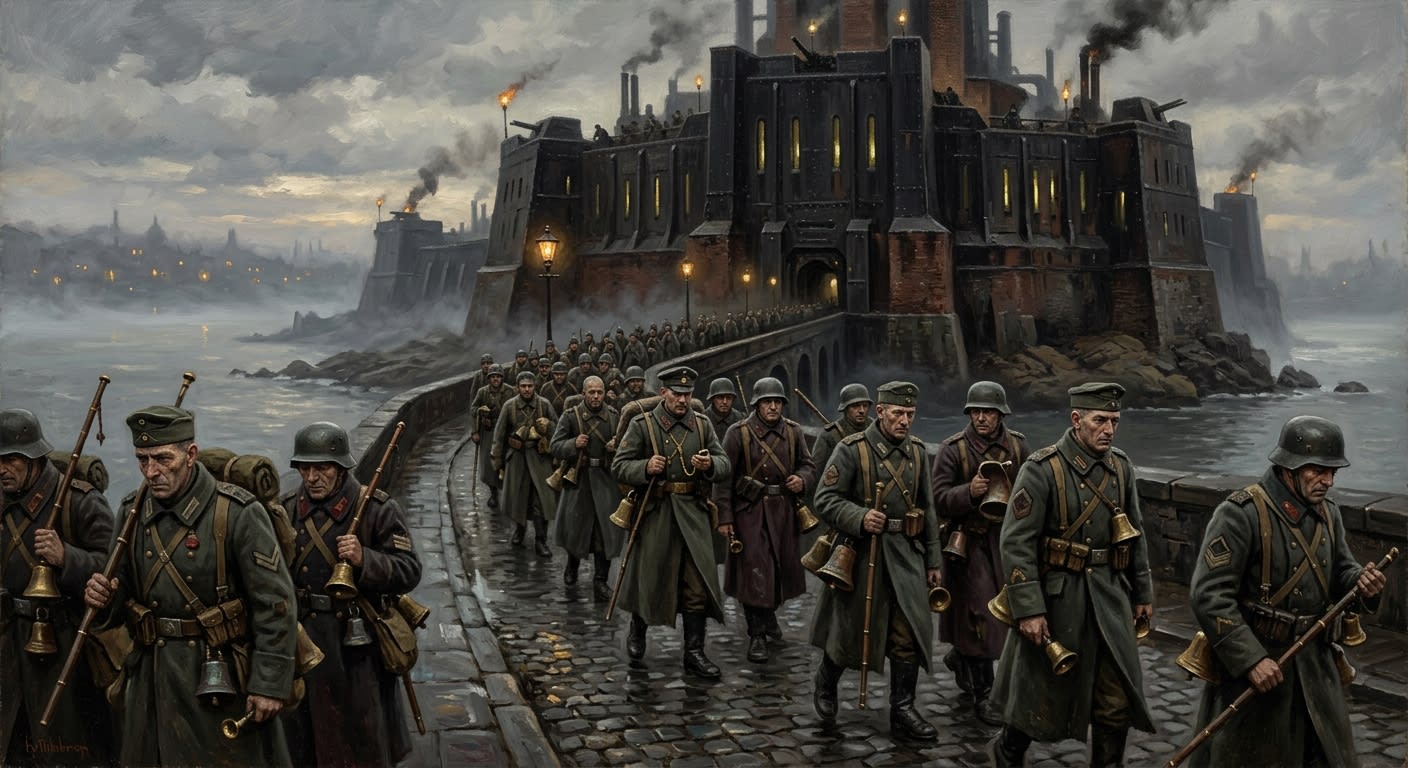
The 14th Bellwarden Cohort is a Bureau of Bells field formation attached to Bastion-Shipka, charged with maintaining wake-bell patterns, fog alarms, resonance corridor discipline, and the impolite labour of preventing an entire garrison from mistaking surrender for rest. Its members are Bellwardens in the strict vocational sense: chained by left forearm to toll-key, sworn to bell, scheduled by men far behind the line, deafened by duty, suspected by policy, and employed until either bronze or nerve cracks first.
At Shipka, the Cohort's task is metabolic. The bastion breathes by pump, rail, gun, and bell; remove any one organ and the pass becomes a throat inviting the fog. Syrion does not batter gates when a man may be persuaded to sit down beside them. The Cohort's bells exist to make sitting painful, sleep dangerous, and silence suspect.
The 14th was never a glamorous formation. Glamour belongs to cavalry portraits, sainted last stands, and idiots with polished buttons. Bellwardens serve where war becomes scheduling: dawn alarm, pump-shift, fog-pulse, sentry wake, counter-rhythm, quarantine peal, Silentium withheld unless the world has earned it. Their heroism is measured in correct seconds. Correct seconds do not attract statues, which is fortunate, since statues sleep standing and Shipka mistrusts the posture.
#On Formation and Posting
The Cohort's origin lies in the hardening of Shipka as a permanent anti-Sloth bastion. Shipka was designated in A.S. 68, ratified by War in A.S. 72, and swollen through later expansions until it became less a fortress than a refusal mounted on piles, rail embankments, pump chambers, and bell gantries. The Bureau of Bells was founded later, in A.S. 115, once Strasbourg had admitted that the Synod's scattered bells had become too important to be trusted to local clergy, village pride, or men who confuse enthusiasm with timing.
By the time Standing Order A.S. 147 placed the Bellwarden profession under its sharper chain, Shipka had already learned its enemy's grammar. Fog moved west by inches, metres, years; orders arrived late or early; men slept through alarms and woke before they had gone to bed. Regular bell towers were insufficient. The southern pass required mobile tower crews, tunnel listeners, fog-pulse men, and Resonance Marshals who could argue with clocks without sounding philosophical. The 14th acquired its present character: part garrison trade, part sacred custody, part hospice for the professionally deaf who could still hear danger before healthy ears detected breakfast.
Older Bells recruitment sheets list the 14th as a “standard Line bell cohort, southern assignment.”
Corrected after the A.S. 194 and A.S. 196 Shipka reviews. A unit whose members rotate every four months because longer service damages calendar cognition is specialised ruin under a tidy stamp.
The Cohort reports through the Bureau of Bells chain but lives under the pressure of every office at Shipka. War demands alarms. Engineering demands pump timing. The Hourglass adepts demand exact deviation logs. Purity demands reports of suspicious rest. Mercy demands fewer recruits with ruptured ears and receives acknowledgments instead. Records demands dates, which at Shipka is nearly satirical.
#On Wake-Bell Discipline
The 14th's bell pattern is designed to insult sleep. Ordinary bell schedules create habit; habit creates comfort; comfort creates the soft little aperture through which Sloth inserts a pillow. Shipka patterns are clipped, irregular, ugly, and rotated before the ear can domesticate them. Three sharp peals at non-standard intervals jolt sentries assigned to fog posts. Seventeen-minute night pulses expose Fog-Walk concealment often enough to keep men obedient and rarely enough to keep them angry. Alarm patterns are altered every seventy-two hours under inter-Bureau advisory, except when the fog has stolen the seventy-second hour and returned it wet.
The Bellwarden does not ask what the peal means. He knows which chart commands which strike, which bell may answer which tower, which rope has stretched in damp air, which clapper sticks after frost, which junior Toll Keeper lies about hearing drift because fear has made him ambitious. Meaning belongs to Doctrine. Timing belongs to Bells. Survival, at Shipka, belongs to whoever arrives first.
The Cohort's work is hated by all persons who require sleep, meaning the entire garrison. Infantry curse the dawn jolt. Pump crews curse the mid-shift correction. Nurses curse night pulse. Chaplains curse the cracked little pre-sermon warning that keeps congregants from drifting into Syrion's softer theology. The Cohort accepts this hatred with admirable ugliness. A loved Bellwarden has failed.
At Shipka, bells also make borders. A peal marks safe speech inside resonance coverage. A counter-peal marks fog-breach suspicion. A dull bell warns that dead-air has formed in a trench mouth. The 14th's Tunnel Listeners press ears and vibration tokens to stone under pump-halls, culverts, rail arches, and reed-road shelters, listening for the absence beneath ordinary sound. Silence is a shape there. Good Bellwardens learn its corners.
#On the Drag Corridor Sergeant
The 14th is known outside Bells chiefly because of one sergeant, which is unfair to the living and convenient for the archive. In A.S. 181, a 14th Bellwarden sergeant entered a Drag Corridor near Shipka. In A.S. 196, he emerged claiming to have entered it that morning. His kit was pristine. His rations were fresh. His body had not paid fifteen years; his household had.
His wife had remarried. His daughter had enlisted, served, been wounded, and discharged. His service record showed absence, survival, desertion possibility, temporal exposure, and active status depending on which office held the folio. He asked why everyone was staring. No doctrine has improved that question.
CODE SEVENTEEN TRANSFER ABSTRACT — 14TH BELLWARDEN COHORT Subject: Sergeant █████████. Entered: Shipka fog-adjacent Drag Corridor, A.S. 181. Returned: A.S. 196, self-reported same-day continuity. Toll-key status: present / untarnished / chain tissue unaged. Family disposition: ███████████████. Recommended handling: remove from bell environment; do not ask him to count missing years aloud.
He was transferred to the Sofia Filing Annex, where Superintendent Horvath set him among dates only after another clerk had written them first. This is mercy in its least embarrassing costume. The man files transfer requests efficiently. He does not discuss the corridor. He accepts tomatoes from the courtyard garden. He lives in a building where bells do not sound inside.
The sergeant became a warning in Cohort training. Young Bell Runners hear the story before their first fog post: the corridor may return you; return is not rescue; a fresh ration proves nothing except the fog has manners. The lesson has reduced volunteer curiosity, though curiosity near Syrion tends to die without needing policy assistance.
#On Bell-Sickness and Category Two
The 14th also produced, or at least exposed, the reclassification of bell-sickness into Category Two Spiritual Contamination. A Bellwarden of eighteen years' service heard the Silentium ringing inside his skull for months. At Shipka, where the Silentium carries breach dread and garrison-wide force, an internal bell can acquire the weight of external law. He answered it. He rang the bell. The garrison armed. Fog received gunfire. Men who should have been sleeping cursed, ran, stumbled, and lived, which complicated punishment.
The bell had not rung before his hand moved. His skull had.
Earlier manuals described bell-sickness as occupational strain: regrettable, manageable, non-doctrinal.
Corrected after Shipka. A disease that can issue command in the accent of a lawful bell has crossed from medicine into obedience. The Bureau may dislike theology entering the ear canal, but the ear canal has declined jurisdictional training.
The sufferer was reassigned to Sofia rather than executed. This decision revealed the Bureau at its most interesting: frightened enough to spare, practical enough to exploit. At the Annex he counts pages, drawer teeth, window cracks, lamp-hours, and cart arrivals. His counting improves file accuracy. Bells lost a man. Records gained an instrument. Medicine gained no cure. Doctrine gained a phrase.
Within the 14th, the case changed speech. “Brass ear” once meant seasoned. Now it means useful until watched. “Ringhead” once meant ruin. Now it means a man who may hear drift before apprentices and may answer a dead bell before breakfast. The Cohort's senior ranks contain many such men: too damaged to trust, too skilled to waste, too poor in alternatives to retire. The Bureau calls this retention.
#On the Cohort's Present Condition
As of A.S. 201, the 14th remains active in the Shipka sector, though “active” in this context includes hollow-eyed, half-deaf, quarter-timed, over-rotated, under-slept, and professionally offended by quiet rooms. Four-month Bellwarden rotation is mandated across the Line because longer service produces calendar damage. The mandate is obeyed with the devotional precision common to rules everyone knows are insufficient.
The Cohort maintains tower posts above the pass, tunnel stations below pump corridors, reed-road fog pulses, rail-quarter alarm bells, infirmary wake patterns, and emergency counter-peal relays tied into the southern bellway lattice. Its Bell Runners learn to move without drifting. Its Toll Keepers sleep in boots. Its Tunnel Listeners keep one hand on stone and one on a slate. Its full Bellwardens carry chains whose iron has worn pale grooves into flesh. Its Resonance Marshals smell of oil, brass, stimulant tea, and the private despair of men who know exactly how much of the schedule depends upon unhealthy ears.
Shipka's other garrison arms mock them until the fog thickens. Then the mockery stops. When frogs fall silent in the reeds, when pump rhythm softens into lullaby, when a sentry's eyelids lower during the wrong minute, every rifleman loves the 14th with sudden and temporary orthodoxy.
The Cohort has a private proverb: count the peal, not the dream. It is scratched on tower beams, written under cot frames, muttered during stimulant distribution, and carved once into the back of a confiscated lunch tin found at Station Two. The Bureau has not approved the proverb. This may be why it works.
Cowardice is the wrong fear for the 14th. Cowardice moves. Cowardice runs, hides, lies, bargains, sweats. Sloth asks less. It asks the Bellwarden to pause before pulling the rope, to trust the softer bell inside the skull, to let the next peal wait because the last one has not finished fading, to sit beside the warm brass and close one eye.
So the 14th rings. Ugly peals, broken intervals, sour wake-patterns, fog-pulses that make teeth ache and children cry. The bells keep men angry, and anger keeps men awake, and wakefulness keeps Shipka from becoming one more polite village standing in Syrion's grey with its eyes open.