
#On the First Chain
The Act of Hierarchical Supremacy was the Synod’s first legal chain, ratified under the Concordat of Strasbourg before the Catechism of Obedience was drafted and before the Twelve Holy Bureaus had learned to quarrel with the full splendour of maturity. It established a simple proposition, large enough to crush a province: all sacred, civic, military, and doctrinal authority descends through the Hierarchs, and every lesser officer, bishop, captain, clerk, widow, apprentice, prisoner, foetus, mule driver, and reader with pretensions to privacy receives legitimacy only by obedience.
The Act did not argue. It declared. Argument belongs to councils before they win and rebels before they hang. The early Synod had survived the Sundering, the Atheist wreckage, famine, saint disputes, refugee tides, princely vanity, and bishops who believed the end of the world had somehow improved their personal jurisdiction. The Act answered them in one voice: no chair outside Strasbourg sits higher than the Seven Seals.
#On Its Occasion
The Council of Worms ratified an Allegiance already in force. Three years later the Concordat of Strasbourg constituted the formal Synod. The longer improvisation ran from the A.S. 55 issuance through A.S. 58 accessions and A.S. 87 ratification: emergency levies, contested relic custody, provisional councils, starving towns and local abbots whose obedience lasted exactly as long as the courier remained in the room.
The first Hierarchs understood the danger. Hell could be resisted by bastions, bells, guns, prayers, and men willing to die in tidy numbers. Rival jurisdiction could not. Rival jurisdiction breeds forms, appeals, exemptions, tolerances, ancestral privileges, and those provincial smiles which mean “we shall comply after harvest,” which means “send soldiers.”
Provincial devotional histories describe the Act as a voluntary harmonisation of regional church liberties.
Corrected. The Act was voluntary in the sense that a man surrounded by pikes may voluntarily discover an interest in theology. Several regions signed quickly. Several signed after their granaries were inventoried. The distinction is archived, not celebrated.
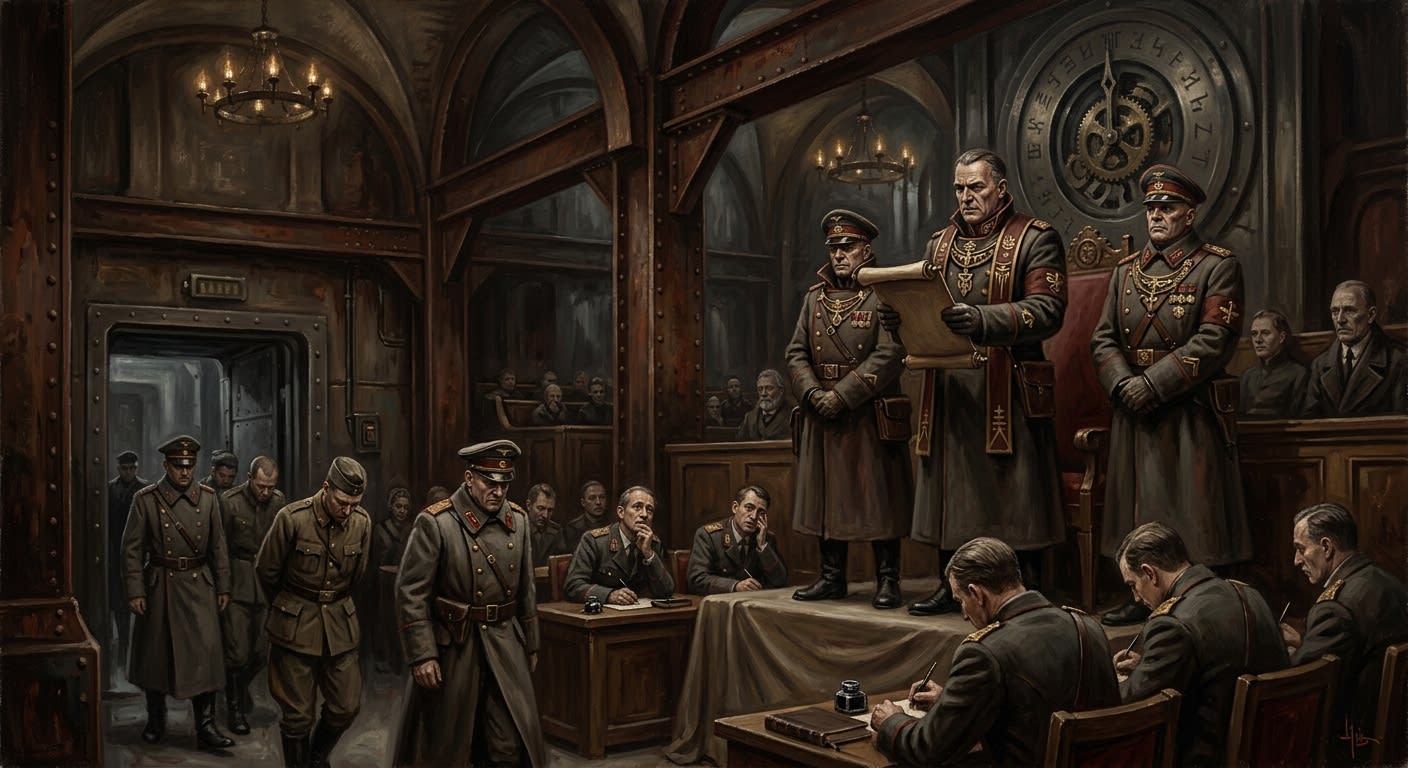
The Act was read in the Cloister of Concord before seven chairs, six confirmed seal-holders, one disputed representative of War, eleven episcopal witnesses, two military auditors, and a Records clerk whose hand cramped during the title. Its preamble named disorder a spiritual wound. Its articles named hierarchy the dressing. Its enforcement clauses named the knife.
#On the Articles of Descent
Article One established the Seven Seals as the summit of earthly authority under Providence: Doctrine, Discipline, Martyrdom, Concord, Purity, Vigilance, and War. Article Two required all offices to trace commission through a recognised Seal. Article Three dissolved unregistered episcopal commands. Article Four subordinated provincial synods to Strasbourg ratification. Article Five placed emergency military authority under War and Doctrine jointly, a marriage whose children have been paperwork and artillery.
Article Six created the hierarchy of appeal: parish to district, district to provincial bureau, provincial bureau to Strasbourg, Strasbourg to the relevant Seal, and the Seal to itself. Article Seven made refusal self-invalidating. A bishop who rejected the hierarchy ceased, by that rejection, to be a bishop in law, and his sacraments became administratively questionable from the hour of refusal. Priests hated this clause. Records adored it. Purity sharpened pens.
The Act’s genius was not punishment. Any butcher with a throne can punish. Its genius was ontological: it made authority a condition of being legible. Refuse the chain and the Ledger could stop seeing you as office, witness, claimant, owner, parent, spouse, or corpse. A man can endure prison. Few men can endure becoming a filing problem with no file.
#On Its Relation to the Catechism
The Catechism of Obedience defined the soul’s licence to breathe. The Act defined who could issue licences. Without the Act, the Catechism would have been a fierce booklet wandering Europe with no hand authorised to close around its throat. Without the Catechism, the Act would have been a ladder with no one told why climbing downward was holy. Together they formed the Synod’s first true machine: supremacy above, obedience below, penalty everywhere.
Certain school primers state that the Catechism is the Synod’s first instrument.
Corrected for children old enough to bear accuracy. The Act preceded the Catechism. The Bureau permitted the older phrasing because children remember chains poorly and catechisms well. This mercy is withdrawn from advanced pupils and irritating adults.
The Bureau of Doctrine cites the Act when defining truth’s custody. The Bureau of Purity cites it when entering houses. The Bureau of Records cites it when refusing to recognise a marriage performed by a priest later dissolved. The Bureau of War cites it rarely, preferring cannon, but its warrants depend upon the Act as a bridge depends upon stones it never thanks.
SEALED CASE NOTE — PROVINCIAL SEE OF █████, A.S. 103 Issue: bishop refused Article Seven dissolution. Action: see declared vacant retroactive three months. Result: ordinations in interval classified ████████████████████. Pastoral remedy: unavailable; surviving records eaten by official damp.
#On Resistance and Correction
Resistance came dressed as conscience. It always does. The bishops of the western marches argued that apostolic succession could not be made subject to administrative seal. The abbots of the Rhine argued for ancient exemptions. Certain princes, having mislaid their armies during the preceding half-century, discovered a passionate love for local liberty. The Act treated these objections as symptoms.
Correction varied by usefulness. A beloved bishop received supervised retreat and a new title involving silence. A stubborn abbot received audit, immurement, and a posthumous clarification of his vows. A prince received a tax investigation, which is slower than hanging and more educational for the children. The Act did not abolish politics. It put politics on a leash and named the leash Doctrine.
By A.S. 134, the Revision of the Catechism assumed the Act so completely that younger exegetes stopped citing it except in procedural disputes. This is how founding violence becomes custom. The first generation remembers the collar. The second polishes it. The third calls it anatomy.
#On Its Present Force
By A.S. 201, the Act of Hierarchical Supremacy remains active in every commission, warrant, oath, appointment, levy, school licence, tribunal summons, and death order issued under Synodal seal. Most citizens never read it. Most citizens never read bridge charters, either, yet complain when the bridge falls. The Act is beneath their feet each time they obey a parish clerk with a stamped form.
Its present controversies are not named controversies, because Orthodoxy does not quarrel with itself in public. They concern the empty Seat of War, the Seal of Vigilance’s reporting line, provincial emergency powers along the Sagittal Line, and whether a dissolved officer’s prior orders remain valid when invalidating them would inconvenience three Bureaus and a railway schedule. The official answer is clear. The working answer is kept in locked drawers.
I keep a copy of the Act under glass in the Cloister. The ink has browned. The seals have cracked. The clauses remain young and mean. Good law ages by making everyone else do the weakening.