
#On the Republic’s Thinking Organ in Vienna
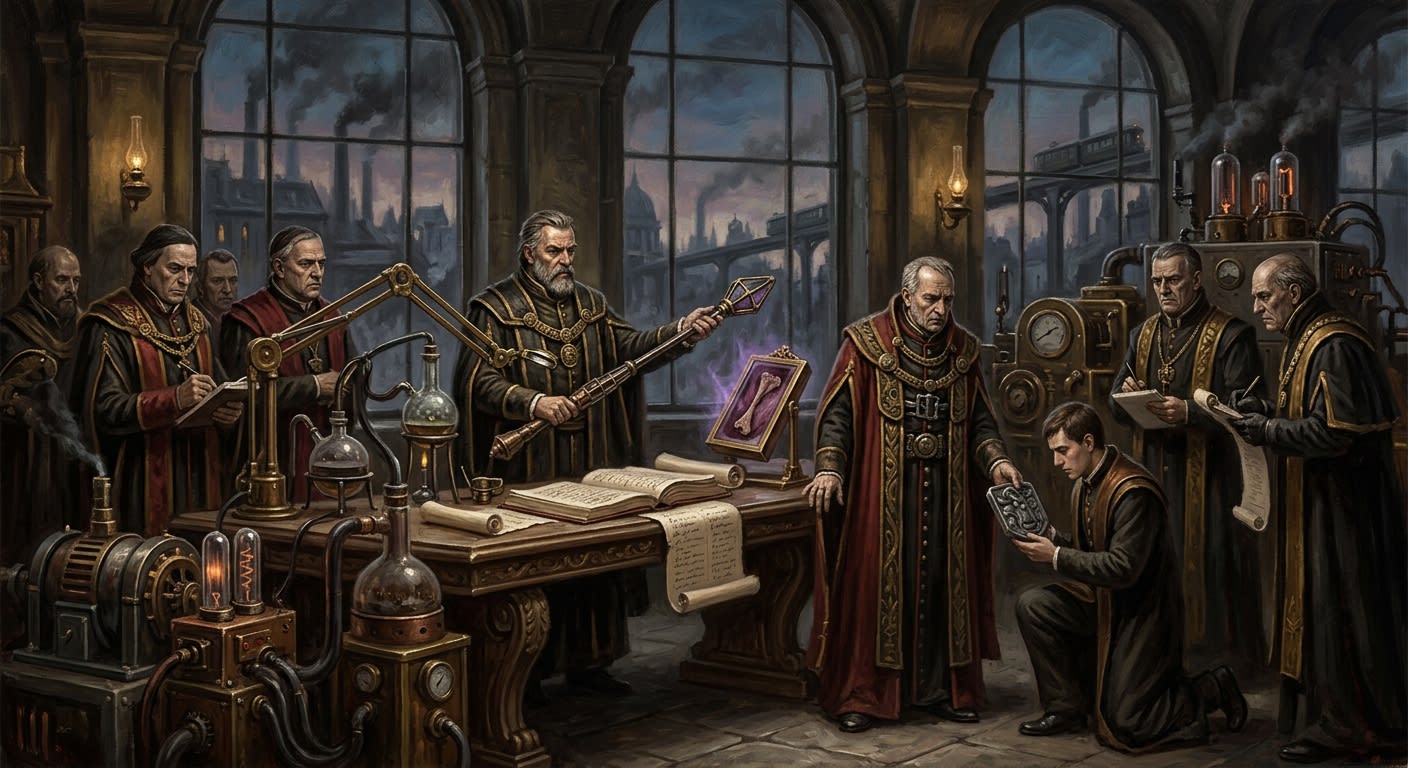
The Académie des Sciences in Vienna was the Rationalist Republic’s preferred organ for declaring that the impossible had occurred naturally. It occupied rooms stolen from an old cathedral chapter after the Treaty of Regensburg, a theft made palatable by polished brass, clean labels, and the civic superstition that a sacrilege stops smelling once catalogued. From those rooms came observatory logs, anatomical jars, public lectures, prize medals, and the seven famous treatises on the Year Without Dawn, each more confident than the last, each now preserved because even error deserves a coffin.
Do not imagine a nest of dunces. Dunces break things by accident. The Académie broke things by method. Its professors measured relic-glow, weighed bone ash, timed bells, dissected plague victims, and produced explanations with the calm of men who believed grammar could outvote Providence. Intelligence without reverence is a knife sharpened on its own handle. It cuts eventually. Usually the hand holding it.
#On the Halls and Their Appetite
The Academy’s Vienna offices stood near the university quarter, close enough to the Hofburg for the Council of Nine to summon expertise, far enough from Saint Stephen’s for professors to pretend the reliquary beneath the cathedral stones was not glowing at them personally. The ground floor held lecture rooms. Citizens sat beneath diagrams of atmospheric layers and learned that miracles were peasant errors awaiting correction. The second floor held laboratories. The third held the Prize Hall, where medals hung in lacquered cases like secular relics too embarrassed to shine.
The basements held the true syllabus. Fossils from Saxony. Glass lungs from Paris. A bell clapper that rang in storms though no bell had claimed it. Twenty-three reliquary fragments labeled “unverified osseous matter.” Two preserved Greyling placentas from A.S. 32, later removed by the Bureau of Purity under escort and three mutually hostile inventories. The catalogues survive in Strasbourg. They are smug in four languages.
#On the Year Without Dawn Treatises
On the seventeenth of Quintilis, A.S. 32, the sun failed to rise. By noon, the Republic required explanation. By evening, Molyneaux had begun providing one: sub-Adriatic vulcanism, ash without ashfall, eruption without tremor, sulphur without smell, cause without evidence. The Academy applauded because the phrase was long, the Latin bones were visible, and the Creator had been kept out of the sentence.
The second treatise blamed solar cycles. The third blamed meteoric debris. The fourth blamed refraction over the Baltic. The fifth blamed mass hysteria, thereby accusing crops, cod, sheep, rivers, infants, and the horizon itself of civic emotional weakness. The sixth proposed that the vocabulary of darkness required reform. The seventh recommended calm. Calm is what institutions recommend when fear would be more honest and prayer more useful.
Older Synodal primers state that the Académie published seven treatises in nine days and then fell silent.
Corrected. The seven were only the famous errors. Supplements, rebuttals, memoranda, prize notices, and correction slips continued until the Dawn returned. Error breeds briskly under velvet conditions.
The instruments betrayed them. Thermometers recorded mild air above dying crops. Astronomical plates showed blank grey where stars should have bitten silver. River pilots lost banks their charts insisted remained present. A pendulum in the east observatory slowed by thirteen heartbeats per hour for the duration of the grey and resumed ordinary swing on the forty-first morning. The keeper called it mechanical embarrassment. The phrase deserves a chapel.
The Academy disciplined the evidence. Faulty readings were recopied. Outliers were excluded. Witnesses were re-interviewed until their terror became vocabulary. Facts, once seated properly, can be made to look obedient. The Académie mistook obedience for truth.
#On Molyneaux’s Prize and the Cellar
The Gold Prize awarded to Molyneaux after the Dawn returned remains the Academy’s purest self-portrait: a medal struck for being wrong in an approved direction. His volcano was never found. His theory predicted neither the Red Flood of A.S. 34, nor the Eastern Silence of A.S. 38, nor the Sundering of A.S. 45. Prediction is useful to shepherds. Institutions prefer ceremony.
RECOVERY ANNEX — VIENNA ACADEMY CELLAR, A.S. 48 Subject: Professor Gérard Molyneaux. Candle: active flame; no measurable fuel. Wall inscription: ████████████████████ Bureau of Bells report: “We recommend immediate demolition.” Outcome: room demolished; singing continued seven days.
When the liberation force found Molyneaux in A.S. 48, he was dead among his papers with a candle still burning. Above the desk was scratched a word the Bureau classifies as a name. I have seen the transcript. I will not write it. Some typography is an unlocked cage.
#On the Ruin and Its Use
After Clemens Stahlhand reclaimed Vienna in A.S. 95, the Academy building was sealed. The upper lecture hall had collapsed into the anatomical theatre. The Prize Hall’s medals had fused into a single lump. The basement stacks remained dry despite three broken floors above them, a fact the Bureau of Engineering called “hydrologically discourteous.” Doctrine confiscated the papers. Records removed the catalogues. Purity burned jars whose contents moved against the glass.
The Bureau of Pilgrimage once proposed opening the Academy ruin as a cautionary stop on the Via Stahlhand circuit.
Denied. The public may be trusted with rubble, warm basalt, approved tears, and gift-shop reliquaries. It may not be trusted with instruments that kept counting after their owners died.
By A.S. 201, the Academy survives as training material. Doctrine clerks read its papers to learn how elegant error sounds before it starts killing people. The first assignment is simple: mark every unsupported premise in red. Most pupils run out of ink. The clever ones ask for a second pot before beginning.
The pediment angels above the sealed ruin have no wings now, only triangles. The triangles endure. Geometry is stubborn. So are warnings.