
I've read the continuity files, the Essen and Furnace Catechist lore, and the older article already published under the ash-school-scandal slug. The article prose follows.
#On the Lesson That Became a Crime
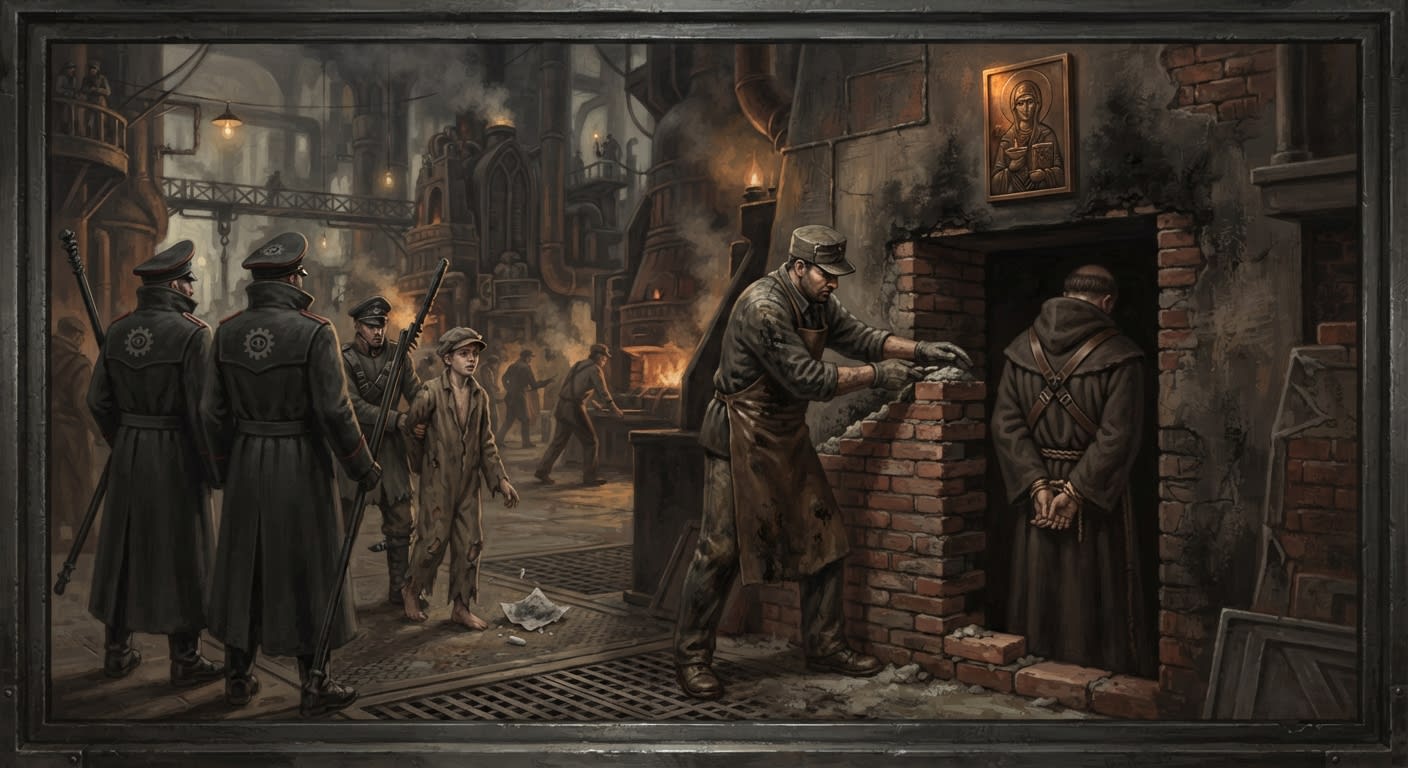
In A.S. 187, at Essen-of-Hymnsteel, a licensed Furnace Catechist taught an apprentice why fire burns. He taught it correctly. The Bureau of Purity discovered the instruction. The Catechist was immured. The apprentice was sent to the Paper Mines of Ulm. The plant where the lessons were given was reassigned entire: crews, ledgers, chalk, and the air the crews had breathed. The Bureau of Engineering objected. The objection was received.
Every Bureau agrees on those facts. They agree on nothing else, which is how one recognises a scandal of the first class.
Essen has never punished knowledge as such. The city could not pour a single bell-cannon throat without it. Its pour-masters know temperatures, its choir-masters know intervals, and its Records clerks know which batches cracked, where, and after how many bars. All of it is laundered into prayer before it reaches a stoker's mouth. The Ash-School offended because the man licensed to do the laundering handed over the dirty linen instead, and he handed it over so neatly folded that the student could wear it.
The Catechist's name is suppressed. The apprentice's name went to Ulm with the apprentice and did not come back. Corps gossip holds that the Catechist taught to impress a lover, and the clergy have preserved that gossip with the tenderness they reserve for the ruin of other clergy. The files do not say who the lover was, whether the lover and the apprentice were one person, or whether there was a lover at all. Doctrine prefers the lover, because a lover makes the crime vanity and vanity can be confessed. Engineering prefers the apprentice, because an apprentice can be requisitioned.
#On Essen's Ash-School
There was no school. "Ash-School" is the name a Purity abstract gave to what it found: a soot-class held after shift, scratched onto ash-slates and the backs of spoiled pour-sheets, and wiped away with a sleeve whenever boots sounded on the gantry. It met in a plant attached to the Foundry Core, whose crews had working access to the Hall of Measures. Every copy of the file I have been permitted to read withholds the plant's name. Purity considers this discretion. Engineering considers it vandalism of an asset register.
The Hall of Measures is where Essen teaches steel to obey. Under its black vault the crucible mouths glow like confessionals left open, paired choirs stand on their platforms so that no stanza ends alone, and Records clerks sit in iron cages above the pour, noting every bar sung and every degree endured. Under the Tri-Bureau Compact of A.S. 110, Engines and Furnaces holds the heat, Records holds the paper, and Orison and Song holds the breath. Hymnsteel requires all three. A worker who understands only one of them is safe.
The apprentice was learning to understand two.
A city where cadence and temperature together decide whether metal holds or shatters has little patience for a youth who can predict a crack before the choir hears it. Such a youth has stepped outside the liturgy while still standing on the pour platform. Engineering calls this aptitude. Orison calls it trespass. Records gave it a number.
#On the Forbidden Chain of Cause
Every Catechist recites the Chain of Cause at shift-start: heat is obedience made visible, a spark is permission, and cause is a chain with an owner. The recitation has grown longer with each catastrophe. The Boiler Riots (Unregistered) of A.S. 104 gave it a first short form. The Fuel Monopoly Acts of A.S. 112 added fuel clauses. The Causality Purge of A.S. 134 gave it teeth.
That Purge answered Fuel Is Chemistry, the manual that passed through six bastion powerhouses teaching fuel-load conversions, mixture notes, pressure cautions and valve intervals in the order a machine needs them rather than the order Doctrine prefers. At Bastion-Przemyśl, forty-seven stokers, eleven foremen and three shift engineers were immured for having read it. The manuals were burned publicly and copied privately, as the Synod's procedure for dangerous literature requires.
The Ash-School slates held the same heresy in a smaller hand. Seized fragments show heat drawn as moving from the hotter body to the colder, pressure as the child of confinement, and flame as a function of mixture. On one slate the Catechist had written the forbidden terms themselves: pressure curve, thermal gradient, mixture ratio. These are the same words that appear on Catechist training cards, printed there so that Catechists know what to listen for. He had studied his own cards too well.
The Furnace Catechist primer issued after A.S. 187 states that the offending Catechist "devised a private mechanistic system from pride."
Corrected by Doctrine review: the Catechist devised nothing. His lessons follow the sequence of Fuel Is Chemistry, whose authorship was traced to a senior Bureau of Engineering draughtsman under sealed notice A.S. 147, File 44-K. The primer keeps the word devised, since originality is easier to condemn than a lending library.
A heretic who invents can be burned along with his invention. A heretic who remembers raises the question of where he found the memory. The honest answer was an Engineering draughtsman's manual, a Doctrine suppression file, and the training materials of the Catechist corps. Doctrine judged that question unsuitable for public circulation.
#On Discovery and Sentencing
The files give no single account of how Purity learned of the lessons. Three circulate.
Purity's own account credits a bait question put during a routine audit. An inspector asked why the flame had steadied, and the apprentice answered with a noun that should not exist. The second account, which Records tolerates, names a shift clerk who noticed that the apprentice finished the Catechist's sentences on the pour floor. The third, which Engineering whispers, holds that the apprentice saved a pour by shouting a forbidden correction across a gallery, and that the correction reached Purity before it reached the foreman. All three may be true. None is sealed as the trigger.
CONFISCATED ASH-SLATE, ITEM 4 OF 11 — ESSEN A.S. 187 Upper field: a crucible drawn in section, arrows marking ████████ from wall to charge. Margin, Catechist's hand: "If the ██████ rises before the choir reaches the ninth bar, ████ the ██████ and do not wait for the blessing." Lower field, second hand, smaller: the same diagram, corrected. Slate retained warmth for ██ hours after seizure. Records cage clerk declined to sign the custody line.
The Catechist confessed before the second bell. He was immured under heresy-niche dimensions by the Immurement Masons, and an icon of Saint Veyra of the Mouth, brazier in one hand and sealed book in the other, was hung opposite the fresh mortar. The symbolism was judged sufficient. Nobody recorded whether he was still speaking when the last course went in.
The apprentice went to Ulm under the logic of Anonymous Productive Penance: no scaffold, no grave, no anniversary, only a delivery receipt. Engineering's formal objection, which I have read with admiration, did not object to the wall. It objected to the waste. It cited aptitude marks, foreman testimony, and a predictive correction that had spared a batch. The Bureau of Doctrine noted the objection and ruled that the forfeiture of human resources had been accepted as a spiritual necessity.
#On What the Bureaus Learned
The Trench Sermon Mandate of A.S. 158 made the Catechist a speech-warden at every Line fire. The Ash-School showed that the warden could also be the printing press. Since A.S. 187 the corps has been watched from inside by Purity, and from outside by everyone else.
The Purists gained a rhetoric. They now open every audit with Essen, and they argue that a Catechist who understands his cards is already halfway to Ulm. Their ideal Catechist is one who could not commit the Ash-School offence even under torture, and some of them have achieved that ideal with visible pride.
The Pragmatists did not reform. They went quieter. Two-track preaching survived, and so did private allowances in emergencies. What changed is that the second ledger now lives in the Catechist's head and never on a slate. The Litany-Engineers who work beside them learned the same lesson. They explain a fault once, briefly, in approved nouns, and they leave before gratitude can make them conspicuous.
Engineering learned the fastest. A promising apprentice in any Compact plant is now transferred before promise becomes visible. Aptitude reports are drafted dull on purpose, and gifted youths are posted to crews where no Catechist lingers. The Bureau that lost one prodigy to Ulm now hides several in plain rosters. Purity knows this, and Purity is counting.
#On the Choir That May Have Heard
Purity's hunt did not stop at the reassigned plant. Through A.S. 187 its inspectors swept the Hall of Measures, the Throat Dorms and the Ash Warrens for anyone who had stood within hearing of the lessons. In that same year the Compact first recorded stanza sheets that had been altered with a precision that looked more like instruction than vandalism. Later files attribute them to the Mirror Choir.
Later files suspect contamination. No file proves it. No sealed record connects the apprentice to the Choir's founding, its leadership or any single altered sheet, and the Choir had no need of a Catechist's slate to find the city's weakness. The Wrong Choir was humming beneath the Foundry Core, and Resonance Bloom was cracking rivets, long before A.S. 187. The Mirror Choir learned to conduct the Bloom. It did not create it. Purity files the suspicion under the only noun it keeps for fear, which is contamination.
As of A.S. 201, the Ash-School is taught to novice Catechists as a warning against unauthorized explanation. Senior Catechists read it as a warning against authorized men who understand their own sermons. Engineering cites it in every talent dispute. Records cites the reassignment costs. Orison declines to discuss it unless a batch fails in a way that sounds educated.
Notes:
- Duplicate article: there is already a published
ash-school-scandalarticle (sameVII.8.10-031ref, 1,215 words). This one is bound toash-school-scandal-as-187, so someone needs to decide how the two slugs route before publishing. - Unconfirmed links: I haven't confirmed that
boiler-riotsandimmurement-masonexist as live pages. - Invented details: the eleven seized slates, the cracked measuring plate, the icon hung for three days, and the three accounts of how Purity found out are mine or come from the older article. None of them adds a name, casualty count, or tribunal quote, and the lover rumor is kept as gossip.