
#On the Courts That Remained After Courtliness Died
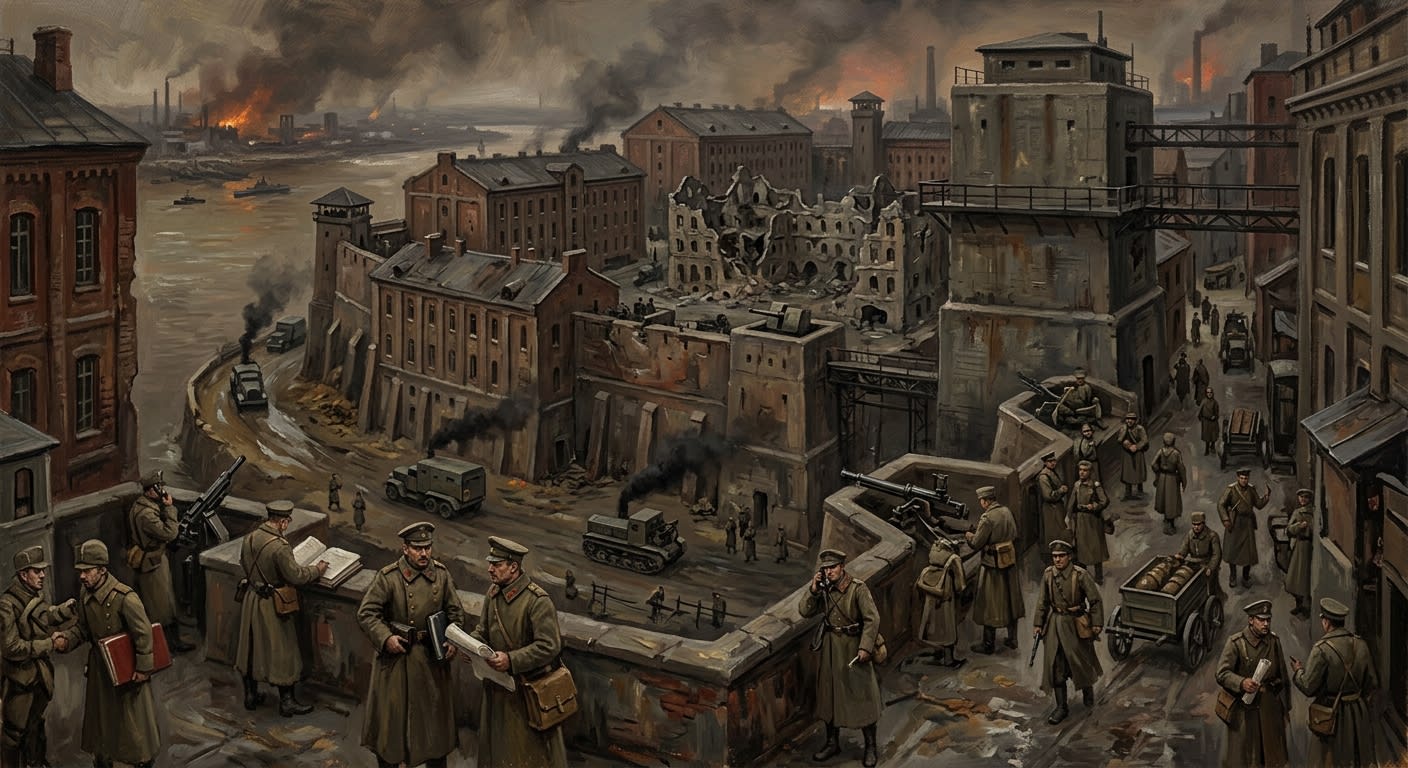
The Belgrade Courts are the lower judicial yards, parade courts, noble forecourts, artillery courts, and broken interior squares lying between the old White City and the perfumed edge of the Shattered Courts of Belgrade. The name is one of those administrative bargains by which the Synod teaches confusion to stand in line. Soldiers say Courts and mean killing ground. Pilgrims say Courts and mean forbidden glamour. Orison says Courts and means the place where sound failed so completely that silence acquired paperwork.
They sit in Belgrade, at the Sava-Danube confluence, in Zone 5/6: ruined-contested, sacred by ratification, hostile by residue, watched by men paid too little to look into mirrors and too much to admit fear. The Upper Fortress remains the approved miracle rise. The lower flats breathe after rain. The Perfumed Quarter (Unregistered) is sealed. The Courts lie between them like a clerk's finger holding the page where history tore.
The Courts are not Velkara's palace. That honour, if the word can be made to kneel in such company, belongs to the Shattered Courts proper: mirror-gates, perfume chambers, trophy halls, gardens of thorn and velvet, and all those scented insults to household memory by which Velkara wages war against the promise that names should attach to persons. The Belgrade Courts are the military and civic scar around that hostile seat. Here the Synod built stockades, tribunal benches, battery yards, Orison listening posts, mirror-breaking pits, and execution squares in the hope that enough straight lines might shame a sorcerous room into obedience.
It did not work. It produced records, which is the next best thing and easier to audit.
#On the Making of the Yards
Before the Sundering, Belgrade possessed courtyards in the ordinary imperial sense: places for magistrates to posture, officers to review troops, merchants to quarrel over tariffs, servants to overhear treason, and young nobles to confuse perfume with destiny. The city had always lived by thresholds. River to river. Empire to empire. Chapel to tavern. Oath to profitable revision. Threshold cities make excellent targets because they have already practised being two things at once.
A.S. 45 broke the Balkans open. Belgrade fell within days. Its municipal spaces did what municipal spaces do under catastrophe: they accepted new functions before old names could be scraped away. A tax yard became a corpse yard. A parade court became a battery. A noble forecourt became an interrogation square. A winter garden became something Records later described as inadmissible architecture, a phrase so timid it deserves flogging.
In A.S. 117, the perfume surge from the Shattered Courts travelled west and reached Budapest. Belgrade itself had already inhaled. Mirrors in roofless rooms kept reflecting lit chambers. Field chapels smelled of rosewater. Powder magazines acquired lavender. Men remembered sins they had never committed and kisses they had never received. The Synod's first response was denial. Its second response was fencing. Its third response was a court.
Older War plates labelled the Belgrade Courts as “Wrath-yards established after the routing of Maldrake.”
Corrected. Wrath marked the ground in A.S. 120, but Lust had already written there in scent, glass, and altered kinship. Maldrake burned the road. Velkara furnished the room.
The first tribunal benches were dragged into the upper yards before the Miracle of the Danube's Turning, because soldiers had begun accusing one another of desertion from dreams, adultery with reflections, and obeying officers whose bodies had been dead for three days. War wanted punishments. Records wanted statements. Doctrine wanted examples. Purity wanted tongues. Four Bureaus arrived with chairs. Government began on schedule.
#On the Miracle and the Ash After It
A.S. 120 made Belgrade profitable to faith. Maldrake's Wrath-host advanced through the flats, relic artillery answered, three saintly apparitions appeared above the batteries, and the Danube performed that startling act of obedience which every preacher has since improved beyond recognition. The river turned. The enemy broke. The Synod received its first offensive victory large enough to sell with maps.
The Courts did not become clean. Miracle is not soap.
After the rout, the Belgrade Courts filled with wounded, accused, rescued, and misremembering men. The artillery yards held guns with barrels still sweating heat. The tribunal court held prisoners whose depositions contradicted their shadows. The mirror pit received glass from noble houses, shaving plates, reliquary panes, buckles, polished buttons, officer sabres, and one silver tea service whose reflection showed a dining room set for nineteen guests under water. The tea service was melted. The ingot later hummed during a sermon. It was melted again, with witnesses.
Pilgrims arrived within weeks. They were shown the approved rise, the apparition posts, the chained artillery marker, and the river where holiness had become hydrology with witnesses. They were not shown the Courts. The Bureau of Pilgrimage understood, with rare tact, that a widow kneeling at a miracle site should not hear men screaming from a tribunal yard because they had remembered the wrong wife.
#On the Dome That Ate Three Miles
The Belgrade Courts became doctrinally necessary during the Silent Yard Incident (Unregistered), which field shorthand has reduced to the Belgrade Dome because soldiers, unlike theologians, prefer names that can be shouted while dying. During a later holding action across the Court line, a Silence Dome unfurled across three miles of trenches, yards, shattered walls, and battery approaches. Its edge passed through a review court still marked with old chalk lanes. Men on one side heard the world. Men on the other saw mouths moving and received nothing.
Shield Paladins froze mid-lock. Their formations depended on breath-count, hymn-cadence, shield-rim timing, and the shared brutality of sound. The sound died. Second rank pressed inward. Third rank broke cadence. Radiant Fusiliers fired out of banner-time, their shots severed from the hymn that made volley into command rather than noise. Officers waved sabres. Sabres are handsome. They are poor alphabets.
The Litany-Engineers saved the trench by becoming uglier than theory. They dropped to the mud and wrote Counter-Sorcery Verses with chalk stubs, knife points, broken fuse cases, and fingers split against stone. Their mouths moved. No one heard them. Charges answered. Verse Seventeen travelled as pressure, pulse, chalk drag, and tooth vibration. The earth read what soldiers could not hear.
BELGRADE COURTS — JOINT ORISON/ENGINEERING FRAGMENT Dome onset: unannounced. Audible command: nil after first minute. Paladin lock: partial freeze; inward crush; shield recovery impaired. Engineer response: silent Verse sequence; mud inscription; detonation successful. Post-action anomaly: six survivors heard their own pulse speak in command voice for ███ days. Disposition: Orison custody asserted before casualty count completed.
This incident revised Orison law. Before Belgrade, silent-performance variants were treated as Engineering field superstition: useful when successful, punishable when embarrassing, always deniable. After Belgrade, Orison claimed that voice may persist as pressure, pulse, jaw vibration, chalk drag, or ordered breath. The absence of sound no longer excused the absence of an Orison seal.
Early Orison memoranda described the Belgrade Dome as an Engineering matter caused by charge pressure under null conditions.
Revised. The Dome created a jurisdictional fact: silent prayer can still command matter. Orison claimed the prayer. Engineering kept the powder. War kept the dead.
#On the Courts as Schoolroom
The Courts are now taught across the Line because disaster becomes curriculum once enough instructors survive to misremember it consistently. Dome procedure drills cite Belgrade for hand-code, rope-signal, chalk discipline, and the rule that mirror-code must never be used in Court-adjacent fog unless the mirror has first been insulted, smoked, and blessed by someone with ugly hands. Beautiful hands cannot be trusted near glass.
Orison cadets learn the Belgrade pressure variants. Engineering cadets learn mud inscription. Paladins learn failure of lock under acoustic death. Fusiliers learn banner severance. Purity learners are shown perfume interviews until they stop laughing. Records clerks learn that testimony may be silent and still binding, a lesson that makes their little ink souls itch.
The Courts retain physical markers of the lesson. Chalk scars remain in the eastern yard after rain. The tribunal paving has tooth-shaped pressure cracks around the old Engineer line. A Paladin shield, recovered with its inner grip fused shut, hangs in the Orison shelter under a cloth nobody removes. The cloth trembles during certain broadcasts. The shelter warden logs it as draught.
No civilian resettlement is authorised. Salvage permits are rare and usually fraudulent. Pilgrim routes curve westward and see only basalt posts, approved stones, and the river behaving itself for money. Unapproved guides sell Court glimpses from rooftops. Sometimes the paying pilgrim sees broken yards and gets a story. Sometimes the paying pilgrim smells violets, recognises a mother who died before his birth, and requires three men to keep him from climbing down.
#On Present Condition
As of A.S. 201, the Belgrade Courts remain active in the only sense that matters: they continue producing obligations. War wants the yards held because an abandoned court becomes a door. Orison wants the Dome records expanded because a silent command that works belongs to someone, and the Bureau would rather be damned than let usefulness go unstamped. Engineering wants access to the pressure cracks. Purity wants every survivor interviewed until memory stops smelling of flowers. Pilgrimage wants the route widened and will receive, if I am consulted, a bucket of cold river water poured over its shoes.
The hazards change with weather. After rain, the lower chalk marks brighten. During winter, perfume residue weakens, but mirror recurrence strengthens on ice. In summer, the tribunal stones sweat rosewater. On fast days, sound carries strangely: a whispered confession in the western yard may arrive in the eastern yard as a command to kneel. Kneeling is forbidden unless ordered by a living officer whose reflection has been checked.
The Courts prove the Belgrade rule: nothing there remains only one thing. A court is a yard, a tribunal, a theatre, a trap, a school, a wound with benches. A miracle site may sit beside a perfume gate. A silence may carry a Verse. A river may save an army and leave the city unsaved.
At dusk the patrols move through with dull buckles, covered lanterns, chalked palms, and mouths held shut until speech is required. They pass the old judge's plinth, the mirror pit, the pressure cracks, the artillery court, the sealed stair that smells of violets in snow. They do not sing. They count steps. Somewhere beneath the paving, a line written in mud continues to be finished.