

#On the Instrument and This Survey
This survey was compiled in A.S. 201 / 1911 CE. It concerns the bell order of Essen-of-Hymnsteel, the instrument by which the Compact Council changes the city's production tempo through its peal schedules. The compilation gives no date for the first such order, and I have declined to manufacture one. I can offer its reach.
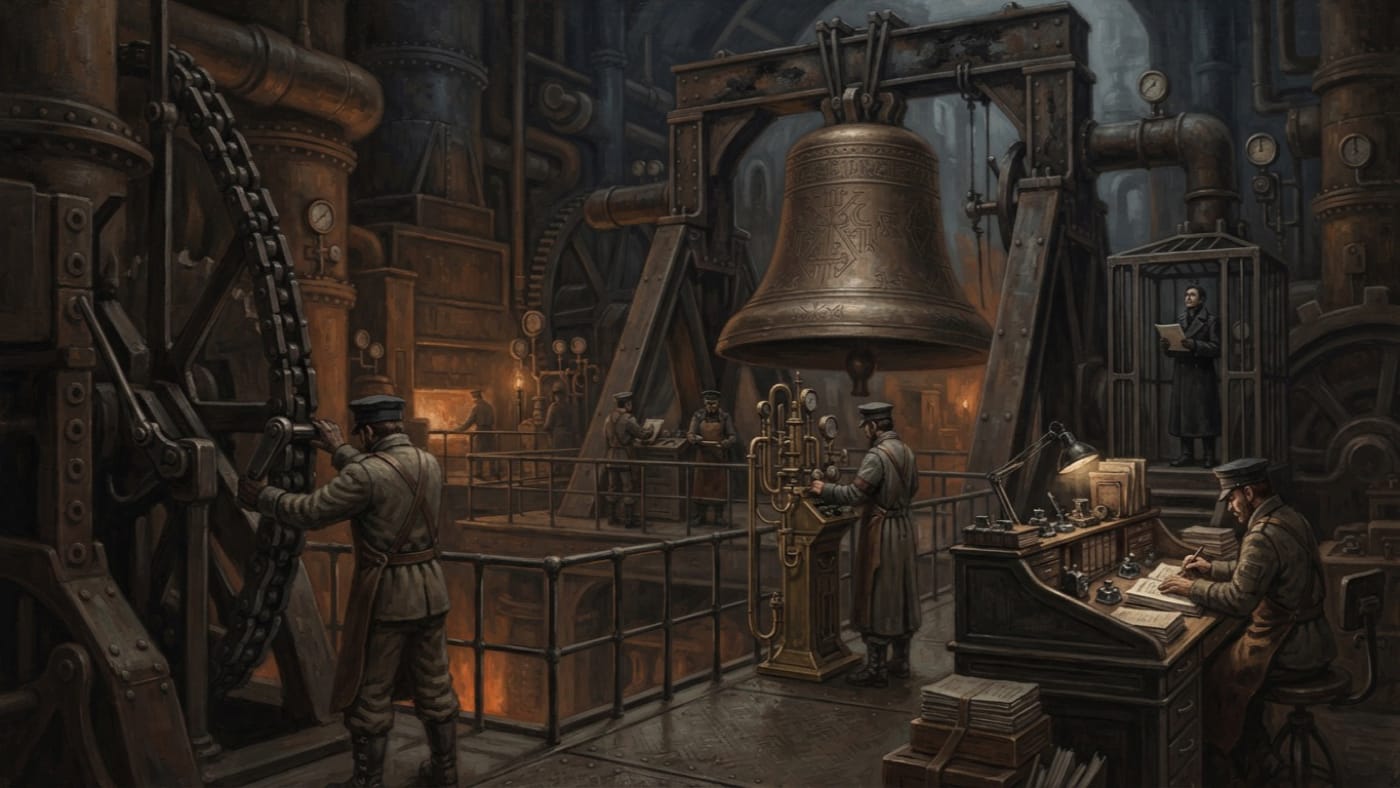
A bell order moves the furnace crew onto the floor, the singer to the bearing, the lockhand to the chain, the clerk to the ink, and the household behind its door. It decides when a man may eat, when he may stop speaking, and when he must explain his sins in figures. Some four hundred thousand people, by the Records count, live inside its intervals. Most could not tell you who signed the order now in force. Every one of them could tell you what the last bell meant.
#On Authority, Seal, and Copy
The Tri-Bureau Compact, ratified in A.S. 110, divided Essen's heat, paper and breath among three Bureaus. The Council exercises that division from the Furnace Basilica through decrees, audits and bell orders. The Compact is the root law. A bell order is a single act under it, issued, contested and superseded as the furnaces demand. Mistaking one for the other is like mistaking the Psalter for this morning's antiphon.
Each chair contributes what it hoards. Furnace-Marshal Kord, for Engines and Furnaces, holds fuel, furnace schedules, overtime and labour requirements. Arch-Notary Veyl, for Records, holds certification, work-writs, identity rolls, ration chits and shipment legitimacy. Master-Calibrator Sister Rauth, for Orison and Song, holds approved stanzas, acoustic clearances, singer rotations and cadence, and with them her share of every bell order. Her acoustic authority stops at the Compact's boundary. She commands Essen's tempo and no tower beyond it.
The Council's own article prints an excerpt of the governing form. I reproduce it without improvement:
Three seals, then. The heat mark attests that the furnaces can bear the change. The existence mark attests that the order exists, which in Essen is never assumed. The pitch mark attests that the throats can hold the cadence. The excerpt does not say which seal comes first, who carries the wax between chairs, or how long the carrying takes. I have no authority to invent a procession, and the clerks would charge me for it.
“In Essen, law is not posted. It is sounded.”
Corrected against the same Council excerpt. The order is sounded and posted, on the shift wall and in the lockhouse copy. The bell announces the command and the paper keeps it on file, ready to be used against whoever did not obey.
#On What the Bell Moves
Heat and breath. A bell order sets shift onset and shift change, which is to say it decides when the stokers' bodies become available to Kord. Before the furnaces light, the First Bell Warming sends choirs from the Choir Quarters to sing the bearings awake. Once a pour opens, calibrated chanting accompanies the metal, and every major pour requires a paired choir so that no stanza ends alone. When an order tightens the pour cadence, it tightens the singers' breathing with it. Hymnsteel learns obedience at whatever tempo the throats can sustain, and when the tempo outruns them, the throats pay first.
Water and paper. The same order governs admission through the Seven Locks, Essen's freight bottleneck, where coal barges wait for a peal and a seal before the gates will move. It governs ration release in the halls of Ledger Row. A shift that begins earlier changes the hour at which the bread line forms and the hour at which a chit becomes valid. Food in Essen keeps furnace time.
Conscience and night. Silence needs permission, and the bell order says when that permission lapses. Private quiet is a licensed commodity, sold by the square foot through the Hushwright Guild and checked by patrol. Confession windows open and close by the schedule. Confession receipts are filed beside production metrics, and under the Ninth Peal Vow workers recite their quota numbers as confession. A man's sins and his output are entered in the same ledger. Curfew intervals close the day. Local sources tie shift change and receipt filing to curfew, and they disagree among themselves over which stroke marks it. This survey names the function and leaves the stroke number unfixed.
Each order lands differently on three kinds of worker. The singer reads it as a change in rotation: more measures, fewer rests, a throat counted as plant. The lockhand reads it as a change in water. Barges arrive on the new schedule, the gates groan on the new schedule, and his chain key turns whether or not his hands have dried. The Records clerk reads it as a change in forms. Every revised interval spawns attendance entries, ration renewals and receipts filed against the new hour, and every late filing earns a fee.
#On Compliance Made Legible
The bell rings, the city moves, and the audit follows. Records clerks walk the Foundry Core checking work permits, injury receipts, ration cards and hymn sheets against the tempo in force. Orison wardens test vocal cadence at checkpoints. Guards and clerks enforce whatever the inspection finds. A sounded command thereby becomes an auditable record, with attendance proved by ledger, singing proved by cadence test, eating proved by stamped chit, and penitence proved by a receipt filed on time.
In this system work, food, identity and confession meet at a single desk. A worker who misses an interval loses more than a quarter hour. He may lose the entry that proves he worked it, which can unsettle the chit that feeds him and the roll that says he exists. The coercive apparatus behind all this is real. Deafening sentences, ration restrictions and identity throttling are established instruments of the Compact. The documents I examined contain no table assigning a fixed penalty to a missed bell, and I have printed none. Essen's discipline works by discretion.
The excerpt's last line deserves attention. The objection period begins after compliance. A worker may object to an order once he has obeyed it. The excerpt names a period. It names no court, no officer and no remedy, and I will not invent a mercy the form withholds.
#On Other Bells and Present Strain
Essen did not invent the bell as an instrument of command. The Office of Bells received its constitution in A.S. 52, bell practices and local records predate even that, and the current Bell Codex dates from its ratified recension of A.S. 115. The Codex, held by the Bureau of Bells, supplies the wider grammar of sanctioned sound: licensed peals, tolerances, curfew locks, Silentium. It does not supply the text of any Essen production order, and an Essen order adds nothing to the Codex.
Compact literature calls the bell order “the Compact's most durable invention.”
Clarified as local institutional pride. The Compact refined the bell into a production command for one furnace-city. Bell governance itself is older than the Compact, and Strasbourg's archivists would like that noted.
Other cities keep other bells. Rhineland crossings answer the Ninth Peal with passes, lamps and witnesses, and that is curfew law, not foundry tempo. The Approved Comforts allow Consolators to direct citizens toward “lawful compliance with bell-order,” which shows how common the vocabulary has become and places the Comforts under no Essen chair. The miners of Liège once rang their own shifts without license and reopened under sanctioned horns. No Essen form governs Liège, and no Liège horn governs Essen.
The present strain arrives from Strasbourg, which demands tripled output for hymn-drive siege engines. Sister Rauth refuses to accelerate the tempo without liturgical stability guarantees. Kord threatens additional conscription from the Ash Warrens. That is a demand, a refusal and a threat. This compilation records none of them as accomplished.
Under each proposed cadence lies the matter of the floor. Resonance Blooms are growing more frequent. Components return from the Sagittal Line cracked along their grain. Official explanation assigns some failures to Mirror Choir sabotage, and the Wrong Choir entry records that Bloom activity predates the Choir's documented operations. Approved countermeasures include closing the Locks, which may damp canal vibration. I preserve the auxiliary verb exactly as written.
Three silences must be kept apart. Licensed quiet is a commodity. Deliberate baffling, when the Locks are muted in panic, is a measure. The silence that follows a Bloom answers to no permit. A bell order can grant the first and command the second. It has no authority over the third.
#Present Compilation Disposition
As of this compilation the instrument remains in force. It keeps tempo above a floor that hums back, and the Council has agreed on no new cadence. Bells mark the hours in the Basilica, as on every other Essen schedule. The clerks have the forms ready for whichever cadence the Council chooses.